💧 Total System Water Volume Calculator
Estimate active aquarium system water from the display, sump operating level, refugium or reactors, plumbing, displacement, drain-down reserve, top-off storage, and margin.
| Component | Count In Active Volume? | How This Calculator Treats It | Best Use |
|---|---|---|---|
| Display tank | Yes | Gross shape volume times operating fill, minus displacement. | Dosing, water changes, stocking math |
| Sump operating water | Yes | Sump length x width x operating height. | True circulating volume |
| Refugium or reactors | Yes | Added as vessel volume when connected to flow. | Nutrient export, media contact systems |
| Drain-down space | No | Compared against empty sump reserve height. | Overflow safety after pump shutdown |
| Top-off reservoir | Optional | Excluded by default; included only when selected. | Stored water planning, not dosing volume |
| Pipe Or Tube ID | Gallons Per Foot | Liters Per Meter | Typical Aquarium Use |
|---|---|---|---|
| 3/8 in tubing | 0.0057 | 0.071 | Dosing, ATO, small reactors |
| 1/2 in tubing | 0.0102 | 0.127 | Return tubing, media lines |
| 3/4 in Sch 40 PVC | 0.0231 | 0.287 | Small drains and returns |
| 1 in Sch 40 PVC | 0.0428 | 0.531 | Common reef overflow plumbing |
| 1 1/2 in Sch 40 PVC | 0.1008 | 1.252 | High-flow drains |
| 2 in Sch 40 PVC | 0.1663 | 2.065 | Large drains and manifolds |
| System | Display Dimensions | Likely Active Volume | Drain Reserve Target |
|---|---|---|---|
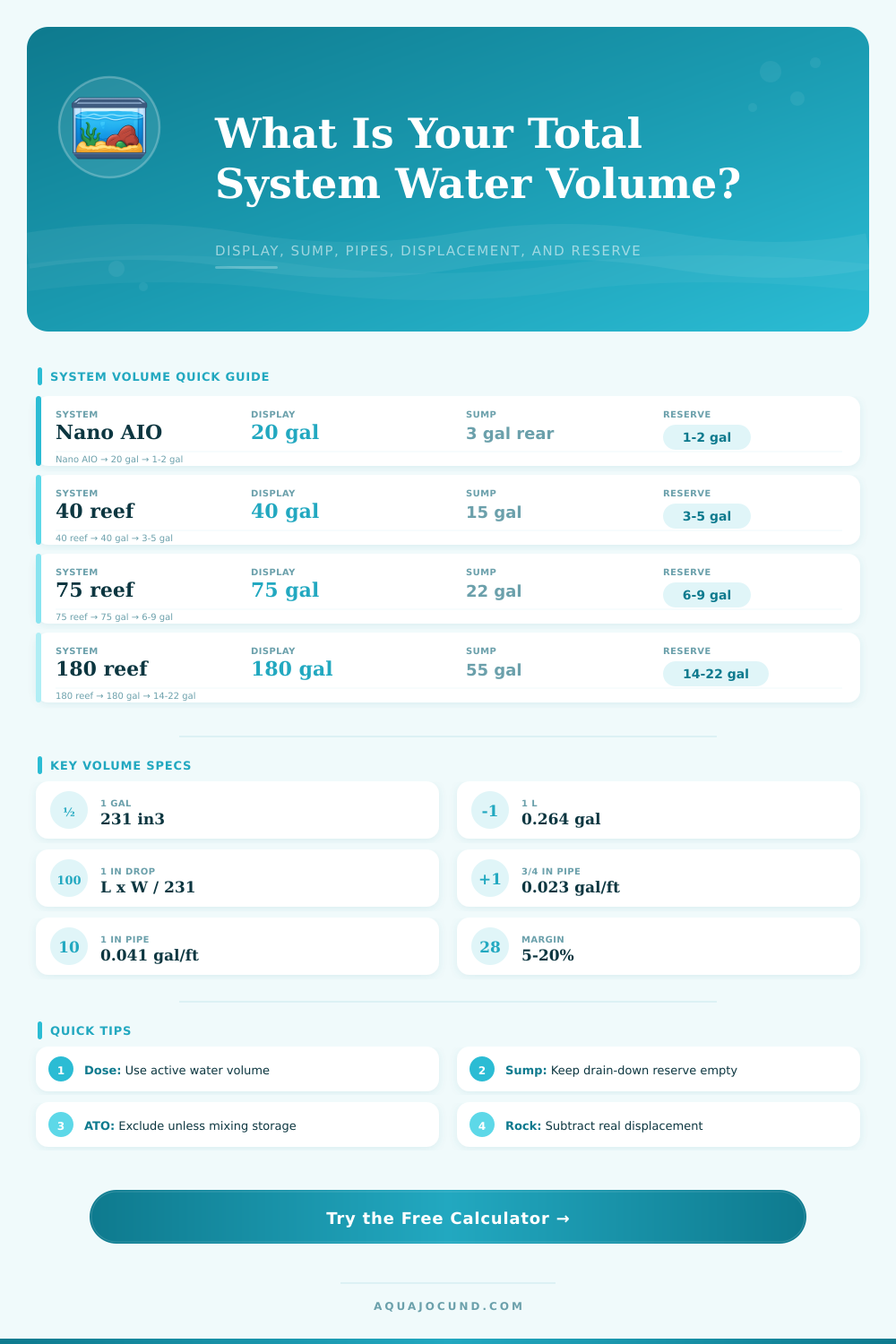
| 20 gal AIO | 24 x 12 x 16 in / 61 x 30 x 41 cm | 16-19 gal / 61-72 L | 1-2 gal / 4-8 L |
| 40 breeder sump | 36 x 18 x 16 in / 91 x 46 x 41 cm | 42-52 gal / 159-197 L | 3-5 gal / 11-19 L |
| 75 reef sump | 48 x 18 x 21 in / 122 x 46 x 53 cm | 80-100 gal / 303-379 L | 6-9 gal / 23-34 L |
| 120 peninsula | 48 x 24 x 24 in / 122 x 61 x 61 cm | 125-155 gal / 473-587 L | 9-14 gal / 34-53 L |
| 180 reef sump | 72 x 24 x 24 in / 183 x 61 x 61 cm | 190-235 gal / 719-890 L | 14-22 gal / 53-83 L |
| Drain Source | Fast Estimate | Why It Matters | Practical Check |
|---|---|---|---|
| Display surface drop | Length x width x drop / 231 | Usually the largest shutdown volume. | Measure waterline before and after pump stop. |
| Overflow box | Box water below teeth to standpipe intake | Can surprise small sumps. | Mark normal and stopped levels. |
| Return back-siphon | Return pipe volume x siphon percent | Nozzle depth can change reserve needs. | Break siphon hole just below waterline. |
| Empty sump space | Sump length x width x empty height / 231 | Must exceed total drain-down. | Keep the max-fill line below this limit. |
Most of us choose a tank size based off the tag on the box unless we are an expert. We gets a seventy five gallon tank and consider it done.
What is the issue? The tag on the box isn’t actualy what the box holds. The real volume hides in the sump, fills pipes, and dissapears behind the rockwork. Unless you count the actual volume of the tank, you’ll overdo supplements (overdose calcium by up to 10% for example) or misjudge water change amounts (waste gallons). Getting the right number mean going beyond the glass and understanding the plumbing that powers the system.
Why You Need to Know Your Tank’s Real Size
But, there’s more to it than just the display tank. Take for example a typical rectangular tank. What about all that empty space under the overflow teeth? How much volume do those inches below the overflow teeth holds? Many folks err here by measuring to the rim and then assuming each inch equals an inch of water. Not so. Once you enter your inside dimensions into calculator, it will automatically adjust for that lost height.
But the display isn’t usually the source of most of the variability in your system. More often than not, the sump contain as much or even more water than the tank. Add in a deep sump with a refugium and you could of have up to fifteen additional gallons of water, and that’s a lot of volume. All of that volume help stabilize parameters and dilute chemicals, both good things for sensitive corals. Yes, it also means you need to dose different than usual.
But then there’s the invisible water in the lines. That doesn’t sound like much until you know that two long runs of one-inch PVC can holds nearly a gallon of saltwater. It is not a lot, but it is enough to matter when you are trying to maintain alkalinity in a complicated setup. Because the tool takes into account how much space a length of pipe take up, you get a reasonable idea as to where all of your water is.
Then you have to take away what isn’t there. Yes, live rock is porous, but the majority of that hardscape take up physical space which displaces real water. If your tank is highly aquascaped, it may contain 10 gallons less water than an empty tank. Failing to account for this displacement means you’ll underdose your supplements and grossly overestimate your system’s capacity.
Don’t forget safety margins. Most hobbyists leave about ten percent extra in their plans for unknowns. That way, you can account for any additional equipment beyond what was measured. It might also be because your measurements were off. The table of references make it easy to see exactly where each piece of equipment fits into the overall total.
It is not only an exercise in math but also one in risk management. How much do you need in your sump to handle everything should your return pump fail? How big does your drain down volume need to be so you don’t flood your tank? Know your reserve capacity. Having less than that in your overflow/overrun means you have a leak just waiting to occur.
Typically, we don’t include the top-off reservoir in our calculations for several reasons. For one, it’s not filled with saltwater; it’s filled with freshwater. If you’re mixing salt into that reservoir (which most aren’t), then sure, include its volume in your active volume. Otherwise, excluding it ensure your chemistry remains stable.
Knowing your actual system volume gives you power. Instead of guessing, you manage. The numbers become a story. This story is about efficiency, safety, and stability. Your aquarium isn’t a static object anymore; it becomes a dynamic system when you know what’s going on behind the scenes.
That change of thinking is everything that separates “keeping fish” from “curating a reef.” You’ll have fewer emergency trips to the supply store, you’ll have healthier corals, and you’ll have clearer water. So, yes, the volume is simply a number, but it’s the most important number you’ll ever record.