Total Dynamic Head Calculator
Estimate aquarium pump head from vertical lift, pipe friction, fittings, outlet pressure, manifold branches, safety allowance, and pump curve points.
| Pipe or hose type | Hazen C used | Best calculator use | Planning note |
|---|---|---|---|
| Clean PVC or ABS | 150 | New hard plumbing returns | Lowest practical aquarium friction |
| Smooth vinyl tubing | 140 | Short cabinet return runs | Barbs may add local losses |
| Flexible PVC spa hose | 135 | Curved sump plumbing | Good balance of bend and smoothness |
| PEX / semi-rigid tubing | 130 | Utility or compact runs | Use actual inside diameter |
| Aged biofilm PVC | 125 | Older reef return lines | Useful when pipe has not been cleaned |
| Corrugated pond hose | 105 | Ponds and waterfall lines | Can add much more friction than size suggests |
| Fitting | Equivalent length used | Head effect | Calculator input |
|---|---|---|---|
| Standard 90° elbow | 30 pipe diameters | Moderate | 90° elbows |
| Standard 45° elbow | 16 pipe diameters | Low to moderate | 45° elbows |
| Tee, straight through | 20 pipe diameters | Moderate | Tee through-runs |
| Tee, side branch | 60 pipe diameters | High | Tee side branches |
| Valve plus union group | 18 pipe diameters | Moderate | Valves / unions group |
| Check valve or flow meter | 100 pipe diameters | High | Check valves / flow meters |
| System | Typical target flow | Common pipe size | Typical TDH range |
|---|---|---|---|
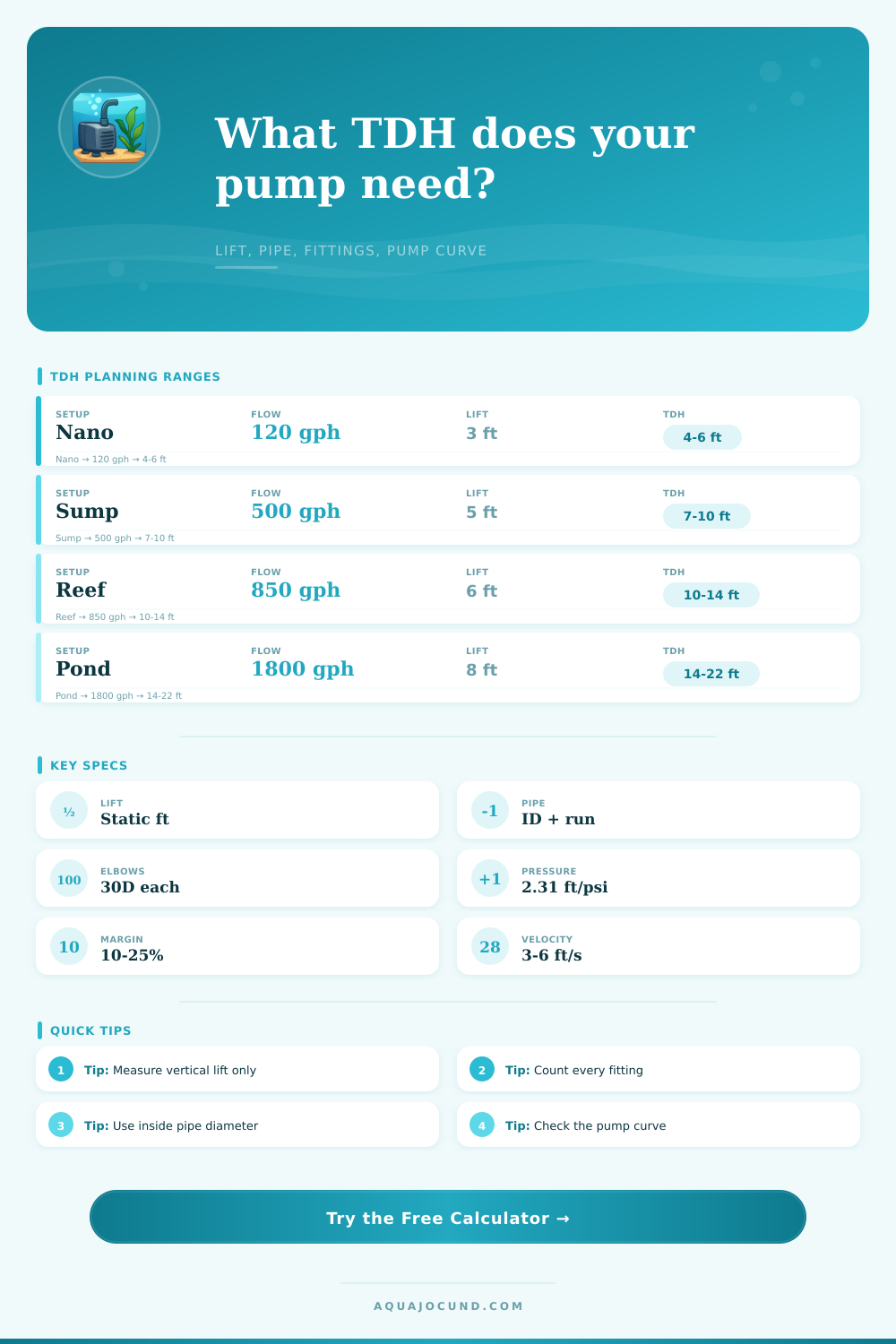
| 10 gallon nano return | 80-150 gph / 300-570 lph | 1/2 in / 13 mm | 3-6 ft / 0.9-1.8 m |
| 20 long sump return | 150-250 gph / 570-950 lph | 1/2-3/4 in / 13-19 mm | 4-7 ft / 1.2-2.1 m |
| 40 breeder reef | 250-450 gph / 950-1700 lph | 3/4-1 in / 19-25 mm | 6-10 ft / 1.8-3.0 m |
| 75 gallon reef manifold | 500-900 gph / 1900-3400 lph | 1-1 1/4 in / 25-32 mm | 9-15 ft / 2.7-4.6 m |
| 125 gallon display | 800-1300 gph / 3000-4900 lph | 1 1/4-1 1/2 in / 32-38 mm | 10-18 ft / 3.0-5.5 m |
| Small pond feed | 1200-2500 gph / 4500-9500 lph | 1 1/2-2 in / 38-51 mm | 12-24 ft / 3.7-7.3 m |
| Pump curve item | What to enter | How this calculator uses it | When to adjust |
|---|---|---|---|
| Open-flow rating | Flow at 0 ft head | Upper pump curve anchor | Use measured flow if known |
| Curve point flow | A published middle flow point | Interpolation check near real TDH | Pick a point close to expected head |
| Curve point head | Head at that middle flow point | Second curve anchor | Match the same published point |
| Shutoff head | Head where flow becomes zero | High-head anchor and pass/fail limit | Lower it for dirty impellers or low voltage |
That aquarium pump probably had great specs on the box. They said it would pushes lots of water at very good flow rates. It was plenty to generate a good current in your tank. So you put it together, plumbed it in, placed a lift up to the display and watched as amount of flow dropped dramaticly.
That isn’t a bad pump. But it’s also constrained by something called total dynamic head. The calculator above let you estimate these things ahead of time so you can make an informed decision before purchase. It calculates out pump curve flow, safety margin, manifold branch allowance, outlet pressure, pipe friction, fittings, and your actual lift all in one place.
How Total Dynamic Head Affects Your Aquarium Pump Flow
The head is the vertical distance between the tank and the sump but it’s not the only component of total dynamic head. The static head (the vertical distance), are only one part. More important are factors like friction which significantly reduce flow. Water want to resist flowing through each foot of pipe. Each elbow will also oppose the flow. Each tee will make it worse and each valve will cause even more resistance.
To account for all this, the calculator takes all of those impediments and turns them into a number that can be compared against pump specs. It then assumes your PVC is clean and has a Hazen-Williams C value of 150 (which means flow is nice and smooth). For example, if you’re using corrugated pond hose, the value is 105. That’s an important point, as the pump will have to does extra work moving the water through rough stuff.
Most people count their vertical lift correctly but ignore fittings. Fittings are more than just a turn or a bend in the line. To them they represent serious resistance. Each standard 90 degree elbow equals thirty pipe diameters of straight run to the tool. A tee with a side branch equal sixty. Each of those add up quickly to an increase in the system head. That’s why what looks like a great set-up on a spray bar may have no flow at all when the plumbing are restrictive. Restriction will overwhelm horsepower. The pump’s impeller spins, but it doesn’t move much water.
For those who are more serious about their aquariums, there’s the pump curve section. This allows users to use the pump performance data that manufacturers may publish, such as maximum flow rate at zero head pressure (something you won’t experience in practice). How much flow does it produce once there is some head pressure? Knowing this allow you to find out how many gallons per hour remain after working against the pressure of water. You enter the open-flow rating, shutoff head, and a known point on the curve (e.g., 800 gph @ 5′ head). The calculator then finds position of your system. If your desired dynamic head is greater than the known point on the pump’s curve, the calculator can lets you know whether you’re within an efficient operating range or forcing the motor beyond its rated capacity.
System health include the speed of the water. Too slow and it won’t carry debris. Too fast and it erodes and makes noise. Your velocity should be between three and six feet per second (quiet return), so the tool will flag you if you’re out of range. Doubling up on pipe size can greatly decrease friction while maintaining reasonable velocity. Purchasing bigger tubing can sometimes be less expensive than upgrading to a higher-powered pump.
There is no “optional” safety margin, there’s a reason why it exists! It is there to compensate for slight voltage drop, changes in filter media clogging, and any biofilm that might develop. When I use a 15% buffer, my skimmer continues operating just fine even under less-than-ideal conditions. If you don’t have a margin, a small bit of algae growing on the impeller will halt your return flow. The calculator includes this allowance automatically, which means you’ll be able to view both the best and worst case scenarios.
Don’t use big numbers blindly. Just because a pump says it can do two thousand gallons per hour doesn’t mean it will. In a complex system, you may get half that. Guessing vs engineering is understanding how much resistance your plumbing imposes. Designing based off total dynamic head makes more sense than max flow. You then select pumps that matches your pipes rather than the amount of water you want to move.
Yes, the lift is important. But the pathway is even more important.