Total Ammonia Nitrogen Calculator
Convert TAN test readings, pH, temperature, salinity, and tank volume into un-ionized NH3-N risk, NH4-N balance, water change targets, and binder estimates.
Calculation breakdown
| Kit wording | What it usually means | Convert to TAN-N | Calculator use |
|---|---|---|---|
| TAN as nitrogen | NH3-N plus NH4-N | Use reading as entered | Best match for scientific TAN tables |
| Ammonia as NH3 | Mass reported as NH3 molecule | Multiply by 14.0067 / 17.0305 | Converts molecular mass to nitrogen mass |
| Ammonium as NH4 | Mass reported as NH4 ion | Multiply by 14.0067 / 18.0385 | Useful for some digital meters |
| Unknown hobby kit | Often total ammonia, basis varies | Check the kit manual | Pick the basis printed on your chart |
| Water condition | pH | Temperature | NH3-N from 1.0 mg/L TAN-N |
|---|---|---|---|
| Soft acidic community | 6.8 | 75°F / 24°C | about 0.004 mg/L |
| Neutral cycling tank | 7.4 | 78°F / 26°C | about 0.017 mg/L |
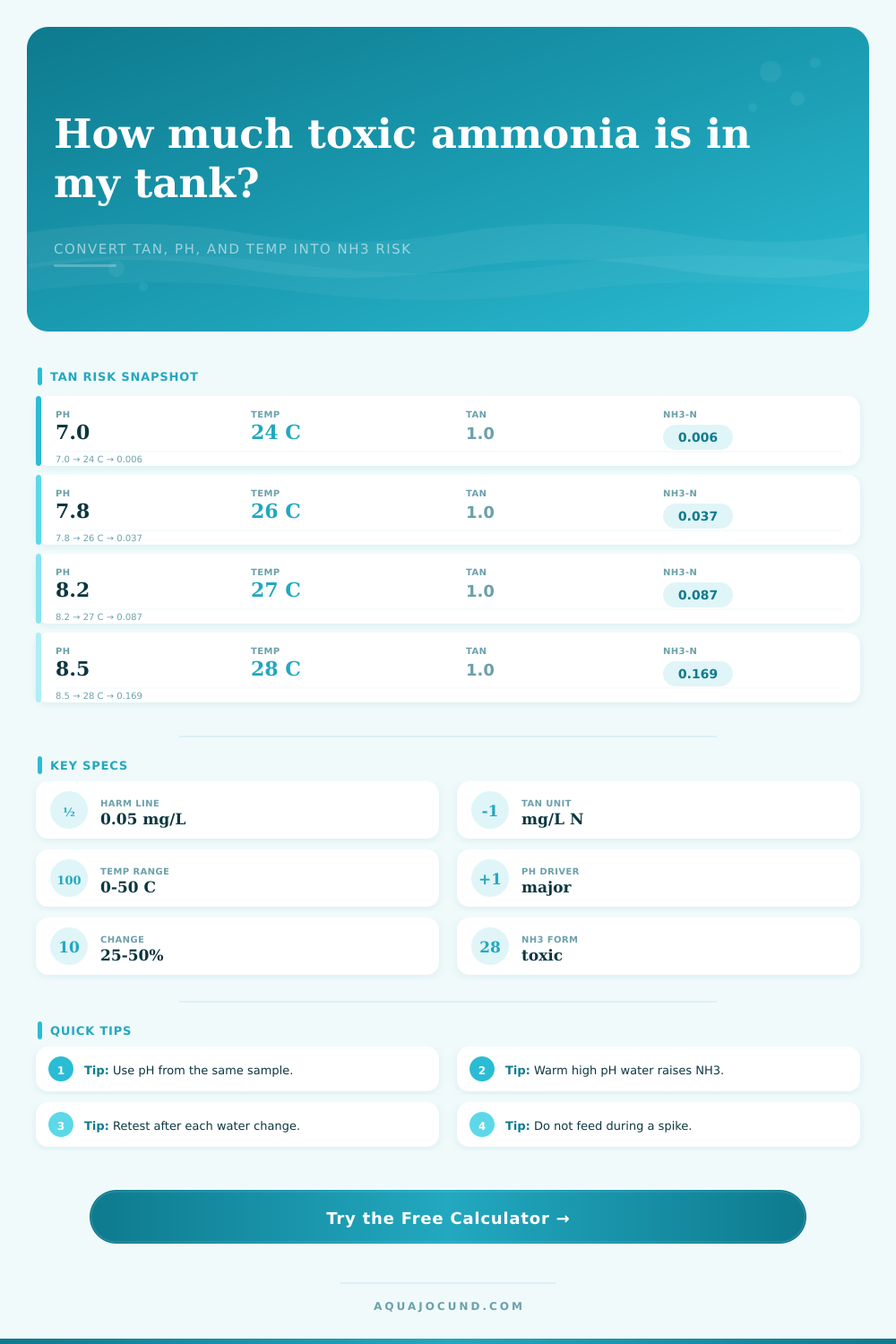
| Planted high pH afternoon | 8.2 | 80°F / 27°C | about 0.087 mg/L |
| African cichlid water | 8.5 | 82°F / 28°C | about 0.169 mg/L |
| System type | Default target NH3-N | Common pH range | Calculation note |
|---|---|---|---|
| Shrimp and fry | 0.010 mg/L | 6.5 to 7.6 | Use the strictest target and retest often |
| Community fish | 0.020 mg/L | 6.8 to 7.8 | Small TAN readings matter more as pH rises |
| Goldfish or koi | 0.020 mg/L | 7.2 to 8.3 | Heavy feeding can add TAN quickly |
| African cichlids | 0.015 mg/L | 7.8 to 8.8 | High pH increases the NH3 share |
| Marine reef | 0.010 mg/L | 8.0 to 8.4 | Confirm with a saltwater-suitable test method |
| Calculated NH3-N | Risk band | Short-term action | Follow-up test |
|---|---|---|---|
| Under 0.020 mg/L | Low | Watch trend and keep normal aeration | Retest on normal schedule |
| 0.020 to 0.049 mg/L | Watch | Reduce feeding and verify pH | Retest within 24 hours |
| 0.050 to 0.199 mg/L | Stress | Stop feeding and change water carefully | Retest after treatment |
| 0.200 mg/L or higher | Urgent | Immediate dilution, aeration, and binder | Retest in several hours |
It is one part per million. That’s what you read off of the chart on the ammonia test kit bottle. You’re staring at a slightly yellow liquid. Your heart drops because of that reading, or so most people who are new to aquariums think. Or so most people who are new to aquariums think.
Here’s the important thing they don’t consider: The test kit doesn’t tell you the whole picture. Total Ammonia Nitrogen isn’t the complete picture. There are two component to TAN, un-ionized ammonia (the stuff that will kill your fish) and ammonium ion (which won’t).
Why Ammonia Numbers Are Not The Whole Story
The form of the ammonia matter entirely based off the chemical composition of your water. So what causes it? Two primary drivers is pH and temperature. They flip that switch on the chemical reactions that converts total ammonia into the dangerous stuff (as the pH goes up, more of it are converted). Warm water is also guilty of doing the same thing. You could have a seemingly harmless reading that’s deadly if your tank happens to be at twenty-eight degrees Celsius and eight point five pH.
Once you plug in your conditions, the calculator will do the math for you. It will translate the raw number from your test kit into actual risk level for your livestock. Why is this important? Because you might see the same total ammonia reading in two different tank. One has zero problems whereas the other loses half its population overnight.
The first challenge is understanding what your test kit does. Different kits don’t report the same numbers. Some report total ammonia (the whole molecule), and some report just the mass of the nitrogen portion of that molecule. Inputting the wrong basis into the tool will distort your risk assessment. Read your manual! Generally, most liquid kits report total ammonia in terms of nitrogen because thats how it’s measured scientifically. Digital meters output ammonia gas or ammonium equivalents, you have to know what yours reports. This input is the difference between accurate danger detection than false confidence. It’s a small detail, but it matters a lot.
With knowledge comes power (and a plan). The tool will estimate how many gallons of water you must change to reduce that toxic part to a safer level. It even takes into account the amount of ammonia present in your tap water (something that’s easy to overlook). For example, if your source water contains some ammonia, then a half-change may not lower the concentration by as much than you’d think. You can visualize this in the reference tables on the page.
These illustrate how rapidly the toxic fraction can spike when water shifts from acidic/soft to alkaline/hard. Because so many African cichlids requires hard water with a high pH, they are harder to keep than fish in community tanks with soft water. This also has a lot to do with what you feed them.
For every gram of protein you feed your fish it will convert into nitrogen waste at some point. Based on how much you feed and the protein content of that food, the calculator can determine your daily load. It is easy to overfeed when trying to condition fish for breeding. That food will rot and spike your ammonia. If the tool says your risk is in the stress zone, don’t feed anymore. Don’t let your fish care about your schedule. They care about their gills. Often, reducing your input is better than adding chemicals.
You might still have a biological filter cycling. Understand that you’re dealing with a new tank. That means it will take time. Expect your biological filter to take 6-8 weeks before it’s fully mature. Ammonia spikes are expected and normal during this period. Manage by not panicking.
Plan your water change using the water change feature to carefully control dilution. This reduces the ammonia concentration without shocking the system with an instant pH or temperature swing. Multiple smaller water changes is preferred over one big ol’ dump. This protects the livestock while maintaining a healthy population of beneficial bacteria.
Ultimately, it is not about numbers but about how they relates to each other. The test kit gives you a snapshot, but the calculator gives you context. Understanding that heat and pH drive toxicity means you stop fearing the number and begin controlling the environment. The yellow stuff in the bottle is merely a starting point for a much larger conversation about water quality. You should of known this earlier. Actualy, it is moddern science.