Top Off Volume Per Day Calculator
Estimate freshwater top-off from tank and sump surface area, lids, fans, humidity, salinity drift, and refill schedule.
💧Quick presets
⚙System and surface area
🌡Room conditions and top-off planning
Top-off estimate
🧪Top-off comparison grid
📋Evaporation factor table
| Driver | Low effect | Medium effect | High effect | Calculator use |
|---|---|---|---|---|
| Relative humidity | 70% slows evaporation | 45-55% normal | 25-35% dry room | Sets vapor pressure deficit |
| Lid coverage | 90% covered | 50% covered | Open top | Reduces exposed display exchange |
| Fan cooling | No fan 1.00x | Small fan 1.40x | Fan bank 1.70x | Multiplies air exchange |
| Sump area | No open sump | Return section open | Large open sump | Adds uncovered water area |
📏Common tank top-off table
| Tank | Dimensions | Surface area | Typical daily top-off | Notes |
|---|---|---|---|---|
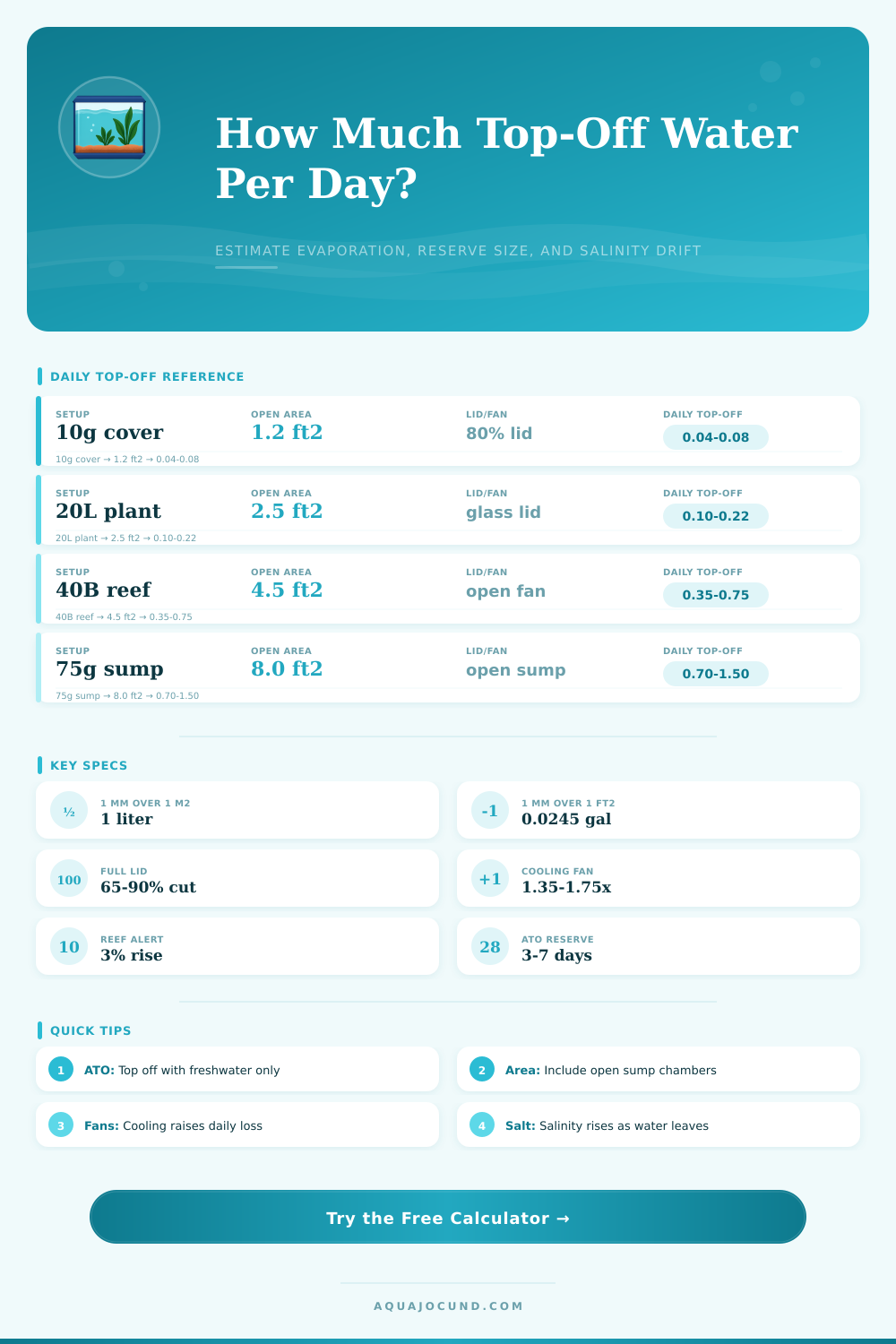
| 10 gallon | 20 x 10 in / 51 x 25 cm | 1.4 ft2 / 0.13 m2 | 0.04-0.16 gal / 0.15-0.61 L | Small systems swing quickly |
| 20 long | 30 x 12 in / 76 x 30 cm | 2.5 ft2 / 0.23 m2 | 0.10-0.30 gal / 0.38-1.14 L | Long footprint raises evaporation |
| 40 breeder | 36 x 18 in / 91 x 46 cm | 4.5 ft2 / 0.42 m2 | 0.25-0.75 gal / 0.95-2.84 L | Open reef and planted tanks differ |
| 75 gallon | 48 x 18 in / 122 x 46 cm | 6.0 ft2 / 0.56 m2 | 0.45-1.20 gal / 1.70-4.54 L | Add sump area if present |
| 120 gallon | 48 x 24 in / 122 x 61 cm | 8.0 ft2 / 0.74 m2 | 0.70-1.80 gal / 2.65-6.81 L | ATO reservoir usually needed |
💡Manual fill schedule table
| Daily top-off | 3 day fill | 5 day reserve | 7 day reserve | Best use |
|---|---|---|---|---|
| 0.10 gal / 0.38 L | 0.30 gal / 1.1 L | 0.50 gal / 1.9 L | 0.70 gal / 2.6 L | Covered nano |
| 0.35 gal / 1.32 L | 1.05 gal / 4.0 L | 1.75 gal / 6.6 L | 2.45 gal / 9.3 L | Medium open tank |
| 0.75 gal / 2.84 L | 2.25 gal / 8.5 L | 3.75 gal / 14.2 L | 5.25 gal / 19.9 L | Reef with sump |
| 1.50 gal / 5.68 L | 4.50 gal / 17.0 L | 7.50 gal / 28.4 L | 10.50 gal / 39.7 L | Large open system |
⚠Concentration warning table
| Water loss before top-off | Concentration rise | Reef salinity example | Freshwater TDS example | Action |
|---|---|---|---|---|
| 1% of system volume | About 1.0% | 35.0 to 35.4 ppt | 200 to 202 ppm | Usually acceptable |
| 3% of system volume | About 3.1% | 35.0 to 36.1 ppt | 200 to 206 ppm | Top off sooner |
| 5% of system volume | About 5.3% | 35.0 to 36.8 ppt | 200 to 211 ppm | Use daily or automated top-off |
| 10% of system volume | About 11.1% | 35.0 to 38.9 ppt | 200 to 222 ppm | Avoid this swing |
Why does water go missing in your tank? The same way puddles dry up following a thunderstorm: it leaves the pool and becomes invisible, a pure vapor of air. What’s left behind, all the dissolved solids and ions of salts that sustain aquatic life; remains. This is why you might have noticed that the water level in a reef tank sat strangely near edge of glass; now you know what the issue is.
The volume stays roughly the same, but concentration climbs dangerously high. And since nobody wants a cloudy tank or stressed out corals, monitoring top-off volume are much more important than many hobbyists think. It is not so much about maintaining a full tank, but about avoiding a hidden chemical disaster that ruins water quality and stresses corals long before anyone realizes the water level fell.
Why Your Tank Loses Water
When you remove the jargon, the physics behind it realy isn’t that complicated. The key variables is pretty much just air flow, humidity, temperature difference, and surface area… Though a large open sump can often contributes more loss than the display tank itself. In fact, if your system has a big open sump, you’ll likely find it contributes greater water loss then does the actual display tank. That’s because a lot of people only measure the dimensions of their main aquarium (e.g., 30″x12″x18″) without thinking about all of that other invisible surface area contained within their equipment. This include things like large open sumps that add extra surface area.
This handy little calculator does all that math for you while taking into consideration your own unique geometry plus environmental multipliers; you can also toggle between metric and imperial units, select a preset for common tank sizes, or input custom measurements for unusual setups like grow-out tubs or rimless bowls. You can switch to metric or imperial units. You can choose from common tank size. You can also enter exact measurements for odd-shaped aquariums like grow-out tubs, bow fronts, or rimless bowls.
Lid coverage and airflow is what really matters. It sounds harmless but even that slight room breeze is constantly replenishing the tank’s atmosphere with drier air which tends to pull more moisture out of the water surface. Installing a cooling fan over the display can accelerate evaporation as much as forty percent or more. This added motion improves gas exchange and keeps corals happy. However, it also require a bigger reservoir to keep pace with increased loss.
The different driver interactions are broken out in the reference tables on this page. Evaporation rates will be slower under a humid basement environment then they would be in a dry living room with powerful ceiling fans. Consider the physical realities against the biology you want to support. But it’s that silent killer, salinity drift. Salts don’t get flushed out when water does. So even a tiny fraction of volume reduction can increase specific gravity. This can result in osmotic stress for shrimps or tissue recession for sensitive corals.
Based off how often you want it to check automatically or manually refill, the calculator estimates how much the salinity will increase during those X number of days of neglecting your tank. It’ll tell you if you’re nudging up against the safe side with a big system if you plan to be away from it for a week. And it tells you exactly how big the reservoir should of be so that there’s always plenty of extra water available without burning out the pump sucking air. Having too little water is just as bad as having too much water because of a sensor failure.
Top off water is one of those maintenance parameters most folks consider a chore, just something to do when needed. Without thought for purity, they grab whatever bottle holds water. Tap water contains chlorine and minerals which eventualy accumulate and alter your chemical balance regardless of your salinity number. Distilled water or reverse osmosis means you’re only replacing what has been lost. It takes diligence to make it work, but the reward is consistent water parameters that will appear clear with vibrant life supporting them.
When you understand your own rate of evaporation, it becomes second nature. No more guessing why the tank dropped so quickly in this week’s heat wave. Now it’s predictable. You adjust your storage container based off your personal lifestyle. This could be automatic, manually topped off every day, or forgotten about for months. Consistency is key. Knowing precisely how much water escapes per day lets you manage the environment rather than letting the environment manage you. It stabilizes the water level and chemistry.
This gives you the freedom to enjoy what truly makes you happy: observing life thriving within.