
A new fish keeper’s fantasies typically includes beautiful coloration and a school of docile tankmates. Then reality sets in as their fish hide and/or gets all riled up. You know what I’m talking about: fish darting frantically around the tank, looking pale, or having torn-up fins. This isn’t bad luck. More often than not, it’s poor planning.
Compatibility isn’t so much about knowing Latin names; it’s more about understanding social dynamics. Are your desired pets solitary predators? Are they high-strung members of a herd who goes nuts without other members? Identifying the type of fish you want to keep will prevent you from making an underwater nightmare.
How to Pick Good Fish Friends
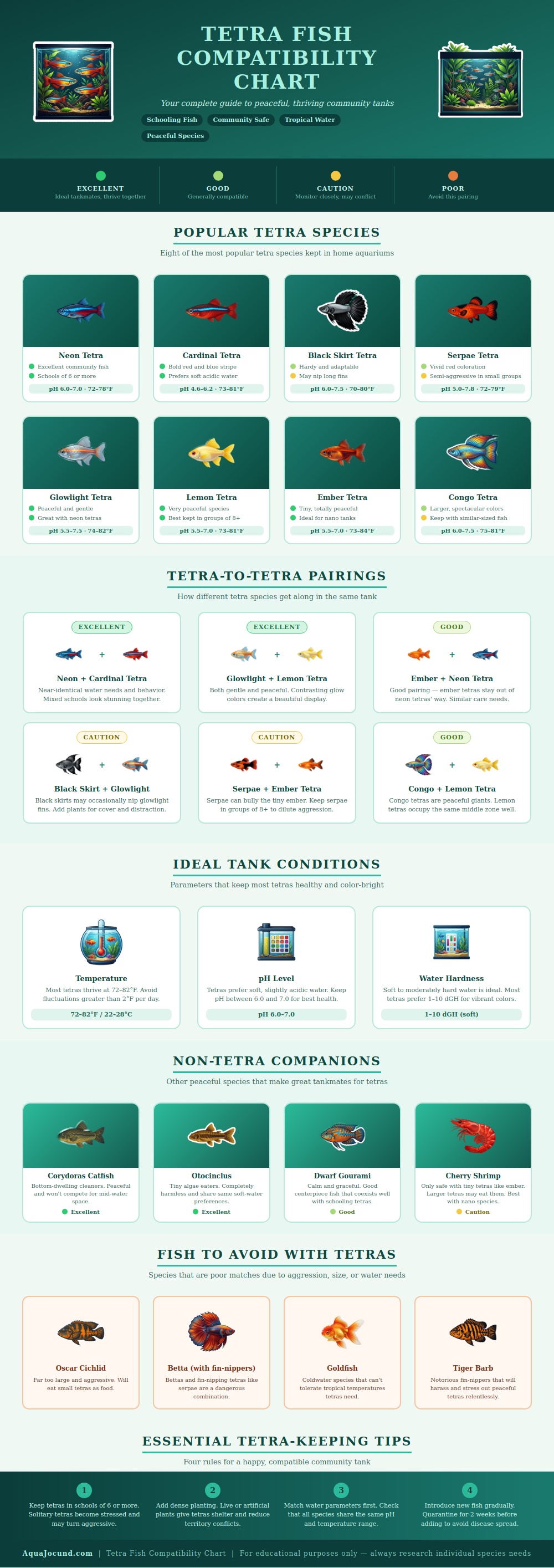
So let’s dive into how eight commonly available tetra types interact visually (see diagram below). I’ve organized it so that you can see which ones makes good tank mates and which ones don’t mix well. For example, the neon and cardinal tetras are listed as excellent together. And why wouldn’t they be? Their personalities is almost exactly the same, and so are their water requirements. Soft, somewhat acidic water works for both. They do best in groups of at least 6 each. They won’t fight over food, nor will they encroach on one another’s territory. Plus, those two colors form such a beautiful combination when housed side-by-side, it is a no-brainer.
Another good pair, according to this chart, are the lemon and glowlight tetras. They’re both mild-mannered fish who likes to hang out near the mid-tank area. Therefore, they tend not to clash with each other as certain more aggressive species might.
But not all tetras play nice with others. Pay attention to the caution labels especially for serpae and black skirt tetras. Both has reputations as nippers (serpae tetras harass slower swimming fish; black skirt tetras nip at longer fins). Pairing delicate glowlights with black skirts is a risky move. It may work out initially, but nipping on fins stresses fish which weaken their immune systems over time.
Serpae tetras are yet another beautiful but tricky species. They’re pretty with their bright red coloration, but they’re also semi-aggressive which means you shouldn’t of keep them alone. Keeping them in numbers (larger groups) does something else: it dilutes their aggression against other tank mates so they directs that energy inward where it belongs. This is what most people miss. One fancy fish = one happy pet? No. Social structure determine behavior.
The other key to the peace is water parameters. Parameters that are incompatible with each other’s requirements will result in fighting, even between supposedly compatible species. Tetras typically require a temperature of 72-82 F. They also need a soft, more acidic pH. Staying within these guidelines is essential to good health. Outside those parameters lead to stressful conditions, stressors! Even the most peaceful tetra will become aggressive under stressed conditions.
Also keep in mind vertical space when you select tank mates. Adding some bottom dwellers such as otocinclus catfish or corydoras catfish can help ensure greater community harmony. Why? Because they use the space that the tetras don’t care about. The smaller cleaners will be near the bottom. They aren’t using up mid-water space that everyone wants, this creates a well-balanced ecosystem rather than a crowded house where every fish want the same space.
On the flip side, there are combinations you shouldn’t mix at all. For example, smaller tetras would just be viewed as appetizers by large cichlids such as oscars. Tropical tetras mixed with coldwater goldfish would also be a recipe for disaster (incompatible water quality and temperature needs). Likewise, tiger barbs is infamous for being fin-nipper thugs. They’ll harass peaceful schoolers relentlessly.
Here is the takeaway. Personality matters, yes, but so does size. Don’t expect a pacifist to make friends with a bully just because you placed him or her in the same room. Read up on the traits of each species before purchase so as to avoid heartbreak down the road. Your best bet is to start with a solid foundation of similarly tempered fish. Keep the water conditions stable and let nature take its course regarding hierarchy establishment. Understanding these invisible social contracts build a thriving tank. The result is a peaceful display that brings calm different than chaos into your home.
