Temperature Rise Time Calculator
Estimate how long an aquarium heater needs to raise water temperature after volume, watts, efficiency, heat loss, and a safe ramp limit are included.
| Profile | Default efficiency | Best use | Calculation note |
|---|---|---|---|
| Glass submersible | 92% | Small and medium displays | Good default when water flow is moderate. |
| Titanium element | 96% | Large tanks, sumps, vats | Strong transfer when placed in active flow. |
| Inline heater | 90% | Canister or return plumbing | Loss and cycling vary with flow rate. |
| Sump chamber | 88% | Systems with overflow and sump | Open water and air exchange can slow net rise. |
| Controller-cycled pair | 94% | Redundant paired heaters | Assumes both heaters are allowed to run. |
| Warm room recovery | 82% | Small heater in a warm room | Useful when heater placement is not ideal. |
| Livestock profile | Suggested ramp | Use when | Calculator behavior |
|---|---|---|---|
| Shrimp or sensitive nano | 0.5-1.0°F/hr | Small tanks, shrimp, delicate fish | Often makes safe time longer than heater time. |
| Reef display | 1.0-1.5°F/hr | Corals and mixed reef systems | Limits abrupt swings even with large heaters. |
| Hardy community | 1.5-2.5°F/hr | Most common freshwater aquariums | Good default for routine recovery. |
| Quarantine adjustment | 3.0-4.0°F/hr | Observed, planned therapeutic changes | Fast limit should be used deliberately. |
| Tank | Net volume | Sample rise | Typical heater | Estimated time |
|---|---|---|---|---|
| 5 gal nano | 4.5 gal / 17 L | 4°F / 2.2°C | 25 W | 2.1 hr before ramp limits |
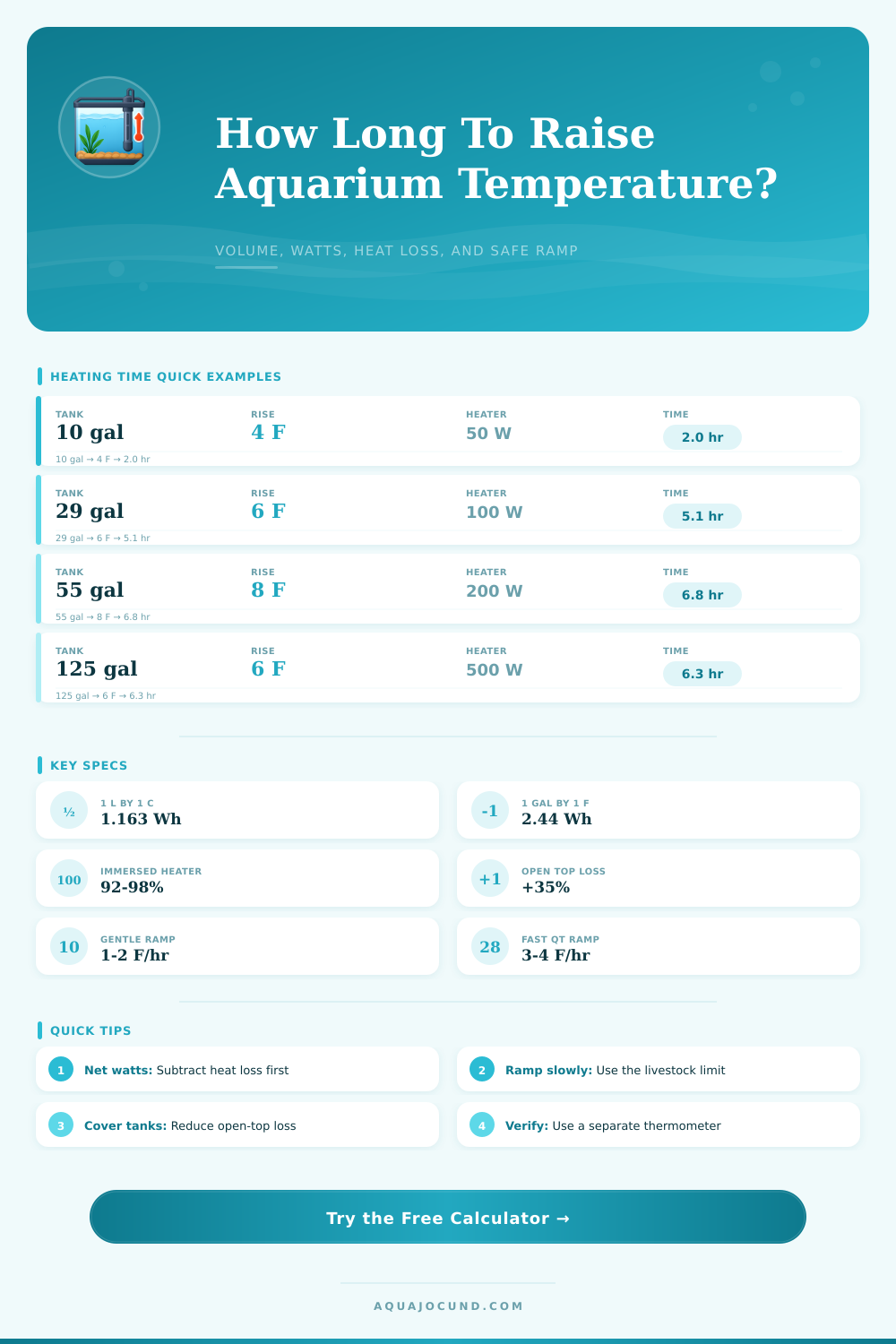
| 10 gal | 9 gal / 34 L | 4°F / 2.2°C | 50 W | 2.0 hr before ramp limits |
| 29 gal | 26 gal / 98 L | 6°F / 3.3°C | 100 W | 5.1 hr before ramp limits |
| 55 gal | 50 gal / 189 L | 8°F / 4.4°C | 200 W | 6.8 hr before ramp limits |
| 125 gal | 110 gal / 416 L | 6°F / 3.3°C | 500 W | 6.3 hr before ramp limits |
| Loss profile | Multiplier | Typical source | Practical input hint |
|---|---|---|---|
| Covered or insulated | 0.75x | Lids, foam back, warm room | Use low watt loss for short recoveries. |
| Average lidded tank | 1.00x | Normal glass display | Good default when unsure. |
| Open top or rimless | 1.35x | Evaporation and surface cooling | Raise heat loss if fans are running. |
| Drafty cool room | 1.60x | Cold room, air movement | Check that net watts stays positive. |
| Open sump included | 1.45x | Sump, overflow, skimmer area | Count sump water in volume and loss. |
| Large vat or pond tub | 1.80x | Large surface area | Use conservative ramp and verify manually. |
It’s very common for water temperatures to drop, particularily as seasons change and/or HVAC equipment fails. It happens so much that often times you’ll notice the thermometer suddenly read colder then before and immediately panic. However, panicking isn’t necessarily the best reaction.
Adding several heater to your tank all at one time can be just as shocking for your livestock as the cool dip was. Knowing how long to warm the water safely will help you avoid a sudden rise of heat which can also be harmful. This ensure biological stability within your system.
Why a Slow Warm-Up Is Important
This number is provided for you by the calculator. However, knowing how it arrives at that number will help you have confidence in the result. First, water has high thermal mass. It’s harder to heat water compared to air. It takes a lot of energy to increase temperature of a single gallon of water just one degree. Hence, a big display remain cool with all that powerful equipment. A tiny nano tank warms up fast.
The calculator know exactly how many watt-hours are necessary to do this based off the net amount of water in your tank. It doesn’t include volume of substrate and rocks because those won’t be heated… Only the water itself. Most hobbyists think that the amount of watts their heaters are rated for directly translates to how much they’re increasing the water temp. Unfortunatly this isn’t true.
There’s always some amount of heat lost. A closed top tank will lose less heat due to surface convection and evaporation than an open top tank. Covering the tank with something (e.g. Lid, towel) can decrease its heat loss. Similarly, if you have an exposed sump or if there is drafts in your room, you are essentially fighting against the conditions around you as you try to warm up the tank. The heat loss profiles clearly adjust for this. Not only do you pay to raise the water temp, but you also pay to compensate for the heat that leaks out in your house.
That means once you know what required energy is, it’s time to look at the other biological considerations. The most important input is the ramp limit. In general, fish (and inverts) prefer constant temps rather than fluctuating ones. Rapid increases in temperature will remove mucous layers on the fish’s skin making them more likely to get disease. These increases can also stress them so much that they weakens their immunity.
When it runs the comparison between how fast your heaters ramp up versus a safe biological ramp rate, it might advise you to wait longer, which will be a safety buffer for the living things involved, even if it isn’t necessary based on physics.
This is a profile of heater efficiency. This is perhaps the most underrated choice when considering heaters. Not all heaters are created equal. An inline unit is different than a titanium element and both are different from a glass submersible heater. How well it can transfer heat depends on placement as well as its raw output. For example, if you have a heater positioned behind some decor where there isn’t good air flow, it is going to cycle on and off in an inefficient way. This waste energy without heating up most of the tank’s water. You can dial down here to account for this type of real world inefficiency and get a better idea of how close your estimate matches reality vs some theoretical best case scenario.
The science of heating an aquarium is part biology and part thermodynamics. It’s about providing enough power to outpace heat loss, yet not too much or it will overheat before the thermostat respond. Knowing a little about what your fish tolerate, your room environment, and your tank size makes this a controllable process rather than an emergency. After all, your objective is to warm the tank while avoiding injury to the occupants. You should of let the math work for you when you respect both biology and physics in the equation.