Temperature Acclimation Time Calculator
Estimate how long to float, drip, or bucket-acclimate aquatic livestock before transfer based on temperature difference, volume, method, and species sensitivity.
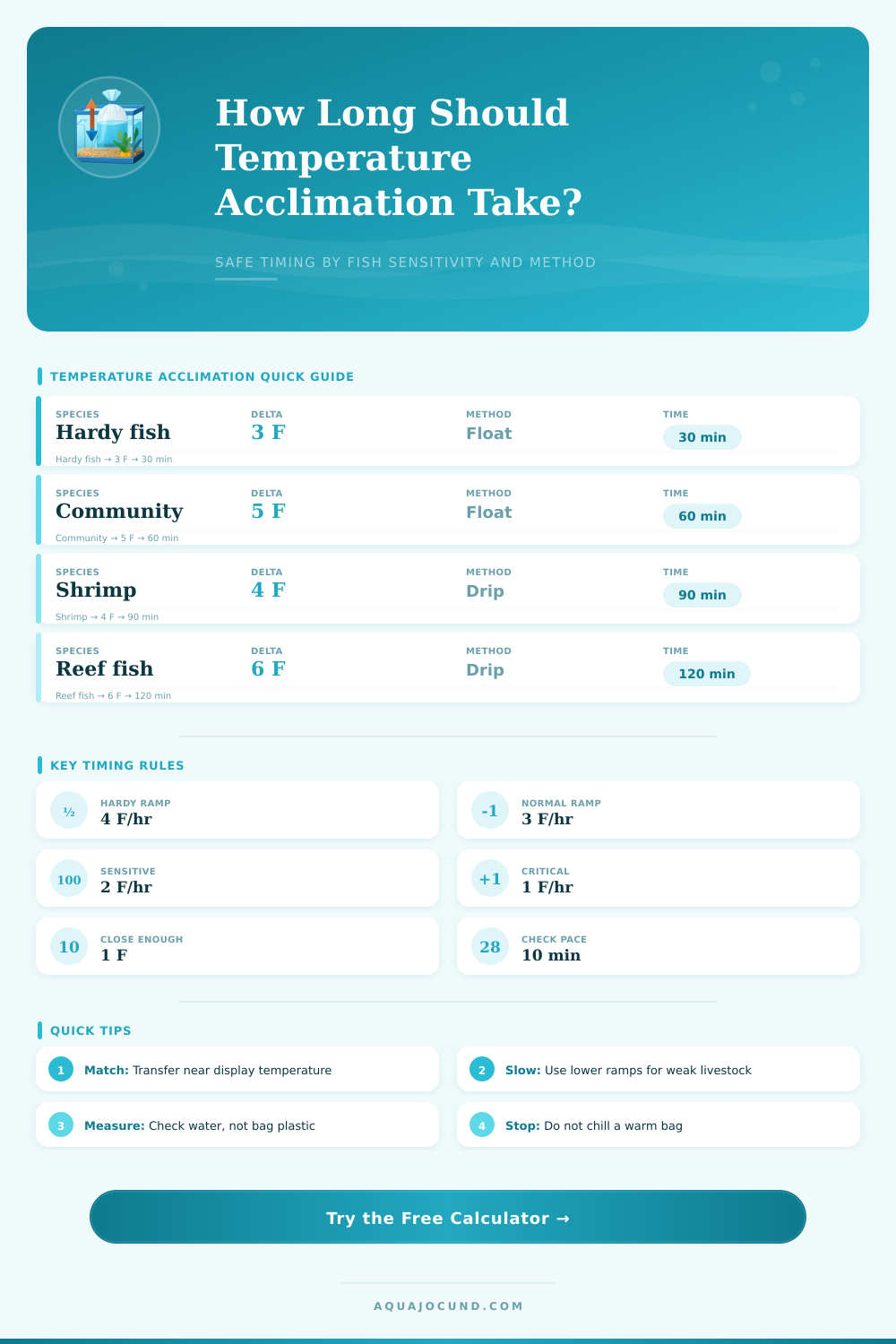
| Livestock group | Typical max ramp | Close transfer target | When to slow down |
|---|---|---|---|
| Hardy freshwater fish | 3 to 4°F/hr (1.7 to 2.2°C/hr) | Within 1.5°F | After shipping, visible stress, very small bags |
| Community tropical fish | 2 to 3°F/hr (1.1 to 1.7°C/hr) | Within 1°F | Large temperature jump or newly arrived imports |
| Discus, rams, wild-caught fish | 1.5 to 2°F/hr (0.8 to 1.1°C/hr) | Within 0.8°F | Any chill, rapid breathing, or quarantine transfer |
| Shrimp and sensitive invertebrates | 1 to 2°F/hr (0.6 to 1.1°C/hr) | Within 0.5 to 1°F | Temperature and water chemistry both differ |
| Marine fish and corals | 1.5 to 2.5°F/hr (0.8 to 1.4°C/hr) | Within 1°F | Salinity is also being changed by drip |
| Method | Thermal behavior | Best use | Main caution |
|---|---|---|---|
| Sealed bag floating | Fast heat transfer through thin plastic | Short store trips, fish already close to tank temp | Do not open old shipping bags too early |
| Open cup or open bag floating | Slightly slower and affected by room air | Short freshwater transfers with clean water | Water can cool if room is colder than the tank |
| Drip acclimation bucket | Thermal change plus continuous mixing | Shrimp, marine fish, sensitive freshwater fish | Small buckets in cool rooms can lose heat |
| Small water exchanges | Stepwise mixing and moderate heat transfer | Fish that should not sit in a long drip | Large exchanges can change temperature too fast |
| Heated holding tub | Controlled target temperature | Large fish, ponds, quarantine matching | Use a guarded heater and thermometer |
| Scenario | Typical delta | Reasonable method | Expected range |
|---|---|---|---|
| Local store fish to community tank | 2 to 5°F | Float bag, verify with thermometer | 25 to 75 minutes |
| Cold weather fish shipment | 5 to 12°F | Float sealed bag, then quick transfer if chemistry is risky | 60 to 180 minutes |
| Freshwater shrimp order | 2 to 6°F | Slow drip in a covered container | 75 to 180 minutes |
| Marine fish quarantine transfer | 3 to 7°F | Temperature match plus salinity-aware drip | 60 to 150 minutes |
| Pond koi bucket to pond | 4 to 10°F | Floating tub or shaded bucket exchanges | 60 to 180 minutes |
| Tank name | Approx dimensions | Display temp use | Transfer note |
|---|---|---|---|
| 5 gallon desktop | 16 x 8 x 10 in | Small water volume | Recheck after transfer because fish bag water can matter |
| 10 gallon standard | 20 x 10 x 12 in | Moderate stability | Good for small bag floating and final thermometer check |
| 20 long | 30 x 12 x 12 in | Stable for small bags | Common community and quarantine receiving tank |
| 40 breeder | 36 x 18 x 16 in | Stable receiving temperature | Large surface area helps floating bags equalize |
| 75 gallon display | 48 x 18 x 21 in | High thermal mass | Use drip or bucket if many bags arrive together |
This calculator estimates temperature timing only. Match salinity, pH, hardness, and quarantine practice separately when those differences are relevant.
Temperature acclimation are the process of acclimating the temperature of a fish to the temperature of the tank in which the fish will live. It is necesary to acclimate the fish to the temperature of the tank in which it will live to avoid stress that can result from either too rapid or too slow of a change in the water temperature of the fish. If the change in temperature of the transport container are too rapid, the fish will become stressed.
If the change in temperature is too slow, the water within the transport container may become an problem for the fish. The temperature acclimation calculator will help to determine the amount of time that it will take for the transport containers water to acclimate to the tank water temperature. The temperature acclimation calculator will ask for the volume of the water within the transport container.
How to Use the Fish Temperature Acclimation Calculator
The volume of the water within the transport container is the measurement that determine the rate at which the water will change temperatures. A small volume of water will change temperatures at a faster rate then a large volume of water, so a large volume of water will take more time to change temperatures than a small volume of water. In addition to the volume of the transport container, the calculation of the amount of time necesary for the temperature to acclimate will require the volume and the shape of the tank in which the fish will live.
A small tank will change temperatures more rapidly then a larger tank, thus the calculator will include additional checks in the case of small tank. The species of the fish will also factor into the calculation of the amount of time necesary for temperature acclimation. For example, goldfish is able to better tolerate rapid changes in water temperature than fish like discus fish, which require very slow changes in temperature.
The calculator will use the sensitivity of the species to the change in temperature to provide an initial calculation of the length of time that will be required to acclimate the fish to the tank water temperature. However, if the fish is stressed as a result of transport conditions, it may be necesary to adjust the rate of temperature change. The method in which the temperature will be acclimated will factor into how the calculator works.
For instance, if one chooses to acclimate the fish by floating the transport container in which the fish is contained, the plastic bag will allow for the heat from the tank to be transferred into the bag. However, if the transport container is used to slowly drip the tank water into the transport container, the two liquids will be mixed, which will allow for a faster acclimation of the transport water to the water in which the fish will live. The calculator will adjust for whether the user is to add tank water to the transport container or if the user is to simply float the transport container in the tank.
The temperature of the room in which the fish is to be acclimated will factor into the calculation of the time for acclimation. Cool temperatures in the room will slow the rate at which the transport containers water will warm to the temperature of the tank water. The calculator will provide three different numbers following the entry of the required information for the calculation of time for acclimation.
Each different number correspond to a different calculation that the calculator performed. One number will indicate how long it will take for the water in the transport container to reach the water temperature of the tank based on the transfer of heat. The second number will indicate the minimum length of time necessary to allow for acclimation based on the rate of temperature change of the species of fish.
The third and final number will be the recommended length of time for the acclimation process; this recommended length of time will take into account both the transfer of heat and the rate of acclimation of the species. The recommended length of time will allow for the process to be either limited by the physical properties of the transport container or by the biological properties of the fish. One common mistake among those attempting to acclimate fish to a tank water temperature is to measure the temperature of the outside of the transport container in which the fish is contained.
The plastic will reach the temperature of the tank water at a faster rate than the water will change to that temperature, so relying upon the temperature of the outside of the transport container will lead to errors in the acclimation process. Instead, the calculator assumes that the user will measure the temperature of the water within the transport container. Additionally, the calculator also assumes that the person will not employ the acclimation process for lengths of time beyond those that are necessary, as the transport water will contain waste that is detrimental to the health of the fish.
When the time indicated by the calculator has passed, the fish will need to be observed to determine if the fish is ready to be placed into the tank water. Observing the fish will allow for the determination of whether the fish have become stressed as a result of transport, and if they are ready to be introduced into the aquarium. Thus, the calculator removes the guesswork that may arise regarding the temperature of the transport container and allows the person to focus on the well-being of the fish.