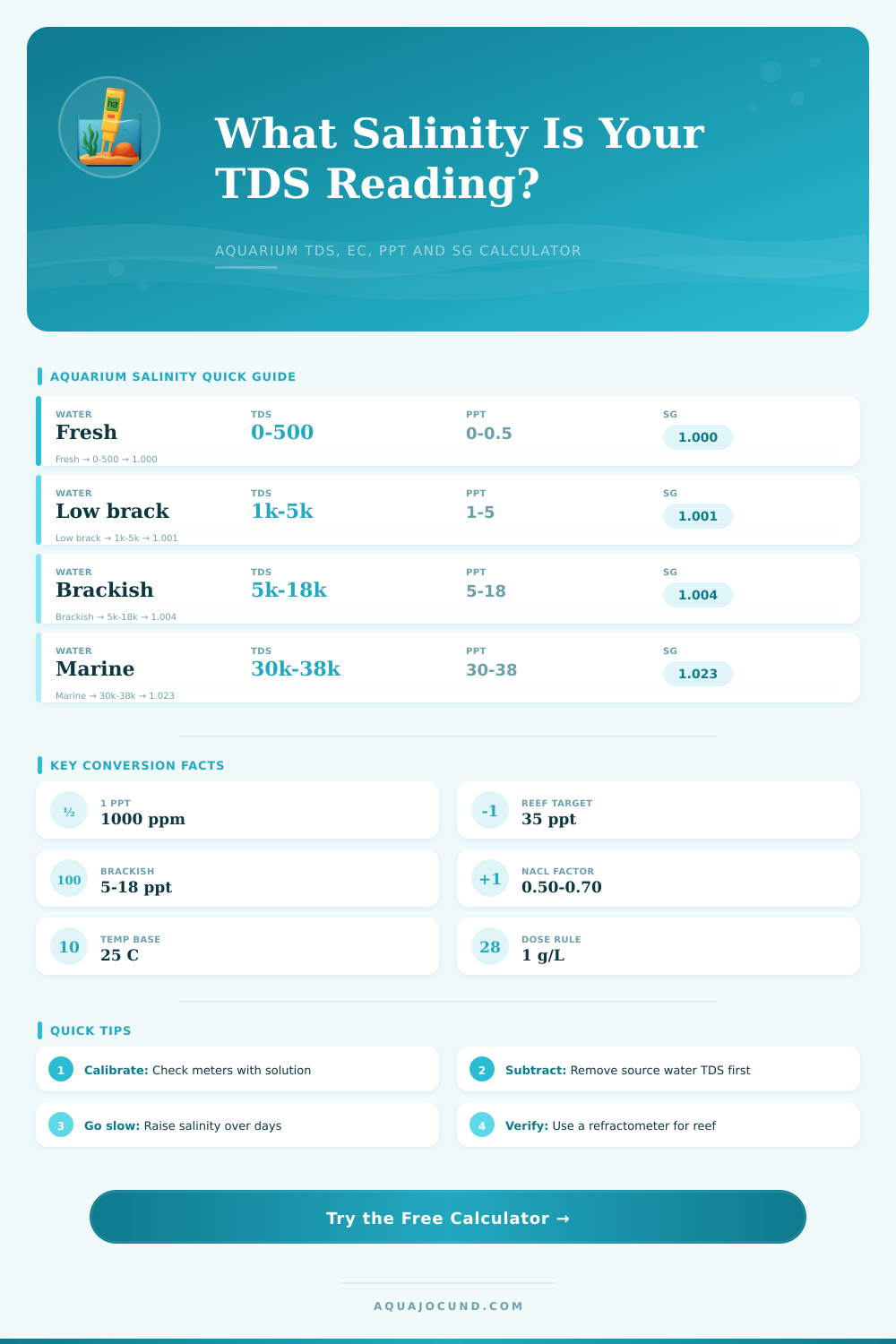
🌊 TDS to Salinity Calculator
Convert aquarium TDS or conductivity readings into estimated ppt, specific gravity, and salt dosing targets.
| Product type | Best use | Dose strength | TDS meaning | Calculator note |
|---|---|---|---|---|
| Reef salt mix | Corals, inverts | Full marine | Very salty | Verify with refractometer |
| Marine salt mix | Fish-only marine | Full marine | Very salty | Good for 30-35 ppt targets |
| Brackish marine mix | Mollies, puffers | Partial marine | Salinity driven | Use ppt target, not ppm alone |
| Aquarium salt | Short-term NaCl | Simple salt | Mostly chloride | Not a reef substitute |
| Pond salt | Koi, goldfish ponds | Simple salt | Mostly chloride | Check purity before use |
| Shrimp minerals | Neocaridina, Caridina | Low salinity | Hardness minerals | TDS does not equal saltwater |
| African mineral mix | Rift lake cichlids | Buffer minerals | KH/GH minerals | Raises TDS without marine salinity |
| Soft remineralizer | Planted RO water | Trace minerals | Very low salt | Use GH/KH tests too |
| Water class | Estimated ppt | Approx TDS ppm | Approx SG | Typical aquarium use |
|---|---|---|---|---|
| Soft freshwater | 0.02-0.15 | 20-150 | 1.000 | Many planted and blackwater tanks |
| Hard freshwater | 0.15-0.50 | 150-500 | 1.000 | Livebearers, rift lake minerals |
| Light brackish | 1-5 | 1,000-5,000 | 1.001-1.004 | Mollies, some gobies, acclimation |
| Mid brackish | 5-12 | 5,000-12,000 | 1.004-1.009 | Figure 8 puffers, bumblebee gobies |
| High brackish | 12-22 | 12,000-22,000 | 1.009-1.016 | Scats, monos, mudskippers |
| Marine fish-only | 30-33 | 30,000-33,000 | 1.022-1.025 | Most saltwater fish systems |
| Reef standard | 34-36 | 34,000-36,000 | 1.025-1.027 | Coral and invert systems |
| Meter scale | Factor | Example EC | Displayed TDS | When to use |
|---|---|---|---|---|
| NaCl scale | 0.50 | 1000 uS/cm | 500 ppm | Salt calibration solutions |
| Aquarium general | 0.64 | 1000 uS/cm | 640 ppm | Mixed freshwater minerals |
| 442 scale | 0.70 | 1000 uS/cm | 700 ppm | Natural water approximation |
| Refractometer | Direct SG | Not EC based | Not ppm | Marine and reef final checks |
| Scenario | Target ppt | Approx SG | Practical check | Notes |
|---|---|---|---|---|
| Planted RO remineralized | 0.1-0.3 | 1.000 | TDS plus GH/KH | Not a saltwater target |
| Neocaridina shrimp | 0.2-0.4 | 1.000 | TDS, GH, KH | Mineral TDS matters more than salt |
| Livebearer hard water | 0.3-1.0 | 1.000-1.001 | TDS, GH, KH | Salt is optional in stable hard water |
| Light brackish community | 2-5 | 1.001-1.004 | Hydrometer or refractometer | Increase slowly after acclimation |
| Figure 8 puffer | 5-10 | 1.004-1.008 | Refractometer | Use marine mix, not plain salt |
| Mudskipper or mono growout | 12-20 | 1.009-1.015 | Refractometer | Needs stable brackish water |
| Marine fish-only | 30-33 | 1.022-1.025 | Refractometer | Match store water before transfer |
| Mixed reef | 35 | 1.026 | Calibrated refractometer | Stability beats chasing numbers |
| Adjusted volume | 1 ppt raise | 5 ppt raise | 10 ppt raise | 35 ppt mix |
|---|---|---|---|---|
| 5 gal / 19 L | 19 g | 95 g | 190 g | 662 g |
| 10 gal / 38 L | 38 g | 189 g | 379 g | 1.33 kg |
| 20 gal / 76 L | 76 g | 379 g | 757 g | 2.65 kg |
| 40 gal / 151 L | 151 g | 757 g | 1.51 kg | 5.30 kg |
| 75 gal / 284 L | 284 g | 1.42 kg | 2.84 kg | 9.94 kg |
| 125 gal / 473 L | 473 g | 2.37 kg | 4.73 kg | 16.56 kg |
💡 Meter Reading Tip
TDS meters infer dissolved solids from conductivity, so two meters can show different ppm for the same water. Use the same meter, calibration solution, and conversion scale when tracking aquarium changes.
💡 Salinity Dosing Tip
For brackish and marine aquariums, dissolve salt outside the tank and raise salinity gradually. Fish tolerate stable salinity far better than sudden jumps from one large correction.
A TDS meter is used to measure an electrical conductivity of the water, but it dont directly measure the number of salt particle within the water. Many people may believe that a TDS meter measure the salinity of the water, but it actualy measures the ability of the water to conduct electricity, which is enabled by the presence of salts. The TDS meter estimates the number of milligrams of solids per liter of water using a conversion factor, but it is a proxy measurement of the salinity.
Because different salts has different rates of conducting electricity, the conversion factor could be based on either pure sodium chloride or a commercial aquarium salt blend. Using a TDS calculator, it is important to choose the correct conversion factor according to the type of salt mix that you are using in the water. Selecting the correct conversion factor will ensure that the math calculations provides the reader with the correct measurement of the salinity.
How to Use a TDS Meter to Measure Aquarium Salinity
In addition, it is also necessary to account for the amount of salinity in the source water. Because the source water may contain a significant amount of minerals, it is important to account for this in the total TDS reading. You can account for this by subtracting the TDS value of the source water from the total TDS reading to determine the amount of salt that was added to the water.
The temperature of the water is another variable that may affect the accuracy of the TDS meter. The conductivity of the water can change based off the temperature of the water. A TDS meter will register a higher salinity value for warm water compared than cold water, even within identical tanks with the same amount of salt.
To compensate for this, you will need to provide the temperature of the water sample to the TDS calculator. The TDS calculator will use the temperature of the sample to provide a corrected TDS reading to the reader to allow for accurate comparison of the salinity of different water samples. The type of fish that you will keep in the aquarium will ultimately determine the target environment for the water.
For instance, Molly fish prefer environments that are light brackish, whereas mudskippers prefer environments that is high in brackish water. If the salinity of the water is changed too quick for the fish, the fish may experience osmotic shock, which is the failure of the fishs systems to manage the fluids within its body. To avoid this occurrence, it is best to slowly increase the salinity of the water over a period of several days when moving the fish from freshwater to brackish water.
When calculating the amount of salt to dose into the aquarium, it is important to provide a safety margin for the water. This is due to the fact that it is easier to add more salt than to remove salt from the water. More specifically, removing salt from the water can require a significant amount of water change to balance the salinity of the water.
Therefore, adding a small percentage of the calculated amount of salt to the water will allow for adjustments at the end to the salinity of the water. Some types of salt are more potent than others. For example, reef salt contains calcium and magnesium, which is beneficial for corals in reef tanks, but people often use plain sodium chloride for medicinal baths.
Consequently, a scoop of marine salt will have a more higher potency than a handful of shrimp salt, so knowing the type of salt and its potency is essential when using the TDS calculator to achieve the desired salinity in the tank. While the TDS meter is a helpful tool for measuring the salinity of the water each day, a calibrated refractometer may be more reliable for measuring high salinity tanks for reef fish. The issue with using a TDS meter for these tanks is that the accuracy of the TDS meter may fail at high salinity.
Using a refractometer, which directly measures the waters density, will provide a more accurate and reliable reading. After accounting for the temperature of the water, the amount of salinity in the source water, and the type of salt chemistry in the tank, the fish owner could of provided the exact environment that the fish need in order to thrive.