Target Magnesium Dose Calculator
Calculate the dry MgCl2 and MgSO4 mix needed to raise aquarium magnesium, check chloride and sulfate contribution, and split the schedule by daily ppm limits.
| Source | Elemental Mg | Companion ion added | Calculator note |
|---|---|---|---|
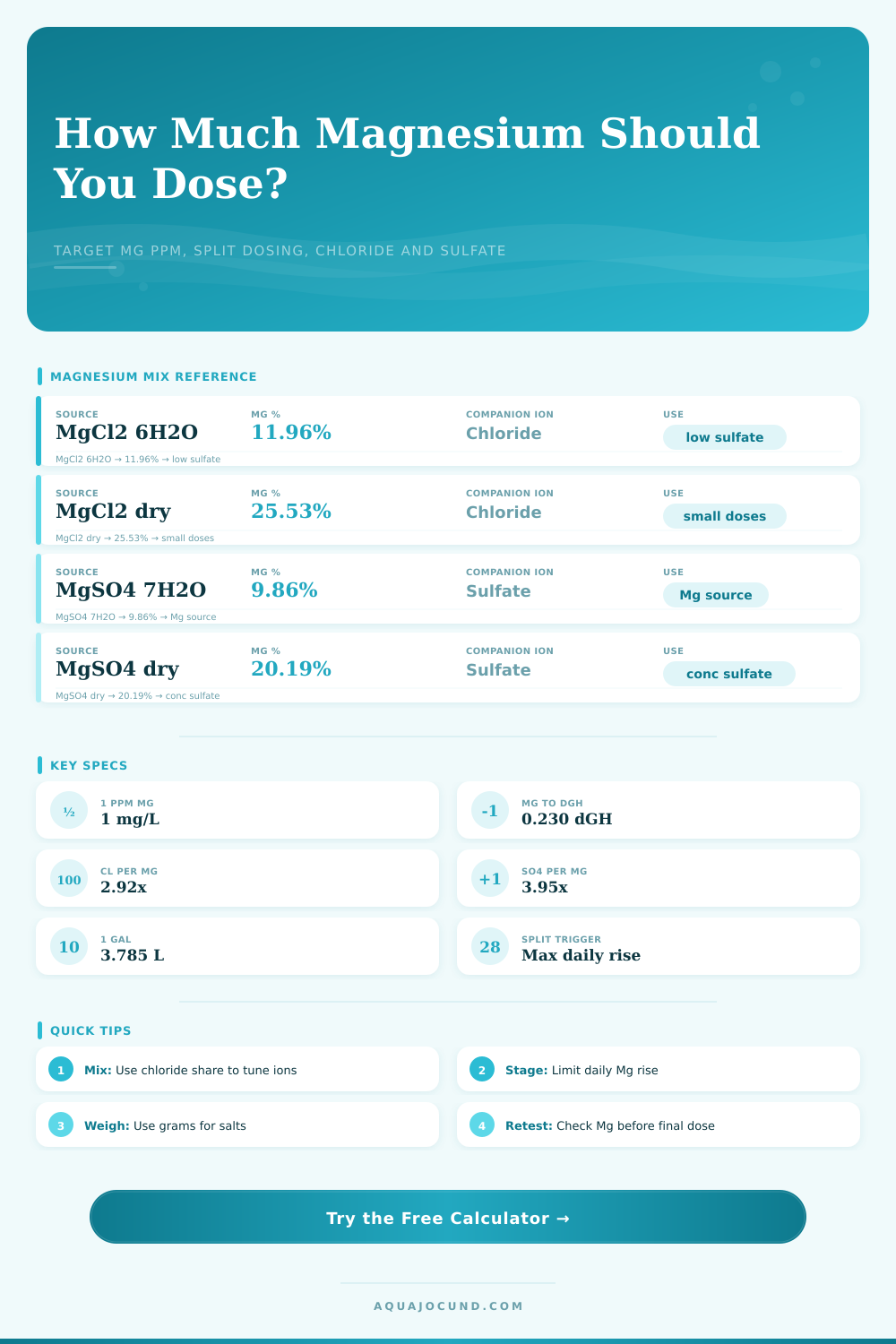
| MgCl2 6H2O | 11.96% | 2.92 ppm chloride per 1 ppm Mg | Common hydrated magnesium chloride. |
| MgCl2 anhydrous | 25.53% | 2.92 ppm chloride per 1 ppm Mg | Strong and hygroscopic; weigh carefully. |
| MgCl2 4H2O | 14.55% | 2.92 ppm chloride per 1 ppm Mg | Intermediate hydrate option. |
| MgSO4 7H2O | 9.86% | 3.95 ppm sulfate per 1 ppm Mg | Common Epsom salt hydrate. |
| MgSO4 anhydrous | 20.19% | 3.95 ppm sulfate per 1 ppm Mg | Concentrated sulfate source. |
| MgSO4 H2O | 17.58% | 3.95 ppm sulfate per 1 ppm Mg | Monohydrate reference if label matches. |
| Water volume | +5 ppm Mg needed | 50/50 mix grams | Added chloride / sulfate |
|---|---|---|---|
| 10 gal / 38 L | 189 mg Mg | 0.79 g MgCl2 6H2O + 0.96 g MgSO4 7H2O | 7.3 ppm Cl / 9.9 ppm SO4 |
| 20 gal / 76 L | 379 mg Mg | 1.58 g MgCl2 6H2O + 1.92 g MgSO4 7H2O | 7.3 ppm Cl / 9.9 ppm SO4 |
| 40 gal / 151 L | 757 mg Mg | 3.17 g MgCl2 6H2O + 3.84 g MgSO4 7H2O | 7.3 ppm Cl / 9.9 ppm SO4 |
| 75 gal / 284 L | 1420 mg Mg | 5.94 g MgCl2 6H2O + 7.20 g MgSO4 7H2O | 7.3 ppm Cl / 9.9 ppm SO4 |
| 125 gal / 473 L | 2366 mg Mg | 9.89 g MgCl2 6H2O + 12.00 g MgSO4 7H2O | 7.3 ppm Cl / 9.9 ppm SO4 |
| Chloride Mg share | Added chloride per +10 ppm Mg | Added sulfate per +10 ppm Mg | Typical reason |
|---|---|---|---|
| 0% | 0 ppm | 39.5 ppm | Sulfate-only correction. |
| 25% | 7.3 ppm | 29.6 ppm | Mostly sulfate with some chloride. |
| 50% | 14.6 ppm | 19.8 ppm | Balanced Mg source split. |
| 75% | 21.9 ppm | 9.9 ppm | Limit sulfate rise. |
| 100% | 29.2 ppm | 0 ppm | Chloride-only correction. |
| Mg rise needed | Max daily rise | Schedule | Check point |
|---|---|---|---|
| 1 to 3 ppm | 3 ppm | 1 dose | Retest after full mixing. |
| 4 to 6 ppm | 3 ppm | 2 daily doses | Retest before dose 2 if sensitive. |
| 7 to 9 ppm | 3 ppm | 3 daily doses | Retest before final dose. |
| 10 to 12 ppm | 3 ppm | 4 daily doses | Confirm salinity or GH trend. |
| More than 12 ppm | Custom cap | Use the calculator split count | Verify source and test kit. |
Whether your aquarium is planted or a reef tank magnesium plays an important role in the lives of fish and other aquatic animals. Consider it not just a value on test kit strip. Magnesium provide the fuel for photosynthesis and helps stabilize calcium carbonate structure. Often these activities happens out of sight until they become visible. Low magnesium cause plants to become unhealthy and corals to stop growing.
Before fixing a deficiency, know what you’re trying to fix. Adding magnesium isn’t always the solution. Especially if it’s added without consideration off the overall chemical picture. A solution isn’t always a good idea unless you can model the dose first.
How to Use the Magnesium Calculator
Here’s where it gets interesting. Using the calculator at the top, you can get an exact calculation of how much MgSO4 (magnesium sulfate) vs MgCl2 (magnesium chloride) you should of use to get your desired result. How does this work?
First, you describe the situation, is this a remineralization batch for reverse osmosis water or will it be used to correct an entire tank? Why? Because that determines volume being treated. Next, you specify existing and goal magnesium concentration in parts per million (ppm). Then you select the proportion of the total magnesium from each source.
For example, you could say 20% of total magnesium comes from magnesium chloride. That’s the key part of the plan. It’s not only magnesium you’re putting into water. You’re also going to add some sulfate or chloride ions. Each gram of magnesium salt have an accompanying ion that will also end up in your system.
Magnesium sulfate adds sulfate. Magnesium chloride add chloride. You can see this clearly in reference table on the page. If you add one part per million of magnesium as chloride, then you’re adding about two point nine two parts per million of chloride at the same time. The same applys to sulfate, but with a slightly larger ratio.
Adding more sulfate from magnesium dosing can upset balance in your water and give you high sulfate levels which may not be good for your livestock. By adjusting the chloride ratio to less than 100%, you are making sure there is more of the other ion then chloride while keeping the overall water chemistry in check.
The other source of common mistakes has to do with purity. Many salt users think that they’re getting one hundred percent pure salts. Nope. Most salts aren’t actualy one hundred percent pure because they often contain water molecules bound within their crystal structure. If you want to use hydrated salts (e.g., magnesium chloride hexahydrate), then those water molecules is stuck inside the crystal lattice and add weight without contributing any magnesium whatsoever.
The calculator is programmed for such hydrates. You can also put in what purity of your product is if it isn’t 100%. Not doing so will result in underdosing. Not cool if you’ve weighed all your stuff precisely beforehand. It is a little bit, but it is an important thing to get right.
You shouldn’t perform large corrections immediately. Abrupt changes in ion levels is stressful and may be lethal for certain sensitive organism. Split dosing solve this problem because it divides a big total dosage into small doses each day. You enter the maximum safe increase (rise) value and it does the rest.
For example, if you want to add 10 parts per million of magnesium and only allow a three-part-per-million rise per day, then it will calculate how many days it take and spread out the addition. This gradual method mirrors nature. It provides time for biological system to accommodate change. Stability is preferred over rapidity.
The last part of the equation is testing. Do the math, divide the dose, and add the salts. Then retest before dosing the final amount to see if you’ve exceeded your goal. Keep in mind that water changes never stand still. Biological uptake, evaporation and test kit variance will move real world numbers away from calculated numbers.
The calculator provides you with an exact formula but the real world requires confirmation. Trust the math but check the water. If you get it right, the water sustains life and leaves you free to go about your business.