Tapered Aquarium Volume Calculator
Estimate tapered tank capacity with top and bottom length-width, frustum average area, fill percentage, taper loss, and displacement.
📌Presets
⚙Tank Inputs
Calculated Volume
📊Taper Comparison Grid
📘Frustum Formula Reference
| Step | Formula | Uses | Output |
|---|---|---|---|
| Top area | top length x top width | water surface footprint | A1 |
| Bottom area | bottom length x bottom width | base footprint | A2 |
| Average area | (A1 + A2 + sqrt(A1 x A2)) / 3 | straight side taper | mean area |
| Volume | average area x height | full tapered capacity | cubic units |
📏Common Tapered Aquarium Checks
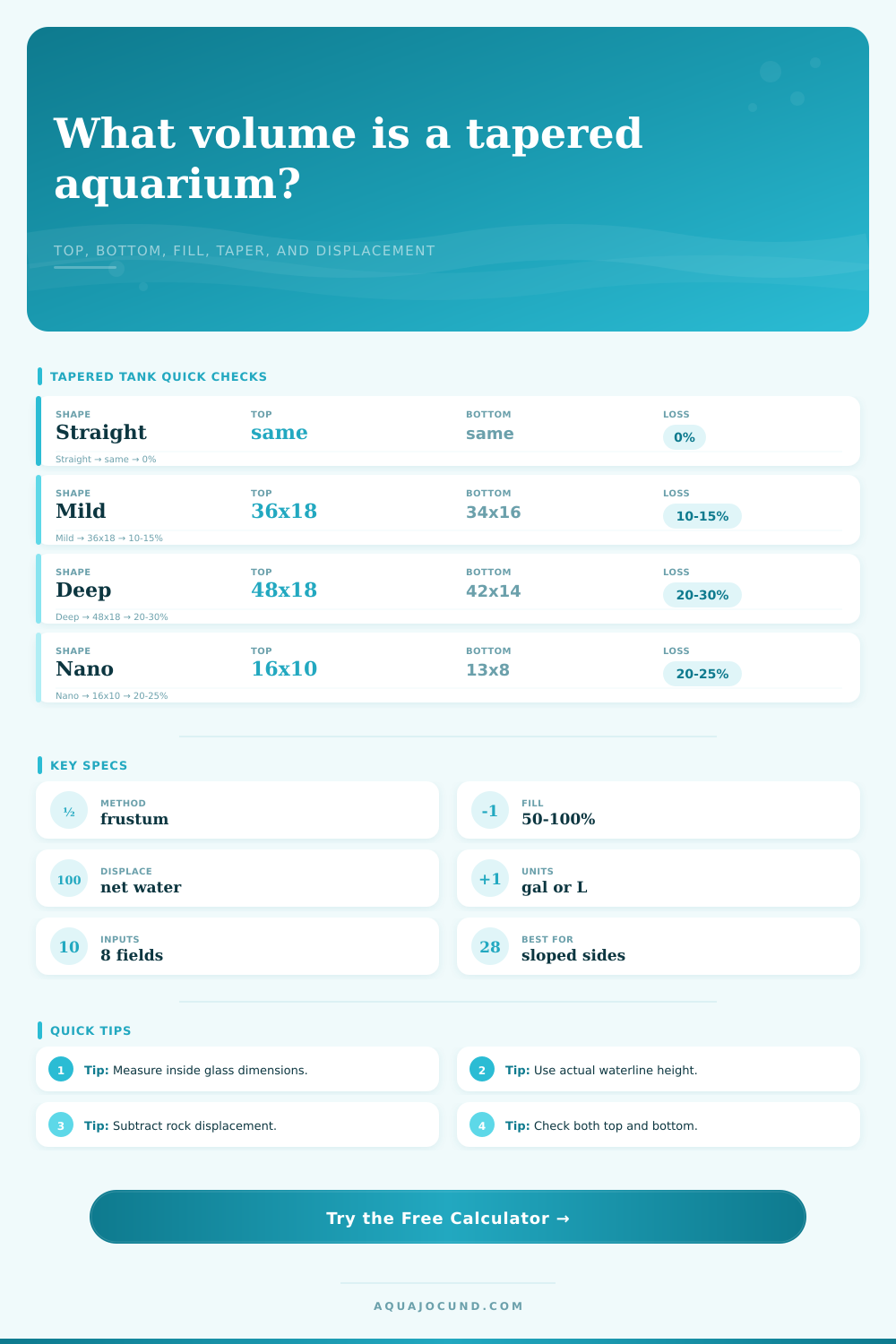
| Scenario | Top dimensions | Bottom dimensions | Typical taper loss |
|---|---|---|---|
| Straight rectangle | same as bottom | same as top | 0% |
| Mild sloped back | 36 x 18 in / 91 x 46 cm | 34 x 16 in / 86 x 41 cm | 8 to 16% |
| Display wedge | 48 x 18 in / 122 x 46 cm | 42 x 14 in / 107 x 36 cm | 18 to 28% |
| Small paludarium | 60 x 35 cm / 24 x 14 in | 48 x 26 cm / 19 x 10 in | 20 to 32% |
🌊Volume Conversion Table
| Measure | Imperial | Metric | Use in calculator |
|---|---|---|---|
| Cubic inch | 231 in³ = 1 gal | 16.387 cm³ | imperial dimensions |
| US gallon | 1 gal | 3.785 L | primary water volume |
| Liter | 0.264 gal | 1,000 cm³ | metric water volume |
| Cubic centimeter | 0.000264 gal | 1 cm³ | metric dimensions |
🧮Displacement Guide
| Aquascape load | Typical displacement | Enter as | Notes |
|---|---|---|---|
| Open swim tank | 3 to 6% | gal or L | few rocks, thin substrate |
| Planted scape | 7 to 12% | gal or L | soil, wood, stones |
| Rock cichlid tank | 12 to 22% | gal or L | large stacked hardscape |
| Reef lagoon | 8 to 18% | gal or L | rock plus equipment volume |
From an external perspective most aquariums appear as if they are rectangular prisms. However, few aquarium are truly perfect rectangles, in fact, it’s rare for them to be perfect boxes when full of water. Have you ever purchased a display tank with a tapered bottom, a curving front, or sloping sides? If so, then you’re well acquainted with how different the real world water volume of the tank is than the manufacturer’s gallonage… sometimes significantly enough to throw off your salinity calculations, overdose medication, or make you wonder why your heater seem to be short-cycling.
The good news: this is primarily a matter of understanding what is being measured. You usually do this by looking beyond the label and into the glass itself. Here are some tips on understanding geometry of your aquarium.
How to Measure Aquarium Volume
The walls are straight and vertical. When calculating volume, most people use a standard volume formula. That assumes sides are all straight up and down. So they measure length, width, and then height, times the length, times the width, times the height….and that’s your volume.
But a tapered tank isn’t like that. A tapered tank is what is called a “frustum.” A frustum is a geometric shape. Its top area differ from its bottom area. To calculate volume of a frustum, use a formula that averages the top and bottom areas to find the true middle. The formula will be calculated for you by calculator above.
Why? A tank with a larger area at the top will hold less water than one with the same height but a smaller area at the top. Conversely, a tank with a greater area at the bottom will hold MORE water. It’s a slight difference in shape, but makes a huge difference in volume. Guessing, anyone?
To use these formulas, you will need to take some measurements yourself. Specifically, you’ll want the internal dimension of the tank both at the very top and also at the very bottom. This is because most companies lists the outside dimensions, including thickness of the glass. On large tanks this difference (that additional inch or two) add up if they’re using thick laminated glass or acrylic. Measure internally. This means you’re getting the amount of interior space available for water (not sand and silica). Use a tape measure and take your time. Boring stuff, but that’s how you know you got it right.
But even when you get the size, the fill level comes back into play. Not many folks run their tanks full to capacity. Let’s say you want to leave two inches of headroom for any reason. For wave action, to clear equipment, etc. That’s not simply taking out a flat section of water. You’re taking out a section from the largest part of the taper. In other words, that headspace represent a larger volume percentage than it would in a straight-sided tank.
What the tool does here is scale down the frustum to your actual water line. Most people do it the opposite way. They figure the total tank volume, then they take off some percent based off how much air space they want. But that percentage are incorrect. It’s correct for the shape of the tank, not the shape at the water surface. You have to use shape of the tank at the water level rather than just the shape of the whole tank.
The last variable to consider that turns theoretical volume into practical reality is displacement. That’s because water can’t fill space taken up by rocks, sand, live coral, driftwood, and yes, even the heater. Depending on how heavily aquascaped a planted tank is, it could be twenty percent full with soil and hardscape. A quarantine tank set up with bare bottom might have near zero. If you dose chemicals using gross volume of the tank, you are overdosing the actual water column. How do different scape styles affects net volume? That’s laid out in the reference table on the page.
It’s not simply a matter of how big the tank is. It’s how much of that space is realy available to the water that supports your fish. Volume isn’t static. It’s not something you can think of as a quantity in gallons. It changes based off how many rocks you put in or how much water you take out. You should of known this earlier.
It’s also an indication of the overall shape of your tank. Once you know that, once you understand its shape, you don’t need to rely on marketing labels anymore. You can begin to manage your system precisely. And careful management is what maintains stability in the water and healthiness of your livestock. Exact management is what transforms a guess into a plan. A plan is the best defense against a hobby that rarely knows how to behave.