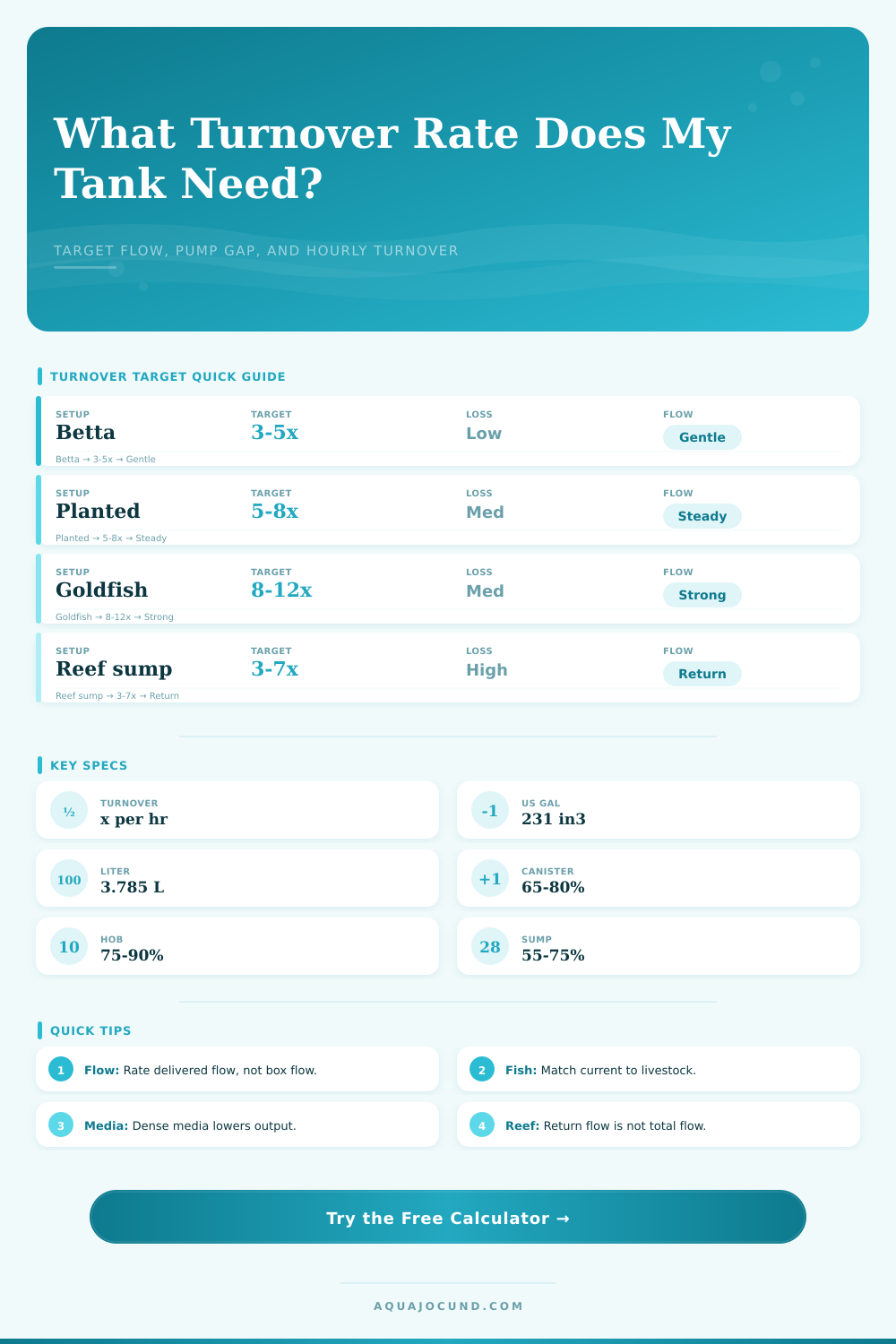
Tank Turnover Per Hour Target Calculator
Estimate aquarium water volume, target flow range, pump size, and delivered turnover after media, head height, and plumbing losses.
| Setup | Common Target | Best Flow Pattern | Calculator Notes |
|---|---|---|---|
| Betta or slow-water fish | 3-5x per hour | Wide, gentle return | Choose the low end when fins are pushed around. |
| Shrimp, fry, quarantine | 4-6x per hour | Sponge guarded intake | Keep intake safe and avoid narrow jets. |
| Community freshwater | 5-7x per hour | One broad circulation loop | Good default for mixed peaceful fish. |
| Planted aquarium | 5-8x per hour | Low dead spots, leaf-safe | CO2 tanks need distribution more than raw speed. |
| Cichlid or messy predator | 7-10x per hour | Strong sweep across bottom | Pair turnover with mechanical prefilter cleaning. |
| Goldfish tank | 8-12x per hour | Strong but not blasting | High waste load often needs extra mechanical flow. |
| Reef sump return | 3-7x per hour | Return plus separate wave flow | Do not count return turnover as total reef movement. |
| Small pond loop | 1-2x per hour | Skimmer or bottom draw | Ponds depend on stocking, sun, and solids load. |
| Filter Type | Typical Delivered Flow | Common Loss Cause | When To Add Margin |
|---|---|---|---|
| Air sponge filter | 40-70% of air rating | Air pump depth and stone age | Deep tanks or multiple sponges |
| Hang-on-back filter | 75-90% of box rating | Cartridge loading and intake sponge | Fine polishing pads |
| Internal power filter | 80-95% of box rating | Small chamber media clogging | Heavy feeding or fry guards |
| Canister filter | 65-80% of box rating | Hoses, media baskets, spray bar | Long hose runs or dense media |
| Sump return pump | 55-75% of zero-head rating | Vertical lift, elbows, valves | Reef returns and basement sumps |
| Pond pump loop | 50-80% of box rating | Head height and UV or bog filters | Waterfalls, skimmers, long pipe |
| Wavemaker pump | 85-100% open flow | Guard fouling and controller mode | Use for circulation, not biofiltration |
| Tank | Nominal Size | 5x Delivered | 8x Delivered |
|---|---|---|---|
| 5 gallon | 16 x 8 x 10 in | 25 GPH / 95 LPH | 40 GPH / 151 LPH |
| 10 gallon | 20 x 10 x 12 in | 50 GPH / 189 LPH | 80 GPH / 303 LPH |
| 20 long | 30 x 12 x 12 in | 100 GPH / 379 LPH | 160 GPH / 606 LPH |
| 29 gallon | 30 x 12 x 18 in | 145 GPH / 549 LPH | 232 GPH / 878 LPH |
| 40 breeder | 36 x 18 x 16 in | 200 GPH / 757 LPH | 320 GPH / 1211 LPH |
| 55 gallon | 48 x 13 x 21 in | 275 GPH / 1041 LPH | 440 GPH / 1666 LPH |
| 75 gallon | 48 x 18 x 21 in | 375 GPH / 1420 LPH | 600 GPH / 2271 LPH |
| 125 gallon | 72 x 18 x 21 in | 625 GPH / 2366 LPH | 1000 GPH / 3785 LPH |
| Check | Good Sign | Warning Sign | Adjustment |
|---|---|---|---|
| Surface movement | Ripples across most of surface | Film or still corners | Raise outlet or widen spray bar |
| Debris path | Waste drifts toward intake | Solids collect behind hardscape | Add circulation or move intake |
| Livestock comfort | Fish hold position easily | Fish avoid open water | Diffuse return or lower target |
| Filter loading | Flow stays stable for a week | Output drops quickly | Add prefilter area or margin |
| Plant response | Leaves sway lightly | Leaves whip or dead zones grow | Split flow into gentler paths |
I suspect most people don’t have fish just to work out their fluid dynamics issues when they change filters; you’re watching live animals.
When you notice your aquarium resembles a stagnant pond, however, you might start to panic. Most of the time it isn’t because pump has quit working. It’s more often than not due to an undersized pump. Boxes advertise flow rates. At best these numbers is optimistic. At worst, they aren’t accurate at all. They represent water traveling through air in a laboratory, not water being pushed through hoses, through ceramic filters, and up toward a return nozzle against gravity.
Why Aquarium Pumps Do Not Work As Expected
New keepers lack confidence because of this rated vs. Delivered gap. You purchase a filter rated for twenty gallons and place it on a ten gallon tank. Enough, right? Wrong. Water height. Media density. The calculator above does the math when you enter your own losses. You won’t have to guess if your spray bar will limit output.
Think of turnover as a range with a target and how that target move based off what you have in the tank. Gentle flow is fine for a betta fish. A cichlid expects current. If you treat them the same, one will be stressed and the other will be bored. Let the tool help you match flow strength to your livestock so the current supports life, not fights against it.
Think about the substrate. Sand and gravel are inert decoration, yet they takes up water space. Hardscape can do the same. Your net water volume is lower than the nominal tank size if you’re using a lot of it. That’s useful when considering flow calculations. You may find your existing pump already satisfies your target turnover. Many folks over-estimate their need to upgrade by assuming they’re calculating an empty box instead of their filled aquarium.
This is what the displacement input does in the calculator. It provides a realistic picture of how much volume require filtering.
The other problem is the plugged filter. It was rinsed, but the original flow did not return. This is normal. Filter media (biological) accumulates slime layers that slow down flow. Head height increases resistance. When sump return pumps are empty they deliver 80% of their rating; when full and plumbed with elbows, they delivers 50%. The chart at the bottom of the page show typical filter type inefficiencies. Canisters is very powerful, but they are picky about hose lengths. Hang-on-back filters are convenient, but will choke on dirty sponges. Knowing which filters lose performance prevents you from buying a larger pump that still won’t push enough water and ends up being frustrating.
It’s turnover; don’t get hung up on the middle of this recommendation range. It’s an idea, not a rule. Observe your fish. Do they hang around nervously at the top? Do they stay away from open space? Then your flow is too strong or poorly directed. There is too little turnover. Then there is rotting stuff building up behind rocks, etc.
It is an easy eye test to look for movement on the surface. You should of some ripple effect over most of the surface helping gas exchange. If water is as glassy as a mirror, it is bad. Balance is the name of the game. You need enough flow to disperse heat evenly and move waste toward the intake, but not so much that you feel like your livestock are livig in a hydroelectric dam.
Determine your starting point with the calculator. Adjust the angles & valves according to your tank. More than the specs on the sheet, this is about how water moves around inside glass.