🐟 Tank Transfer Method Schedule Calculator
Build a date-and-time transfer calendar with water volume, salinity and temperature matching checks, duplicate equipment counts, and reminder windows.
✅ Transfer Calendar Results
| Vessel Type | Typical Nominal Size | Working Fill Used | Planning Advantage | Equipment Count Note |
|---|---|---|---|---|
| Food-Grade Bucket Pair | 5 gal / 19 L | 70% | Compact calendar for small groups | One lid, air stone, and heater per bucket |
| Glass Aquarium Pair | 10 gal / 38 L | 80% | Clear viewing and stable heater placement | Duplicate thermometer and cover for each tank |
| Plastic Storage Tote Pair | 10 to 20 gal / 38 to 76 L | 75% | Lightweight swap-and-clean workflow | Use matching marked lids when jumping risk exists |
| Small Specimen Box Pair | 1 to 3 gal / 4 to 11 L | 85% | Small measured volumes for tiny fish | Mini heater or heated room planning matters |
| Large Utility Tub Pair | 27 to 40 gal / 102 to 151 L | 65% | Room for larger fish or divided groups | Count stronger aeration and secure covers |
| Heated Reef Holding Pair | 10 to 20 gal / 38 to 76 L | 75% | Includes salinity and temperature matching | Dedicated refractometer rinse cup is useful |
| Container Or Tank | Nominal Volume | At 70% Fill | At 80% Fill | Four Transfers Plus Start |
|---|---|---|---|---|
| 2.5 Gal Mini Tank | 2.5 gal / 9.5 L | 1.8 gal / 6.6 L | 2.0 gal / 7.6 L | 8.8 to 10.0 gal / 33 to 38 L |
| 5 Gal Bucket | 5 gal / 19 L | 3.5 gal / 13 L | 4.0 gal / 15 L | 17.5 to 20.0 gal / 66 to 76 L |
| 10 Gal Aquarium | 10 gal / 38 L | 7.0 gal / 26 L | 8.0 gal / 30 L | 35 to 40 gal / 132 to 151 L |
| 20 Long Aquarium | 20 gal / 76 L | 14 gal / 53 L | 16 gal / 61 L | 70 to 80 gal / 265 to 303 L |
| 27 Gal Utility Tote | 27 gal / 102 L | 18.9 gal / 72 L | 21.6 gal / 82 L | 94.5 to 108 gal / 358 to 409 L |
| 40 Breeder Tank | 40 gal / 151 L | 28 gal / 106 L | 32 gal / 121 L | 140 to 160 gal / 530 to 606 L |
| Check | Calculator Input | Difference Math | Common Planning Window | Calendar Reminder Use |
|---|---|---|---|---|
| Salinity | Current and new vessel ppt | Absolute ppt difference | 0.5 ppt or user-entered limit | Test before transfer reminder |
| Temperature | Current and new vessel degrees | Absolute degree difference | 1 to 2°F / 0.5 to 1°C | Pre-warm or cool reminder |
| Mixed water reserve | Reserve percent | Working volume multiplied by reserve | 10% to 25% | Mix enough before the next time block |
| Dry buffer | Hours after each move | Transfer time plus buffer | 12 to 24 hours for scheduling | Gear-ready reminder after cleaning |
| Item | Count Basis | Why It Appears In The Calculator | Typical Reminder Timing |
|---|---|---|---|
| Clean vessel | Two per active group plus spares | One vessel can be in use while the next is prepared | Before every scheduled transfer |
| Heater or temperature control | One per counted wet vessel | Lets new water reach the target before the transfer time | Lead time selected above |
| Air stone and airline | One per counted wet vessel | Keeps each prepared holding volume aerated | When filling the next vessel |
| Net, cup, or transfer container | Duplication mode selected above | Keeps the equipment count aligned with the chosen workflow | At staging and transfer time |
| Thermometer and salinity tool | At least one verified measuring set | Checks whether the new vessel matches the target values | Before the move, then again after filling |
Fish transportation logistics are handled by the calculator (above). Moving fish is less about biology and more about supply chain management. Temperature matches has to be exact, there must be plenty of clean water, and the schedule can’t fall apart from becoming too complicated. This tool will turn the mental gymnastics of which equipment needs sanitizing, how much water to move, and what interval works best into a set-in-stone calendar. No more panicking at 3am because you noticed the water in your quarantine bucket got cloudy. It is not about the disease itself, but about the logistics, and organization becomes possible.
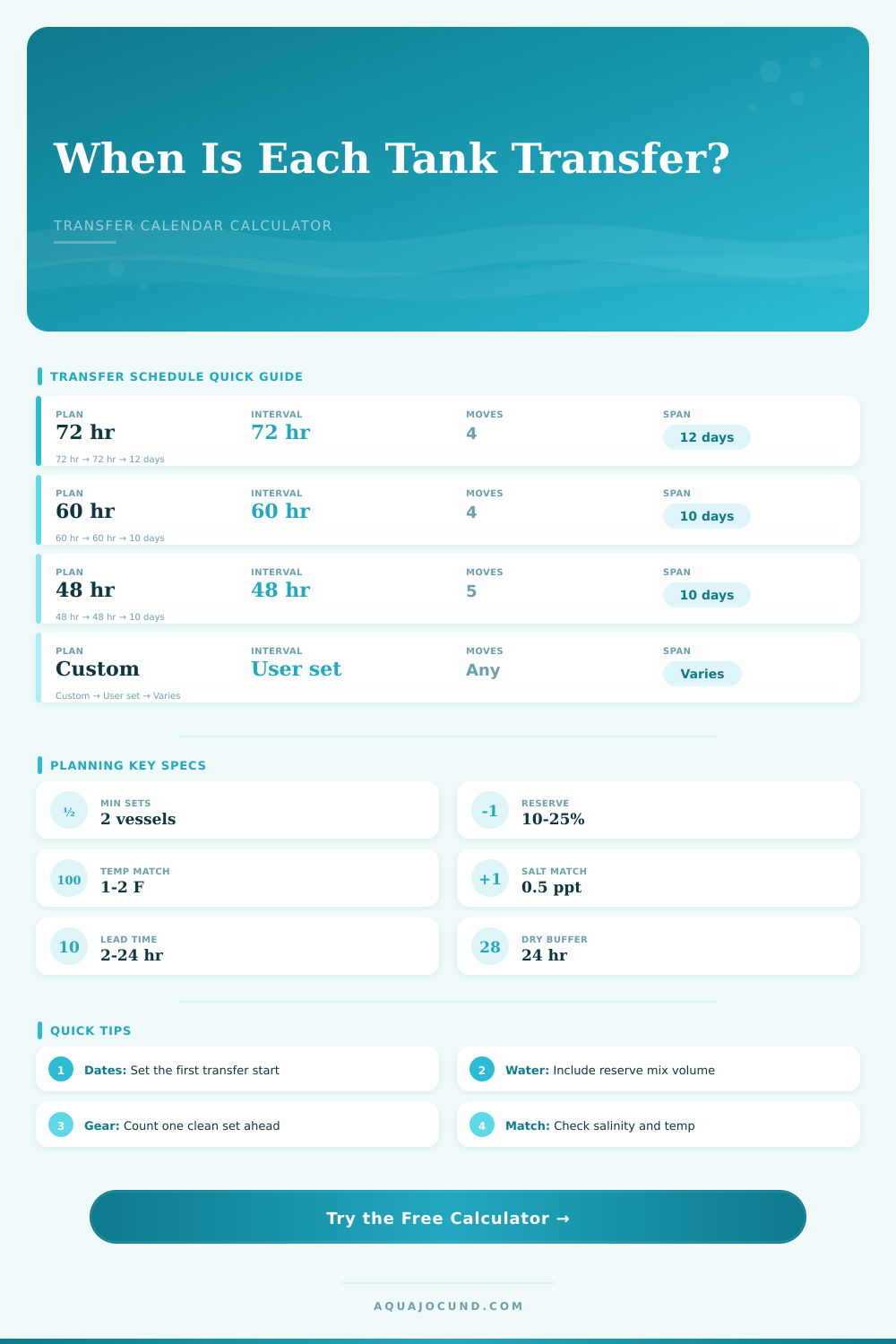
First up, what do you want the rhythm to be? Most protocols recommend you move every forty-eight to seventy-two hours. You can set a custom interval, and the tool has presets too. Do you go with a stable seventy-two-hour interval? In that case, you’re betting on less handling stress due to fewer disturbances. But they’ll also be in one water column for a longer duration. Go with a more frequent forty-eight-hour interval? You’re betting on fresher water parameters but accepting more disturbance. Whatever you pick, the tool will map it all out for you: when you should move them, down to the date, depending on your start time. No more guessing about when Thursday evening or Wednesday morning will be the best day.
Why This Tool Makes Fish Transport Easy
And then there’s the water. Here is where folks typically underestimate requirements. Not only do you need water for your tank but you need reserve water. Things spill, evaporate, and get left behind when you’re siphoning sediment out. Add to that ten to twenty-five percent more than what you think is needed for reserve, this isn’t wasted water. This is insurance. Run dry mid transfer because you didn’t calculate properly? Now you’re scrambling. Before a single drop goes into the vessel, the calculator has summed up how much water all together will be required. It has accounted for the fill level of the vessel itself. A ten gallon bucket doesn’t hold ten gallons of usable water. It might be seven or eight. It’ll adjust the math to make sure you aren’t mixing for ghosts.
The nuts and bolts of the transfer are the matching parameters. Take a fish out of water at 78 degrees and put him in a tank where he’s 82 degrees and don’t think he’ll be happy with you for it. The calculator prompts you for the existing and desired temps and salinities. Then it compares them against a tolerance level you enter into the equation. Say you have a new bucket but it’s a degree or two different. It’s flagged as being outside limits. I am not nitpicking. That’s preventing shock. The reference table on the page shows how small errors can add up if you make more than one move. Minimizing the difference reduces chasing down spikes in ammonia later.
The secret pain in the ass is equipment counts. Two buckets? Yep, there are two buckets. There are two heaters. Yes. There are two air stones. Yep. You need covers for them. Yep. You also need a sanitizer that lets you clean everything after use. How do you share equipment with multiple vessels versus dedicate by boat? Does the math ask if you have one group of fish or three groups of fish? Oh crap, I have three groups, I gotta have three sets of nets…or at least I should soak them really good between every single batch. This thing does the inventory count of actual equipment you’ll have to pull together. It also lets you know that cleaning is happening and takes time. Enter the dry buffer. It plans a pause between batches so you can disinfect or just let something air off before using again.
This is where the spreadsheet shines (or doesn’t). What it really does is take away your thinking. If an alarm sounds, you don’t want to be doing math about the tank status. That’s for looking at the fish. Offload the schedule to the tool and let it run. Let the calendar worry about the when. You worry about the how. It’s just a division of labor that makes the process flow smoothly.
The first time to place it is the easy part. Choose one that will work. Once you do, the tool does the rest for the week. It becomes almost mechanical and routine, taking the place of the three-in-the-middle-of-the-night freak out. The fish don’t know what day it is. They just want the water conditions to be correct when they show up. And the tool makes sure you’re ready for them when they get there.