Tank Temperature Swing Day Night Calculator
Estimate aquarium temperature drift from water thermal mass, day and night ambient air, heater watts, light heat load, and evaporative cooling.
Estimated Day/Night Temperature Swing
| Profile | Evaporation Rate | Heat Exchange | Best Used For |
|---|---|---|---|
| Sealed glass cover | 0.005 gal/sq ft/day | Low | Quarantine, breeding boxes, low airflow tanks |
| Typical glass lid | 0.015 gal/sq ft/day | Low-medium | Community tanks with normal room humidity |
| Partial lid | 0.040 gal/sq ft/day | Medium | Planted tanks with filter gaps and feeding holes |
| Mesh lid | 0.070 gal/sq ft/day | Medium-high | Jump-prone fish where gas exchange is open |
| Open rimless | 0.100 gal/sq ft/day | High | Rimless planted or reef tanks without fans |
| Fan cooled open top | 0.200 gal/sq ft/day | Very high | Summer cooling, reef fans, dry rooms |
| Open sump or overflow | 0.140 gal/sq ft/day | High | Systems with exposed sump water or overflow turbulence |
| Humid fish room | 0.060 gal/sq ft/day | Medium | Many tanks in one damp, warm room |
| Thermal Item | Reference Value | Formula Use | Practical Meaning |
|---|---|---|---|
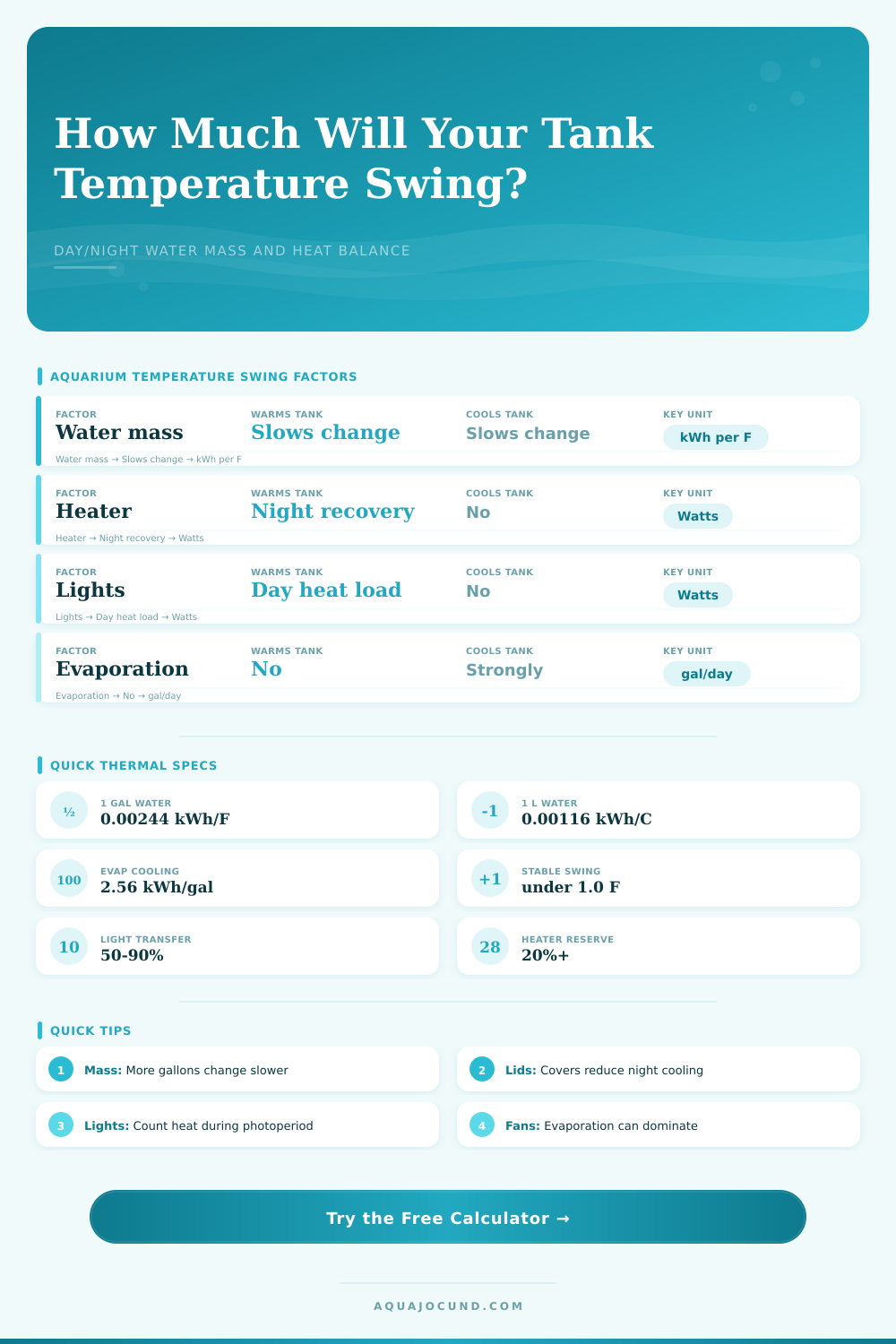
| US gallon of water | 8.34 BTU per °F | 0.00244 kWh per °F | More gallons slow each watt of heat change. |
| Liter of water | 4.186 kJ per °C | 0.00116 kWh per °C | Metric thermal mass basis. |
| Evaporated gallon | about 2.56 kWh | Cooling energy removed | A small water loss can offset many watts. |
| Heater watt | 1 Wh per hour | Thermostat heat input | Duty rises when night air is far below target. |
| Light watt transfer | 50-90% common | Photoperiod heat gain | Closed canopies and close LEDs transfer more heat. |
| Tank | Dimensions | Water Mass | Typical Concern |
|---|---|---|---|
| 5.5 gallon | 16 x 8 x 10 in / 41 x 20 x 25 cm | 0.013 kWh/°F | Fast night drops and lamp-driven daytime bumps |
| 10 gallon | 20 x 10 x 12 in / 51 x 25 x 30 cm | 0.024 kWh/°F | Needs steady heater control in cool rooms |
| 20 long | 30 x 12 x 12 in / 76 x 30 x 30 cm | 0.049 kWh/°F | Large surface area increases evaporation |
| 40 breeder | 36 x 18 x 16 in / 91 x 46 x 41 cm | 0.098 kWh/°F | Open tops react strongly to fans |
| 55 gallon | 48 x 13 x 21 in / 122 x 33 x 53 cm | 0.134 kWh/°F | Taller profile holds heat better than shallow tanks |
| 75 gallon | 48 x 18 x 21 in / 122 x 46 x 53 cm | 0.183 kWh/°F | Lights and open sump can set daytime high |
| 125 gallon | 72 x 18 x 21 in / 183 x 46 x 53 cm | 0.305 kWh/°F | Large mass smooths short room swings |
| Daily Swing | Interpretation | Likely Driver | Calculation Check |
|---|---|---|---|
| 0-1.0 °F / 0-0.6 °C | Very stable | Enough water mass or heater reserve | Confirm thermometer resolution. |
| 1.0-2.5 °F / 0.6-1.4 °C | Normal managed swing | Photoperiod heat or cool nights | Compare morning and late-day readings. |
| 2.5-4.0 °F / 1.4-2.2 °C | Moderate swing | Open top, fans, or small heater | Check evaporation and heater duty. |
| Over 4.0 °F / 2.2 °C | Large swing | Low water mass or strong room changes | Recheck ambient inputs and surface area. |
Most aquarium hobbyists often considers temperature an afterthought. Get a heater, dial it up to seventy-eight degrees, and call it good. Unfortunately, that’s not how it works.
Temperature never stands still. Every moment of every day, your tank heats up or cools down to match surrounding air. At the same time, light cycles and evaporation cause nighttime cooling and daytime warming. Without awareness of these forces, sensitive animals will face extra stress.
Why Temperature Changes in Your Tank
That’s where mathematics comes in. The calculator above do all the work for you, but knowing the physics makes you feel confident in the outcome and allows you to fine tune your setup actualy.
Water is stubbornly efficient at holding heat. This has both pros and cons. On the plus side, water retains its heat well. Water buffers fast changes in the room. If your room heater cycles off while you are away, the water will resist rapid change due to it’s heat storage. It simply won’t have enough time to get cold!
On the negative side, low thermal mass can be a bad thing. Low thermal mass means that a lot of heat energy can warm up a small tank several degrees but only add half a degree to a large tank. Keep in mind that rated capacity does NOT reflect amount of water in the tank. The air gap under the rim, the substrate, and any rocks all displace water. This take away from thermal buffering effects. To make sure you get an estimate based off how much WATER is actualy in the glass, the tool factors in volume displaced.
Daytime high temperatures are driven by lighting. For every watt of overhead lighting used, some fraction becomes heat energy in the water column. Some escapes into the room air but a significant portion dumps directly into the water column. Running bright LEDs for eight hours is like having a low-wattage heater going all day long when the lights are on. Many keepers use a heater set to kick on during the coldest part of the night, which means they’re ignoring what happens cumulatively from the lamp heat. While you’re at work, the water will warm up and often overheat past the desired temperature by the time lights go out. You can see that from the table below; thermal balance shifts significantly as the percentage of light transferred changes.
The main reason for cooling is evaporation. When those water molecules escape into the air, they carry away a lot of energy, just like sweat cools you down. The energy used to turn liquid into gas does that very thing. If you have an open tank sitting in a dry room with a fan, it can lose water over night and cool the tank quite a bit. Sealing the lid stops that process, retaining heat but potentially trapping gas (such as ammonia) if there isn’t sufficient filtration. So do you want thermal stability or gas exchange? A mesh lid is a compromise because it allows for some evaporation without letting fish jump out, but it won’t retain heat like a solid glass cover.
Duty cycles show how much work my equipment has to do. Is my heater cycling between 10 and 20 minutes every hour (good), or is it cycling 5 minutes off, 50 minutes on (bad)? Does my air conditioner run 24/7 all summer because I don’t have adequate insulation or a cool-enough room? Heater duty cycles show you what’s going on.
The calculator estimates these duty cycles as well; it will help you sanity-check how hard you’re making your hardware work. Too high? Maybe get a tighter lid, some extra thermal mass. Too low? You might be overheating the room unneccessarily. You may be overcooling the room by turning on the AC when you really don’t need it.
Swings are okay, Some amount of fluctuation is normal and harmless. We want to keep those fluctuations slow and within the safe zone. Stable cycles helps fish and invertebrates adjust; abrupt rises and falls do not.
Water mass, evaporative cooling, and light heat all work together to create a sense of stability for the occupants. It’s primarily about knowing what you’re measuring. When you become familiar with the interaction between those variables, the mystery of the floating thermometer fades. Then you don’t guess anymore. Instead, you manage environment on purpose.
The heat is in the water. The air takes it out. Your tools link them together. Get that balance correct and what was once just a glass box becomes a solid, self-sustaining ecosystem.
You should of checked this sooner.