Tank Levelling Shim Thickness Calculator
Estimate aquarium stand shim stacks from measured corner gaps, stand footprint, length and width slope, shim compression, load spread, and safety flags.
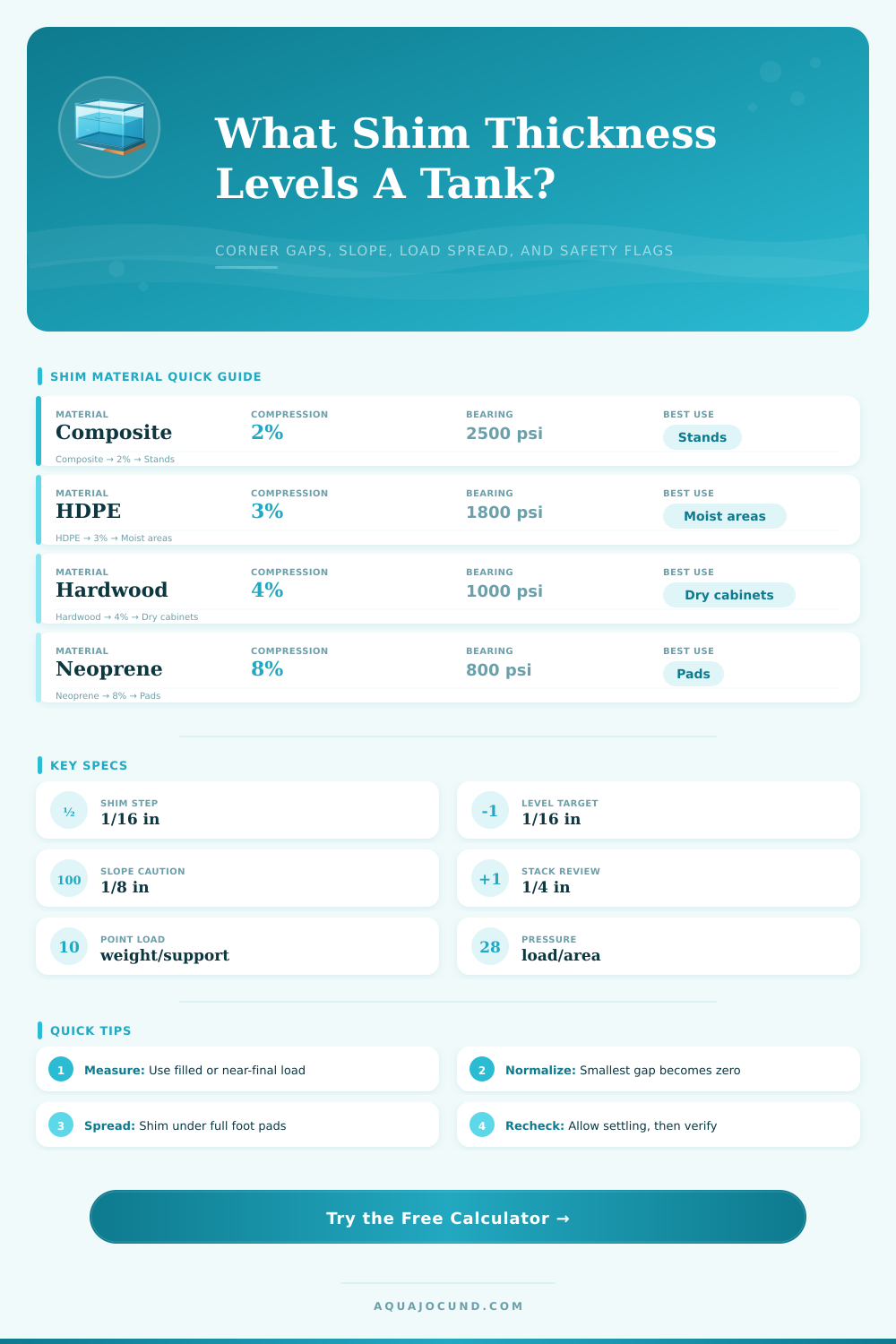
| Material | Reference Bearing | Typical Compression | Calculator Use |
|---|---|---|---|
| Composite plastic shim | 2500 psi / 17,237 kPa | 2% | Durable default for cabinet corners and full-width support strips. |
| HDPE strip | 1800 psi / 12,411 kPa | 3% | Moisture-resistant shim when cut to cover the full foot pad. |
| Nylon machinery shim | 6000 psi / 41,369 kPa | 1.5% | Low-compression option for precise thin stacks. |
| Sealed hardwood | 1000 psi / 6,895 kPa | 4% | Usable only when sealed and supported across the full bearing area. |
| PVC trim shim | 1500 psi / 10,342 kPa | 5% | Moderate compression; avoid tiny point-contact pieces. |
| Neoprene rubber pad | 800 psi / 5,516 kPa | 8% | Useful for vibration isolation, but compression must be included. |
| Cork-rubber pad | 300 psi / 2,068 kPa | 12% | Soft pad material; review heavy aquarium loads carefully. |
| Stainless steel shim | 30000 psi / 206,843 kPa | 0.5% | Very low compression, but edges need full bearing and protection. |
| Stand Size | Footprint | Typical Filled Weight | Shim Review Point |
|---|---|---|---|
| 10 gallon | 20 x 10 in / 51 x 25 cm | 100 to 130 lb / 45 to 59 kg | More than 1/8 in / 3 mm at a corner. |
| 20 long | 30 x 12 in / 76 x 30 cm | 225 to 275 lb / 102 to 125 kg | Check rack legs and pad contact. |
| 40 breeder | 36 x 18 in / 91 x 46 cm | 475 to 575 lb / 215 to 261 kg | Full cabinet base should bear evenly. |
| 55 gallon | 48 x 13 in / 122 x 33 cm | 625 to 750 lb / 284 to 340 kg | Front rail twists need extra attention. |
| 75 gallon | 48 x 18 in / 122 x 46 cm | 850 to 1000 lb / 386 to 454 kg | Review any stack above 1/4 in / 6 mm. |
| 125 gallon | 72 x 18 in / 183 x 46 cm | 1400 to 1700 lb / 635 to 771 kg | Use broad continuous support, not tiny wedges. |
| Measured Condition | Approximate Meaning | Common Action | Safety Note |
|---|---|---|---|
| Under 1/16 in / 1.6 mm | Small floor variation | Thin plastic or composite shim layer. | Recheck after the tank is filled. |
| 1/16 to 1/8 in / 1.6 to 3.2 mm | Noticeable but common gap | Stack shims under the full bearing pad. | Keep all corners supported. |
| 1/8 to 1/4 in / 3.2 to 6.4 mm | Large slope or uneven floor | Use wider shims or continuous strips. | Review twist and cabinet racking. |
| Over 1/4 in / 6.4 mm | High levelling correction | Consider floor repair or a base panel. | Do not rely on narrow wedges alone. |
| Support Pattern | Pressure Formula | Good Practice | Watch For |
|---|---|---|---|
| Four cabinet corners | weight / 4 / pad area | Use pads that cover each full corner foot. | Twist between diagonal corners. |
| Six-foot metal stand | weight / 6 / pad area | Shim each foot so all feet share load. | Center feet hanging after end shims. |
| Full cabinet base | weight / strip area | Prefer long strips under rails or perimeter base. | Point pressure from short wedges. |
| Round plinth | weight / support pads | Use equal pads around the plinth edge. | Rocking if only three areas touch. |
The particular type of panic that accompanies sliding a two hundred pound aquarium onto a stand, and hearing the faint pop of back right leg giving out. Never mind that the floor wasn’t actualy as flat as it appeared beneath six hundred pounds of glass, water, live rock, and gravel.
A level should fix everything, right? Wrong. A level only informs you whether tank is sitting horizontally. It doesn’t tell you whether the load are being distributed safely to all four corner of the stand.
How to Keep Your Aquarium Safe and Level
Why does this matter? An unlevel tank alter its center of gravity. That shifts the distribution of even stress points, which can lead to cabinet joints snapping and glass cracking over time.
Once you plug in your footprint dimensions and corner gaps into the calculator above, it’ll handle the math for you. No need to guess at conversions and coefficients.
Floors are not perfect. Concrete slabs settles, expand, and contract with moisture changes. Even though it is a slab, there is still some sort of crown on it after years of service. Wood subfloors moves under concentrated point load. And yes a stand may be level when unloaded but will twist just a little bit when loaded.
The thing is you want to use something to bridge the gap between your floor and the foot pad. You want to use enough to spread out the weight equaly. You don’t want one leg taking more than there fair share. So most folks quit when the shim is against the floor, this is where they go wrong.
You enter the air gap measurements taken from the four corners of the stand in their final positions. The tool then adjusts those measurements and assumes the smallest gap is zero. That sets the plane of comparison. This is important, because now we know how far off the base is sloped from side-to-side and front-to-back.
Any slope greater than one eighth inch over four feet normally raises a caution flag. It means beyond adding some thin shims, there’s more work to do.
What the calculator also takes into account and what many people overlook is material compression. Shims made out of plastics such as composite or HDPE will compress ever so slightly under constant load. Rubber type materials such as neoprene rubber pads will compress quite a bit. So if you don’t account for the shrinkage, then your perfectly level setup starts to get crooked in weeks as the materials conform.
Decide on your shim material. When selecting the proper shim material, consider its durability vs. Rigidity. For instance, composite plastic has good bearing strength, but compresses very little. It is great for rigid cabinet corners. Wood shims are great if used in a dry environment. Seal wood shims against moisture or they will rot and swell. A rubber pad will dampen sounds from pumps/filters while isolating vibrations. Since the pads compress a lot, use several pads stacked thick enough to make up for height lost under weight. The table on the page makes all of this clear. It shows how each material handles the pressure.
You want a material that holds up to the point load without permanently breaking or losing its shape.
The other key element is load spread. Four feet in the corners of a big tank concentrate massive weight on very little surface area. If you increase the width of the shim pads, then the pounds per square inch of force will be much less against both the floor and the shim itself. That prevents crushing softer shims and indenting hardwood flooring. The calculator also calculates this pound/square inch so it does not exceeds the safe amount for your chosen material. More is not always better; a tiny wedge with no give would of exerted more force over time than a larger, moderately compressed pad.
One last thing, Always double check everything after you’ve filled it partway and let the structure set up. The floor will compress. The cabinet will flex. The shims will move. What was good at install may have shifted a fraction of an inch in real world operation. A quick check shows whether or not your initial figures stood up to the test of water weight and gravity. Do it right the first time and avoid expensive repairs down the road.