💧 Tall Tank Volume Calculator
Estimate tall aquarium water volume from glass thickness, fill height, usable swim column, displacement, aquascape allowance, oxygen surface ratio, and depth pressure.
| Preset size | Common outside dimensions | Nominal volume | Tall calculation note |
|---|---|---|---|
| 20 high | 24 x 12 x 16 in / 61 x 30 x 41 cm | About 20 gal / 76 L | Modest tall profile; surface ratio usually remains workable. |
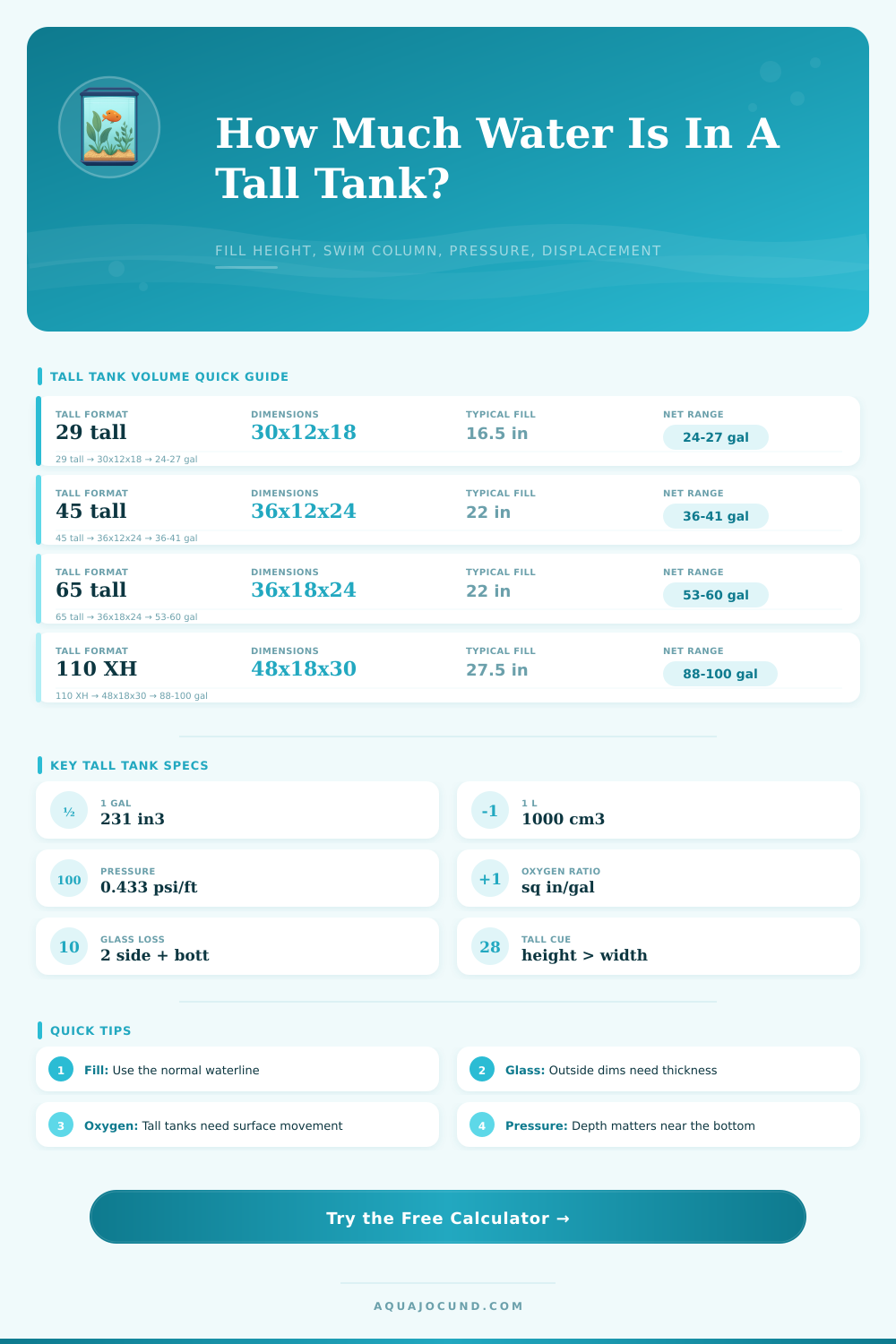
| 29 tall | 30 x 12 x 18 in / 76 x 30 x 46 cm | About 29 gal / 110 L | Longer length helps oxygen surface ratio compared with columns. |
| 45 tall | 36 x 12 x 24 in / 91 x 30 x 61 cm | About 45 gal / 170 L | Good example where fill height and pressure matter. |
| 65 tall | 36 x 18 x 24 in / 91 x 46 x 61 cm | About 65 gal / 246 L | Wider front-to-back depth improves gas exchange per gallon. |
| 110 extra high | 48 x 18 x 30 in / 122 x 46 x 76 cm | About 110 gal / 416 L | Deep water column makes pressure and access planning important. |
| Glass thickness | Approx metric | Internal footprint loss | Best use in calculator |
|---|---|---|---|
| 1/4 in | 6 mm | 0.5 in from length and width | Common for smaller framed tall aquariums. |
| 3/8 in | 10 mm | 0.75 in from length and width | Useful default for mid-size tall rimless estimates. |
| 1/2 in | 12 mm | 1.0 in from length and width | Large tall tanks and extra high displays. |
| 5/8 in | 16 mm | 1.25 in from length and width | Very deep custom builds; verify actual panel schedule. |
| Aquascape profile | Default allowance | Typical tall tank contents | Manual input note |
|---|---|---|---|
| Bare or equipment only | 0% | Heater, intake, riser, sponge filter | Add measured displacement only when known. |
| Tall planted layout | 6% | Deep substrate slope, vertical wood, plant mass | Good default for aquascapes that keep open swim lanes. |
| Stone column layout | 9% | Stacked stone or steep hardscape ridge | Increase known displacement for dense rock stacks. |
| Tall reef rockwork | 10% | Porous rock towers, returns, overflow box | Use net water for dosing and salinity adjustments. |
| Heavy hardscape stack | 14% | Dense vertical stone, large driftwood root | Bucket displacement gives the best result. |
| Metric to watch | Low range | Comfortable range | Why it matters in tall tanks |
|---|---|---|---|
| Surface ratio | Under 10 sq in/gal | 12-18 sq in/gal | Tall tanks gain volume faster than surface area. |
| Water pressure | Under 0.6 psi | 0.6-1.2 psi | Higher fill depth increases stress near the bottom panel. |
| Usable swim height | Under 70% of fill | 75-90% of fill | Deep substrate and tall hardscape reduce open water column. |
| Aquascape allowance | 0-5% | 6-12% | Vertical layouts can hide a meaningful volume deduction. |
It is a tall tank. It has sleek profile. Roommates will be impressed by your design choice. Fish will swim in deep water where they can be admired. But what about all the engineering challenges related to this very structure?
Physics change when you go from a wide tank to a tall one. The deeper you go, the more the pressure increase. And total volume relative to surface area decreases. It’s almost like magic…until it comes time to fill up the tank and you have no idea how much water you just added.
Why Tall Fish Tanks Are Harder to Keep
All you have to do is plug in your numbers and the calculator on this page does the rest. The calculator handle the math once you plug in your dimensions, so you don’t have to guess about displacement or glass thickness. It will also prevent you from running out of room later on.
This leads me to my second point. Don’t trust the size listed by the manufacturer. A 45-gallon tank will not hold 45 gallons of water. Glass isn’t nothing. It takes up space. If you’re buying a rimless build, there’s a good chance they’re using very thick panels. The panels is as wide as half an inch or even wider. All that thickness eats away at your internal footprint on every side. Width goes bye-bye. Length goes bye-bye. Bottom panel eat into your height. Outside versus inside measurements makes a huge difference when it comes to your heater fitting or running out of substrate midway through.
Finally, there’s the problem with the water line. You don’t fill a tank to the rim because you want some freeboard to prevent splashing and allow for equipment. That inch of freeboard will cost you half a gallon in a short tank and two or three gallons in a tall tank. That’s the sneaky part. Your tank is still visually very full but you’ve lost a big chunk of its water mass. That makes a difference when it comes to dosing medications and keeping parameters stable. The fewer gallons of water there are, the less stable they will be against changes in temp and pH.
The other factor is depth. With depth comes water pressure. Water press on each square inch of glass it covers. That’s weight. And that weight presses down on all of the seams and the bottom panel. At twenty inches deep, you may not feel it. But at thirty or forty, it turns into a structural discussion. In many cases, taller tanks will be made from thicker glass then what you’d expect for their volume if the tank were wider. A normal long tank would usually only need three-eighths-inch glass, but this one needs half-inch glass because it is so tall. It’s not overengineered, physics ensures that your floor stays dry.
The same holds true for vertical profiles. Oxygen exchange is poor. Where does gas occur? On the surface, not down below. Does a narrow tank with a lot of height have as much surface area to breathe into as a wide one? Nope. Not by a long shot. And the calculator keeps track of oxygen surface ratio so you know how close you’re cutting things. If it’s low, you’ve got some work to do. Air stones, powerheads, and overflows becomes functional instead of just being decoration. Without them, you’ll have a stagnant zone at the bottom of your beautiful vertical column. Your oxygen will starve while waste gathers there.
The other factor in the equation comes from substrate and decor. Driftwood, rocks, etc all displace some water as well. Deep sand beds look super cool, but they also displaces a lot of water. This calculator allows you to calculate how much your hardscape displaces so you can accurately account for your net volume. You might think you’ve got forty gallons but after accounting for the hardscape, you actualy only have thirty-five. Those five gallons make a difference if you’re trying to dose nutrients or figure out what size biofiltration you need.
A reference table on the page shows how quickly the net volume changes from nominal ratings as height increases. So measure twice to avoid error. Cut once. Respect pressure limits. And subtract for proper glass thickness. What appears as 40g may actualy be 30g. Know what to expect by using the reference table. The math must support the dream, else it won’t be worth the look!