Surface Area Stocking Limit Calculator
Estimate a conservative fish biomass limit from tank length, width, open water surface, oxygen exchange, temperature, filtration, aeration, fish size, and safety margin.
Surface area stocking snapshot
Results update from surface area, fish biomass, oxygen exchange, temperature, filtration, and safety margin.
| Exchange class | Multiplier | Typical setup | Stocking note |
|---|---|---|---|
| Still / lidded surface | 0.68x | Quiet tank, glass lid, weak ripple | Use conservative biomass and dawn checks. |
| Light ripple | 0.86x | Small filter ripple or light sponge flow | Good for light nano or shrimp loads. |
| Normal filter ripple | 1.00x | Typical hang-on-back, canister return, or internal filter | Baseline aquarium planning class. |
| Strong ripple / spray bar | 1.18x | Visible surface movement across most of the tank | More exchange, but not a license to ignore waste. |
| Overflow, sump, or waterfall | 1.28x | Weir, sump drop, pond spillway, or wet-dry movement | Strong oxygen support with good circulation. |
| Protein skimmer / high exchange | 1.34x | Marine skimmer or heavy gas exchange system | Often oxygen rich, still limited by behavior and nutrients. |
| Fish profile | Adult length | Typical mass | Demand factor | Use case |
|---|---|---|---|---|
| Nano fish / shrimp | 0.75-1.25 in / 2-3 cm | 0.4-1.0 g | 0.82x | Rasboras, small tetras, shrimp colonies. |
| Community tropical fish | 1.5-2.5 in / 4-6 cm | 2-5 g | 1.00x | Typical peaceful mixed freshwater tanks. |
| Active schooling fish | 2-4 in / 5-10 cm | 4-12 g | 1.15x | Danios, barbs, rainbows, fast swimmers. |
| Cichlid / territorial fish | 3-6 in / 8-15 cm | 8-35 g | 1.28x | Behavior and oxygen demand both reduce headroom. |
| Goldfish or koi | 4-10 in / 10-25 cm | 20-150 g | 1.45x | Messy, oxygen-hungry fish with large waste load. |
| Marine reef fish | 2-5 in / 5-13 cm | 4-30 g | 1.12x | Usually supported by skimming and sump exchange. |
| Condition | Calculator effect | Why it matters | Planning response |
|---|---|---|---|
| 64-72°F / 18-22°C | Small positive oxygen reserve | Cool water holds more dissolved oxygen. | Still confirm species temperature needs. |
| 73-79°F / 23-26°C | Baseline range | Common community aquarium temperature band. | Use the regular safety margin. |
| 80-84°F / 27-29°C | Moderate reduction | Warm water holds less oxygen while fish metabolism rises. | Boost aeration and reduce margin pressure. |
| 85°F+ / 29°C+ | Strong reduction | Discus, quarantine, and heat-wave tanks have less reserve. | Use low biomass unless measured DO is strong. |
| Covered or plant-choked top | Surface factor below 1.00x | Open area, films, and floating plants change gas exchange. | Count only actively rippled open water. |
| Tank | Top dimensions | Open area | Approx baseline biomass | Surface-area note |
|---|---|---|---|---|
| 5 gal standard | 16 x 8 in / 41 x 20 cm | 128 sq in / 826 sq cm | 8 g after 25% margin | Single betta or tiny group planning. |
| 10 gal standard | 20 x 10 in / 51 x 25 cm | 200 sq in / 1,290 sq cm | 13 g after 25% margin | Short but useful open top for small fish. |
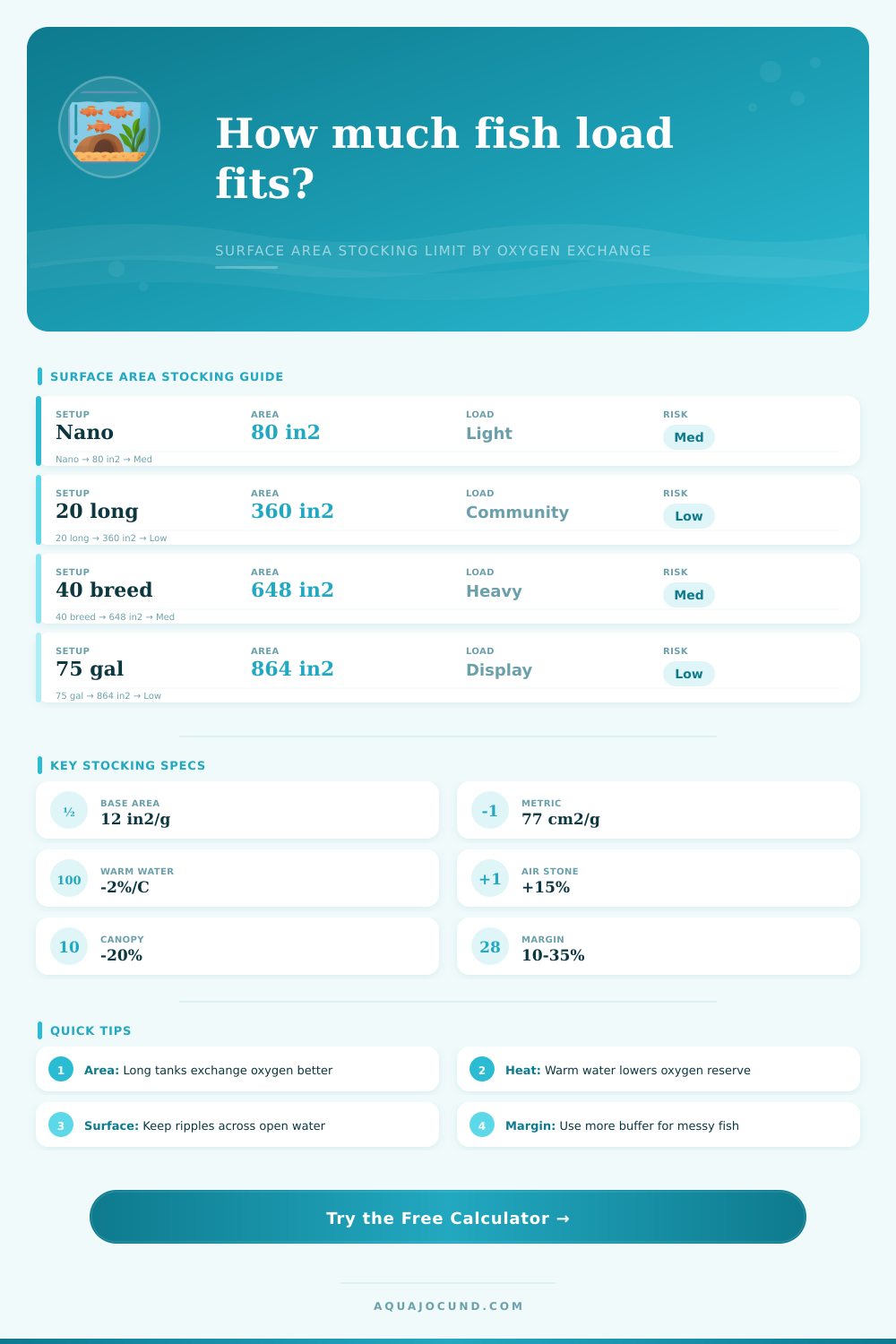
| 20 gal long | 30 x 12 in / 76 x 30 cm | 360 sq in / 2,323 sq cm | 23 g after 25% margin | Better oxygen footprint than tall tanks of similar volume. |
| 40 breeder | 36 x 18 in / 91 x 46 cm | 648 sq in / 4,181 sq cm | 41 g after 25% margin | Wide footprint supports more stable exchange. |
| 75 gal standard | 48 x 18 in / 122 x 46 cm | 864 sq in / 5,574 sq cm | 54 g after 25% margin | Strong display footprint with good ripple. |
| 125 gal long | 72 x 18 in / 183 x 46 cm | 1,296 sq in / 8,361 sq cm | 81 g after 25% margin | Long run helps distribute oxygen exchange. |
People have been taught to view an aquarium as the number on label. They buy fish tanks like cars, measured in gallons. Big numbers equal more fish. This is false. The capacity of any tank do not depend on how many gallons you put into it. How big the opening at the top are determines how many fish you can keep safely in that tank.
And fish don’t breathe from the depths of the water. They breathe from the surface. They breathe from the surface. The surface area between air and water limits all other considerations related to stocking.
Why Surface Area Matters More Than Tank Size
You only need to know your condition and dimensions. The calculator will do the rest for you. You do not need to try to remember conversions or coefficients.
The theory begins with a basic premise, how many square inches of surface area can support what amount of biological mass? That’s the base. But it’s here where details of your own system either support or eat away at that assumption.
Temperature is a big factor. Warm water has fewer dissolved oxygen particles then cool water. That means as days gets warmer in the heat of the summer, your oxygen reserve will fall faster as fish use more oxygen and metabolize quicker. It happens gradually so you’re not always aware that it’s happening…until it’s too late. By decreasing the safe limit as you dial up the temp, the tool reflects the fact that a hot tank can be a biological pressure cooker.
You also need to consider movement. A dead calm surface is basically a closed lid, which means there’s no way for gases move across the barrier except through a stagnant boundary layer that resists gas exchange. To overcome this, you want to introduce some ripple to shatter that film. A gentle return line will just barely disturb the surface to allow oxygen entry, but an overflow system or a spray bar add stronger agitation and drives that limit even further up.
Since respiration happen at the interface, refreshing that interface more often makes its surface area do much more work than it seems to. It’s not all about getting water moving around; it’s about constantly refreshing that very layer. The chart on the page does a good job laying this out with a reference table showing what various levels of agitation mean in terms of multipliers against your safe load.
Geometric shapes also matter, a lot, and not just how much water you can fit in them; a tall skinny tank (a narrow footprint compared to its volume) hold lots of water but is a poor oxygen/waste “trap” because it has very little surface area for gas exchange compared to the actual volume of water. The actual volume of water. Long shallow ones have better exchange since their surface area is spread out rather than being concentrated into one end. Even the shape of the front makes a slight difference. Bow-fronts distort the usable tank width, and corner or hexagonal shapes looks less good compared to how efficient they are. These little geometric penalties really start to add up when your system’s on the edge.
Then there’s the matter of what lives in the water. A single large goldfish or cichlid produce much more biological load than a school of small tetras, which creates not just greater amounts of ammonia (which indirectly stresses the system) but also a need for stronger filtration support. Even if the total weight appears comparable on paper, activeswimmers use up more oxygen and messier eaters generates more ammonia. To normalize this variable, the calculator asks for an average biomass; allowing you to compare, say, a tank full of medium-sized community fish to one full of only shrimp on equal terms.
Nature happens. Equipment breaks. Therefore, you should of need a safety margin; you cannot compromise on this front. Heatwaves and power outages causes temperatures to shoot up. That’s why we leave 25% of our calculated capacity empty as a cushion for such normal variances. And this becomes the buffer between having a stable ecosystem vs. This creates an emergency situation that requires water changes. Just because the numbers say you can max it out doesn’t mean you should.
To sum up, it’s all about surface area. You can have the tank cycling like a champ and have the greatest filter ever made. However, if the surface area to support what lives in it isn’t large enough, it won’t work. Look at your aquarium from above, not how deep it is, since that’s realy where the limitations lie. Plan the surface area first and the rest (volume) will follow.