💧 Sump Section Volume Calculator
Size skimmer, refugium, and return chambers with freeboard, backflow reserve, usable gallons, and evaporation tolerance.
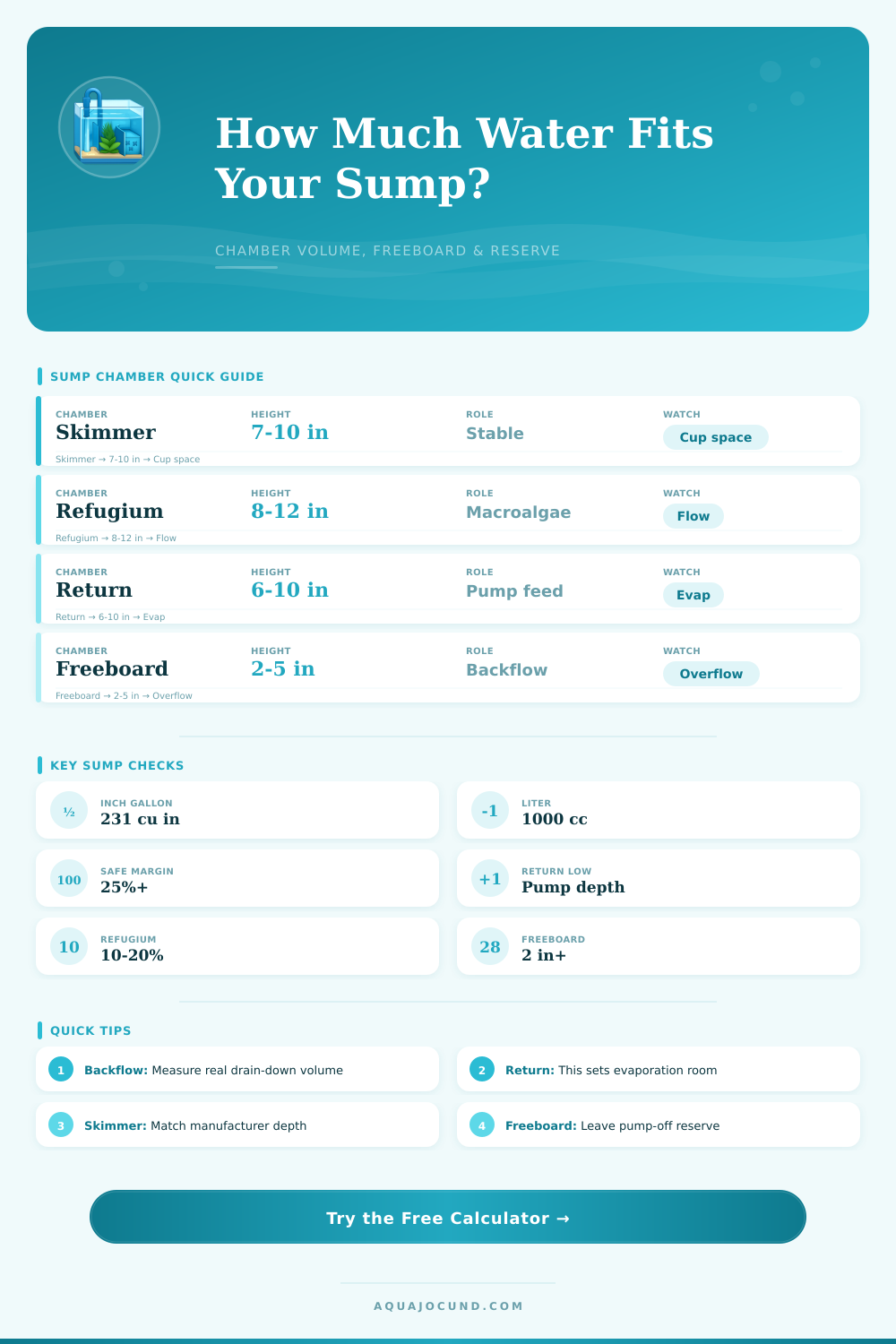
| Chamber | Common Operating Height | Main Constraint | Volume Note |
|---|---|---|---|
| Skimmer | 7-10 in / 18-25 cm | Manufacturer depth | Keep level stable |
| Refugium | 8-12 in / 20-30 cm | Light and flow | Often 10-20% display |
| Return | 6-10 in / 15-25 cm | Pump submersion | Controls evaporation room |
| Freeboard | 2-5 in / 5-13 cm | Drain-down reserve | Should exceed backflow |
| Sump Shell | Inside Dimensions | Nominal Capacity | Typical Running Volume |
|---|---|---|---|
| 10 gal tank | 20 x 10 x 12 in | 10 gal | 5-7 gal |
| 20 long | 30 x 12 x 12 in | 20 gal | 10-14 gal |
| 29 gal tank | 30 x 12 x 18 in | 29 gal | 14-20 gal |
| 40 breeder | 36 x 18 x 16 in | 40 gal | 22-30 gal |
| 75 gal tank | 48 x 18 x 21 in | 75 gal | 40-55 gal |
| Drain-Down Source | Formula | Example | Reserve Impact |
|---|---|---|---|
| Display water drop | L x W x drop / 231 | 48 x 18 x 1 in | 3.7 gal |
| Return plumbing | Pipe volume x length | 3/4 in x 6 ft | 0.17 gal |
| Overflow box | Box area x drop | 10 x 4 x 8 in | 1.4 gal |
| Safety margin | Backflow x margin | 4 gal x 1.25 | 5 gal target |
A sump is an container that holds the water for your reef tank. The sump is typicaly divided into three chamber. Each of these chambers has a specific function within the sump, but each require some amount of space within the sump itself.
Thus, each of the functions within the sump compete for the same amount of space within the sump. If not sized correctly, the sump may overflow or the return pump may run without enough water to accomplish it’s tasks. Within the sump, each of the chambers requires a certain amount of space to accomplish its tasks.
How to Size a Sump for Your Reef Tank
For instance, the skimmer chamber must have enough depth for the skimmer to function at the proper level within the sump. Furthermore, the chamber must have enough space within it to allow the water level within the sump to fall into the collection cup within the skimmer if the power stop. The refugium chamber must have enough space within it to allow the macroalgae to grow into the chamber.
Furthermore, there must be enough space within the refugium for the macroalgae not to obstruct the water movement within the sump. Finally, the return pump chamber must have enough depth for the return pump to always be submerged within the sump, even if water evaporate from the sump. Additionally, the return chamber must have enough space within it to hold the water that return from the display tank if the power fails.
Thus, dividing the sump into three equal section of space is an ineffective way to determine the required space for each of these chambers. One method of calculating the proper size for each of the chambers is to use a calculator that estimates the size of each of the chambers. You must enter each of the dimensions of the chambers into the calculator, as well as the volume of the backflow that occurs from the plumbing and the display tank.
Based off these entries into the calculator, the calculator will indicate whether the sump has enough space within it for the water that return from the display tank when the return pump is turned off. Thus, the calculator can help assure that the sump has enough capacity to handle the water movement from the reef tank when the return pump stops. Many reef owners do not realize the amount of water that returns to the sump when the return pump stops.
For instance, if the display tank is four feet in height and the water level within the tank drops one inch, several gallon of water will move into the sump. Furthermore, additional water exist within the overflow and return plumbing that can also be lost if the power is lost. Thus, should the reef tank and plumbing lose five or six gallons of water, but the sump only has four gallon of space for that return water, the sump will overflow.
The user can adjust the safety factor within the calculator from a small percentage, such as 10%, to a much larger percentage, such as 50%. The larger the percentage, the more water that can return to the sump; however, it may indicate that there is a large amount of backflow in the reef system or in the plumbing. Furthermore, the amount of water that evaporates from the sump while the sump is in operation must also be considered.
The return chamber of the sump is the section of the sump that loses the most water to evaporation. The deeper the return chamber and the larger the surface area of the sumps return chamber, the more water that will evaporate from the sump. Thus, the calculator also asks for the depth and the surface area of the return chamber so that the sump owner can have an estimate of how long it will take for the return chamber to lose all of its buffer water.
Should the return chamber be too shallow, it will lose its buffer quick on warm days. Should the return chamber be deep, the return sump will last longer between buffer additions but will have less buffer for backflow within the sump. The size of the refugium chamber is also important to consider.
Many who create reef tanks aim to make the refugium chamber 10% to 20% of the total volume of the display tank. The calculator also permits adjustments to the volume of the refugium tank in case the owner also has a predator tank, a mixed reef tank, or an SPS tank. Additionally, the calculator will indicate if the volume of the refugium tank is too small or too large in comparison to the total size of the display tank.
One final way to ensure that the calculated dimensions of each of the chambers will provide the proper amount of space for the function of each of those chambers is to manual test the calculations. One way to do this is to fill the sump with freshwater and turn off the return pump. The water level within the sump will rise to a certain height.
This measurement is the actual backflow volume of the reef tank. This number can then be entered into the calculator. By entering the actual backflow into the calculator, the calculations can become even more accurately.
Thus, by using both the calculations from the calculator and the manual measurement of the backflow of the system, the sump can be created to ensure the proper function of each of the chambers within the sump, the return pump will always have enough water to function, and the sump will not overflow when the return pump is turned off. You should of checked the volume first.