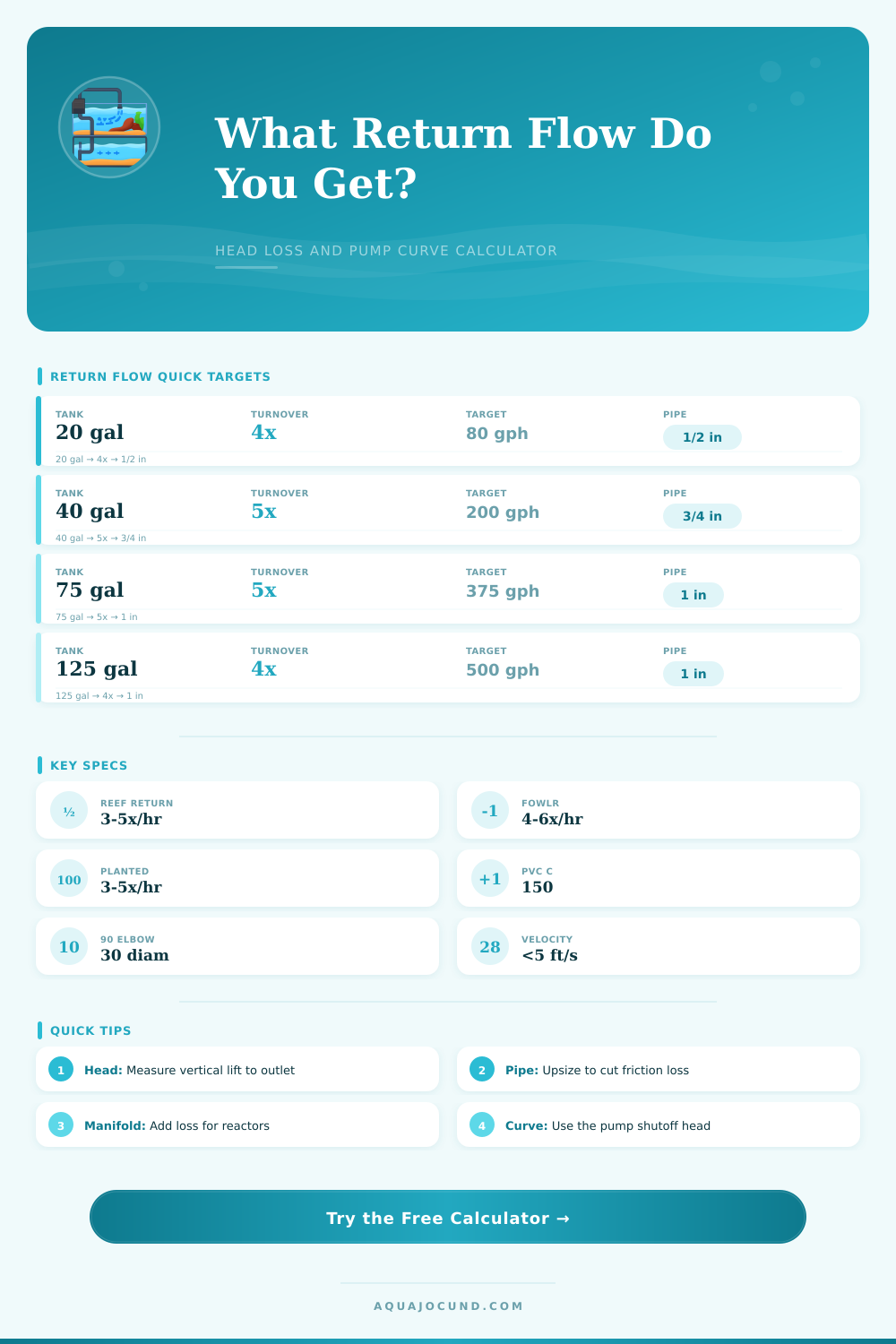
🌊 Sump Return Flow Rate Calculator
Estimate target turnover, head loss, pump curve derate, and actual return flow.
| System Type | Display Volume | Turnover Target | Return Target | Common Pipe |
|---|---|---|---|---|
| Low-flow reef sump | 40-75 gal | 3-4x/hr | 120-300 gph | 3/4-1 in |
| Mixed reef sump | 75-125 gal | 4-5x/hr | 300-625 gph | 1 in |
| Fish-only sump | 75-180 gal | 4-6x/hr | 300-1080 gph | 1-1/2 in |
| Planted sump | 40-125 gal | 3-5x/hr | 120-625 gph | 3/4-1 in |
| Frag system | 50-100 gal | 5-8x/hr | 250-800 gph | 1-1/2 in |
| Large display | 180+ gal | 3-5x/hr | 540+ gph | 1-1/2-2 in |
| Tank | Dimensions | Volume | 4x Return | 5x Return |
|---|---|---|---|---|
| 20 Long | 30 x 12 x 12 in / 76 x 30 x 30 cm | 19 gal / 72 L | 76 gph / 288 lph | 95 gph / 360 lph |
| 40 Breeder | 36 x 18 x 16 in / 91 x 46 x 41 cm | 45 gal / 170 L | 180 gph / 681 lph | 225 gph / 852 lph |
| 55 Gallon | 48 x 13 x 21 in / 122 x 33 x 53 cm | 57 gal / 216 L | 228 gph / 863 lph | 285 gph / 1079 lph |
| 75 Gallon | 48 x 18 x 21 in / 122 x 46 x 53 cm | 79 gal / 299 L | 316 gph / 1196 lph | 395 gph / 1495 lph |
| 90 Gallon | 48 x 18 x 24 in / 122 x 46 x 61 cm | 90 gal / 341 L | 360 gph / 1363 lph | 450 gph / 1703 lph |
| 125 Gallon | 72 x 18 x 22 in / 183 x 46 x 56 cm | 123 gal / 466 L | 492 gph / 1863 lph | 615 gph / 2328 lph |
| Item | Equivalent Length Used | Why It Matters | Calculator Field |
|---|---|---|---|
| Standard 90° elbow | 30 pipe diameters | Adds noticeable friction in small pipe | 90° elbows |
| Standard 45° elbow | 16 pipe diameters | Lower loss than a sharp 90° turn | 45° elbows |
| Ball valve / union | 45 pipe diameters | Restriction plus internal turbulence | Valves / unions |
| Manifold branch | Percent flow loss | Reactors and UV units steal flow | Manifold loss |
| Vertical lift | Actual height in feet or meters | Main part of total dynamic head | Head height |
A sump system require an efficient return flow to effectively cycle the water within the aquarium display tanks. An efficient return flow is necessary for ensuring that the water level within the display tank dont drop. Many peoples pay significant attention to the pump when setting up there sump systems.
However, the efficiency of the sump system depend on the amount of water that can make its way from the sump system to the display tank. The amount of water that a pump can move is often less than the flow rate that the manufacturer is advertise for that particular pump due to the effect that friction, height, and the various fittings along the sump system can have upon the movement of the water. In order to determine the necessary flow rate for your sump system, you can use the sump flow calculator.
Calculate the Right Pump and Pipe Size for Your Sump
This calculator allow you for entering the dimensions of your display tank and the desired turnover rate for that tank. The calculator will use these values to calculate the result for you. In addition to these fields, you will also need to enter the head height for your system, the diameter of the pipes that will be used within the sump system, and the number of elbows and valves that you will have established in your system.
Each vertical foot of head height that you have within your sump system will reduce the pressure of the water within your system. Each elbow within your sump system will create turbulence in the water. Additionally, manifolds that you establish in your sump system in order to provide water to your reactors or UV systems will reduce the amount of water that is available for your display tank.
If you do not account for these factor, you may find that you are forced to purchase a pump that may appear suitable for your sump system, but which will not be able to provide the amount of water that is necessary once it is established into your sump system. Pipe size is one of the most significant factor in establishing an efficient sump system. The size of the pipes within your sump system will have a direct effect upon the movement of the water through your sump system.
A half inch pipe may be an appropriate size to use within a small nano sump system. However, the same size of pipe will restrict the amount of water that can move through a seventy-five gallon sump system. In most cases, if the sump system and display tank are correctly sized, it is possible to increase the size of the pipes by one size to improve the movement of the water through the sump system.
One way of determining if the size of the pipes is appropriate is through the velocity reading that the calculator provides for the sump system. The velocity reading indicates the rate at which the water will be moving through the sump system. If the velocity reading is above five feet per second, it indicates that the water will be moving fast enough to create noise within the system, but that the desired turnover rate has not been achieved.
If the velocity is high but the turnover rate is low, it is recommended that the return pipe be enlarged. Depending upon the type of sump system that you are creating for your aquarium display, different target turnover rates will need to be established. For instance, reference the turnover rate tables to determine the proper turnover rate for your aquarium.
For reef tanks, the turnover rate should be between four and five times per hour. However, for tanks that contain only fish and decorations (fish-only tanks) or tanks that contain both fish and frag plants, the turnover rate will need to be higher. One of the main use of the turnover rate calculator is to provide a turnover target that you will compare to the actual output of the sump systems water return.
If the actual output is significantly less than the target turnover rate, you can use the breakdown section of the calculator to determine the reasons for the lost water pressure. Based off the information provided in the breakdown section, you may be able to determine whether or not your system needs to be adjusted for efficiency. Many people make mistake when entering the head height parameter for the calculator.
These errors in measurement will result in incorrect calculations of the required parameters for the sump system. One of the most common errors is measuring the head height from the floor of the display tank. Instead, you should measure the head height from the water line within the sump system.
Additionally, the length of the last vertical pipe section that exists after the pump should be included in the measurement of head height. Finally, another error that many people make is in the assumption of the performance of the pump. The presence of debris within the pump, or the possibility that the pre-filter is dirty, will reduce the amount of water that the pump can move.
In order to account for this potential issue, the calculator provides the pump derate field. This field ensure that you are not assuming that the pump will perform according to the numbers that are published by the pump manufacturer. The output from the calculator will provide you with two specific values.
These are the turnover goal and the pipe velocity. These two figures will help you to determine the adjustments that must be made to your sump system. If the water flow within the system is too low but the pipe velocity is high, it is recommended that you increase the size of the pipes within the system.
If the water flow is high but the pipe velocity is low, it is possible to reduce the speed of the water within the sump system by introducing a gate valve into the system. The goal of your sump system is to provide a stable and quiet return flow to the aquarium. A stable and quiet return flow will ensure that the display tank is moving at the rate that your livestock and the sump system filtration require.
When you reach the point where you have achieved your target turnover rate and your pipe velocity is within a comfortable range, you can be sure that your sump systems plumbing is functioning correct and that your pump is not having to work too hard to accomplish its tasks.