Sump Return Pump Head Loss Calculator
Estimate real return flow after vertical lift, pipe friction, elbows, valves, unions, outlets, pipe material, and target sump turnover.
📏Tank volume and return target
This is display-to-sump flow, not powerhead or wavemaker circulation.
🚰Pump and return plumbing
Use the maximum head from the pump curve when available.
Use measured inside diameter if barbs, tubing, or adapters narrow the line.
Counts ball, gate, or true-union valves left mostly open.
Calculation Breakdown
🔧Pipe material roughness guide
📊Return plumbing reference tables
| Pipe inside diameter | Best flow range | High flow warning | Typical return use |
|---|---|---|---|
| 1/2 in / 13 mm | 60 to 180 gph / 227 to 681 L/h | Above 250 gph gets restrictive fast | Nano or compact AIO sump |
| 3/4 in / 19 mm | 150 to 450 gph / 568 to 1703 L/h | Elbows matter above 500 gph | 20 to 55 gallon returns |
| 1 in / 25 mm | 300 to 800 gph / 1136 to 3028 L/h | Good balance for many reef tanks | 55 to 100 gallon systems |
| 1 1/4 in / 32 mm | 550 to 1200 gph / 2082 to 4542 L/h | Use gentle fittings for manifolds | Large displays and split returns |
| 1 1/2 in / 38 mm | 800 to 1800 gph / 3028 to 6814 L/h | Outlet nozzles often become the limit | 125 gallon and larger systems |
| Fitting or restriction | Equivalent length rule | Loss severity | Calculator input |
|---|---|---|---|
| Long sweep 90 degree elbow | About 20 pipe diameters | Moderate | Count as one 90 elbow |
| Standard 90 degree elbow | About 30 pipe diameters | High | Count as one 90 elbow |
| 45 degree elbow | About 16 pipe diameters | Low to moderate | Count each bend |
| Fully open ball or gate valve | About 8 pipe diameters | Low when open | Open valves field |
| Union or barb adapter | About 6 pipe diameters | Low to moderate | Unions or adapters field |
| Swing check valve | About 100 pipe diameters | Very high | Check valves field |
| Tee branch or manifold outlet | About 60 pipe diameters | High | Tee branches field |
| Common tank size | Dimensions | Quiet sump target | Common return line |
|---|---|---|---|
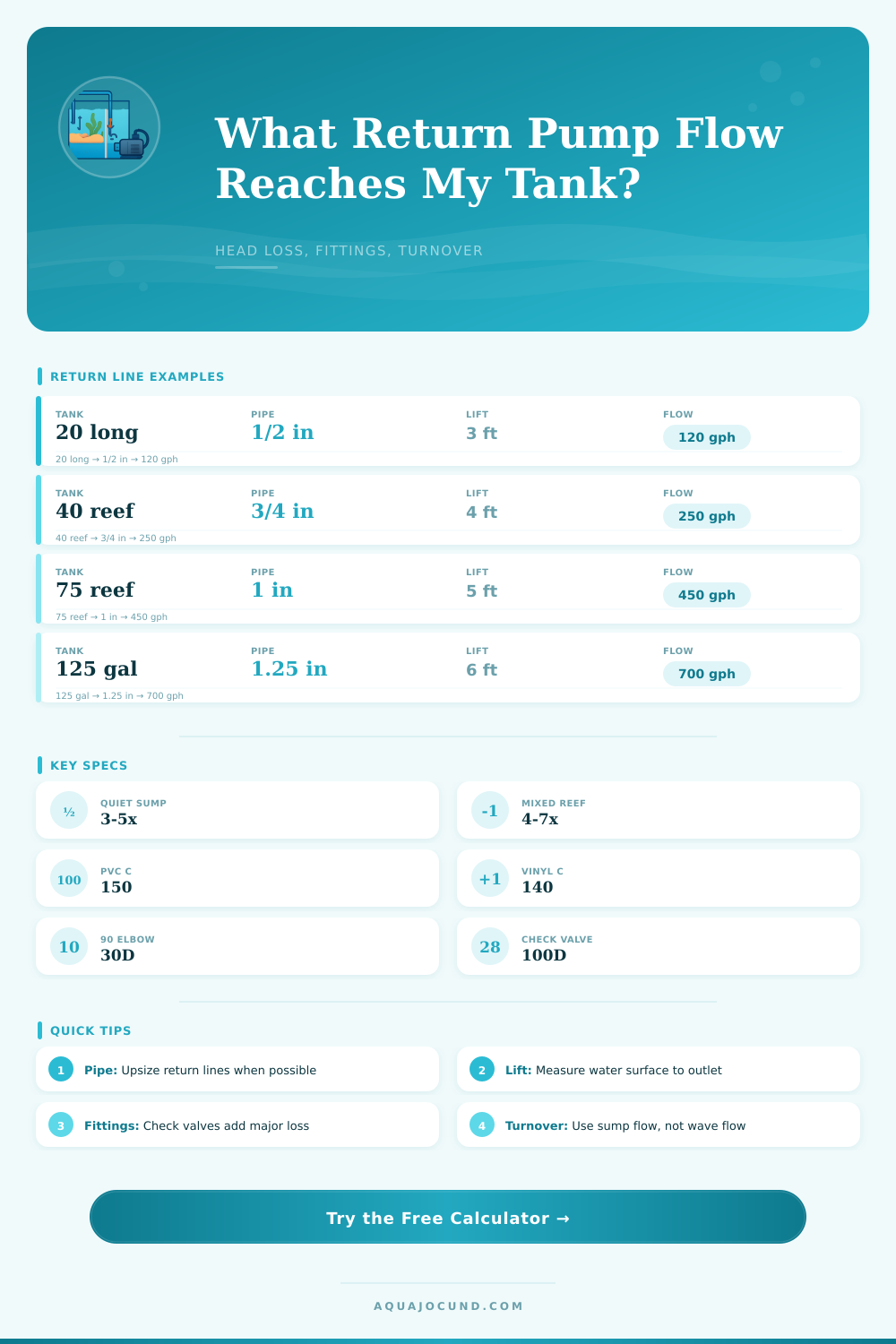
| 20 long | 30 x 12 x 12 in / 76 x 30 x 30 cm | 80 to 160 gph / 303 to 606 L/h | 1/2 to 3/4 in |
| 40 breeder | 36 x 18 x 16 in / 91 x 46 x 41 cm | 160 to 280 gph / 606 to 1060 L/h | 3/4 in |
| 75 gallon | 48 x 18 x 21 in / 122 x 46 x 53 cm | 300 to 525 gph / 1136 to 1987 L/h | 3/4 to 1 in |
| 90 gallon | 48 x 18 x 24 in / 122 x 46 x 61 cm | 360 to 630 gph / 1363 to 2385 L/h | 1 in |
| 125 gallon | 72 x 18 x 21 in / 183 x 46 x 53 cm | 500 to 875 gph / 1893 to 3312 L/h | 1 to 1 1/4 in |
| Return layout | Outlet count | Turnover range | Head loss note |
|---|---|---|---|
| Simple single nozzle | 1 | 3x to 5x per hour | Lowest fitting loss and easiest to predict |
| Dual loc-line split | 2 | 4x to 7x per hour | Splitters and small nozzles add outlet loss |
| Return manifold | 2 to 5 | 3x to 6x per hour | Tee branches need a larger pump or larger pipe |
| Basement sump | 1 to 2 | 3x to 5x per hour | Vertical lift dominates total dynamic head |
| Large peninsula | 2 to 4 | 4x to 6x per hour | Long horizontal runs reward upsized plumbing |
💡Return pump calculation tips
You want good flow in your aquarium so you buy an eight hundred gallon per hour pump. It is installed neatly behind a cabinet with the tubing routed carefuly, and then you flip the switch. The tank barely ripples. Most hobbyist give up on their gear right there. Usually it’s not a bad pump. Your expectations are stopped by physics.
Electricity flows through copper wire but water doesn’t flow through plastic. Instead, it drags along every inch of pipe wall, fights around every elbow and loses pressure through every valve you bolt in to the system. Once you enter your own set of parameters on what’s possible given your plumbing, the rest are handled by the calculator (above). You no longer have to guess how much of that rated flow actualy returns to your fish.
Why Your Aquarium Pump Is Not Working Well
The process begins by specifying both volume of your tank(s) along with the desired turnover rate. Most tanks commonly uses four to six times their volume per hour. A typical reef tank require this much flow passing through the sump every hour. That’s not talking powerhead wave-making here, it’s about bulk movement to provide gas exchange and filtration. Three turnovers may be doable if you have a low bioload. If you’re housing corals requiring lots of oxygen exchange however then that figure becomes important.
Next is plumbing geometry. Static head are vertical lift. This means how far your outlet nozzle sits above your water level at the sump. Gravity doesn’t care who you are… That’s a foot of lost pressure potential no matter what kind of slick, streamlined pipes you use. Fittings create chaos; horizontal run length add friction. The table on the “equivalent lengths” page show this clearly. One simple ninety degree elbow in PVC pipe equals the resistance of several feet of straight pipe. That’s something people underestimate all the time.
The lever you’re pulling on is pipe diameter. Switching from half inch tubing to three quarter inch tubing may seem like a cosmetic tweak. It isn’t. At average aquarium flow rates, doubling the cross sectional area will dramatically reduce friction loss and velocity. That’s why most people needs larger tubing in their return line as their tank size increases. Sure, you’re also moving more volume. But you’re doing so without increased turbulence.
Another pitfall is check valves. These keeps water flowing one way (great if your sump drains during a power outage). However, at low flows, a swing check valve totally screws you over because it only opens fully after being forced to do so by pressure which adds huge amounts of head loss. The calculator figures in these factors. It includes the dynamic friction losses and the static lift of the system. It then add standard coefficients for fitting geometry and pipe roughness to calculate overall dynamic head. All that does is let you know where you’re actualy running on the pump curve.
Where do pumps gets their ratings? At zero head (no resistance whatsoever). So that’s basically a marketing number. Your real world has resistance. Getting your head around rated flow vs. Delivered flow prevents you from underperforming your layout, but also from overbuying pump. A little goes a long way
The material selection also have a subtler impact. New rigid PVC have smooth internal surfaces. Old vinyl tubing or ribbed hoses create more drag because they build up biofilm. It is a small thing. But if you’re trying to eke out a couple more gallons per hour, it matters. Clean lines save money on pumps down the road if you design your own system. The pump isn’t working so hard to push water around an obstructed path, so you pay less for electricity and wear.
So all told, plumbing is a game of budget, look, and water flow. Maybe you like how it looks to have a hidden return. That means you add some valves and maybe some bends behind that rock wall. Each one of these come at a cost: your flow. The tool lets you see this upfront so you don’t cut any pipe until you know what the cost will be.
After seeing how elbows and valves affect your pumps…you can make better decisions. You could of taken out a check valve? You have another safety net with an overflow. Do you shorten the run? Do you slope the pipe up a bit more? Little changes compound. And then water will remember each and every obstacle in its path. View your return as the path your water takes through your filtration system. Remove the obstacles, and the water flows naturaly. The math makes sense and the tank breathe right.