Sump Overflow Weir Length Calculator
Estimate the crest length, toothed-comb span, water level rise, and box fit needed for a quiet sump baffle or overflow chamber.
💧Flow and chamber target
Use measured return flow after head loss, manifold takeoffs, and pump setting.
This is the water depth above the spill crest during normal operation.
The drop from upstream chamber to downstream chamber before splashing becomes annoying.
🧮Comb, safety, and fit details
Use 2 only when there are two independent open rows at the same water level.
Used to flag whether the predicted rise leaves room below the sump rim or tray top.
Calculation Breakdown
⚙Weir style comparison
📊Reference tables
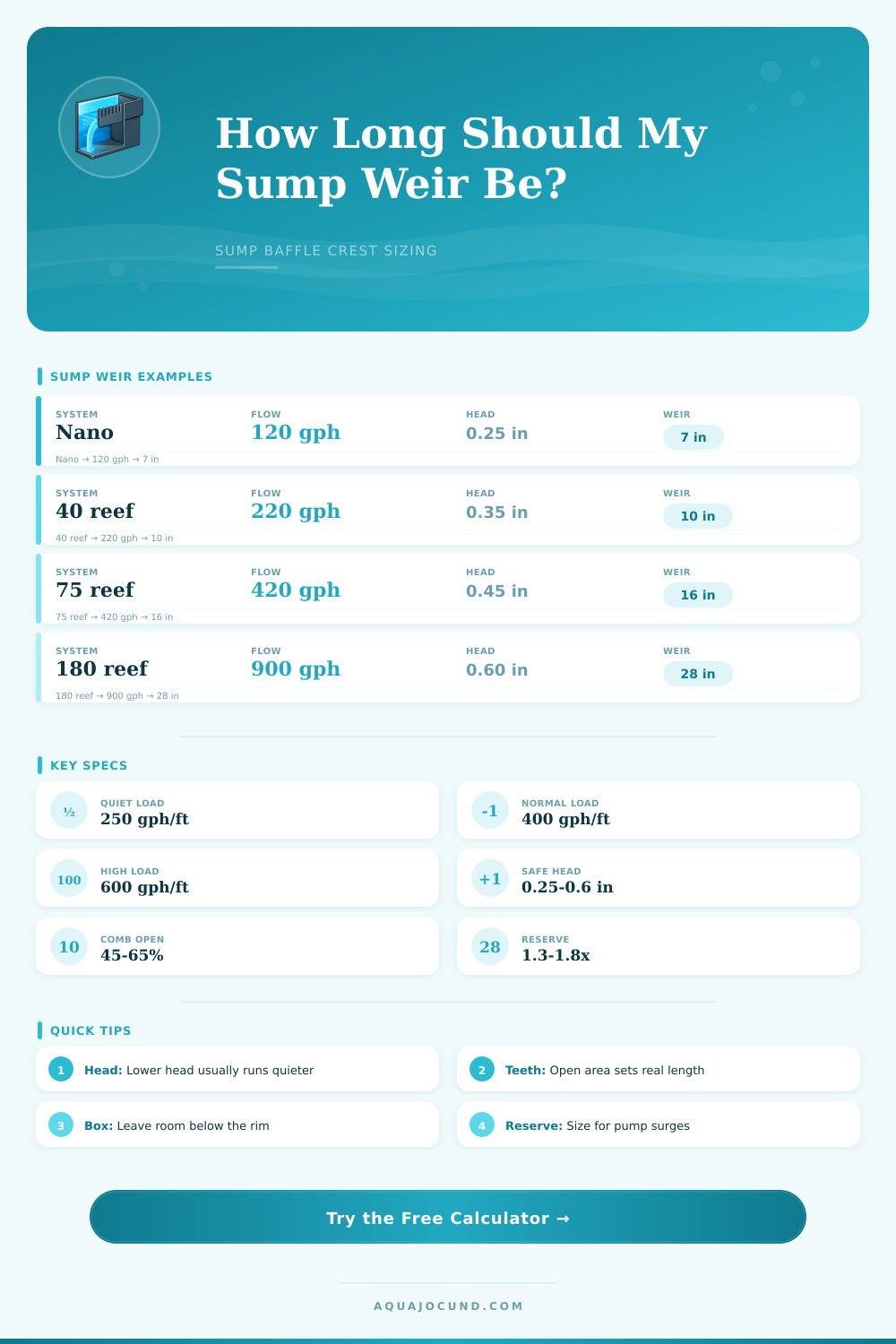
| Sump or display setup | Measured return flow | Typical quiet crest head | Starting physical span |
|---|---|---|---|
| 12 gallon AIO rear chamber | 80 to 140 gph / 303 to 530 L/h | 0.20 to 0.30 in / 5 to 8 mm | 5 to 8 in / 13 to 20 cm |
| 10 gallon refugium chamber | 90 to 180 gph / 341 to 681 L/h | 0.25 to 0.35 in / 6 to 9 mm | 7 to 10 in / 18 to 25 cm |
| 20 long sump under 40 breeder | 180 to 300 gph / 681 to 1136 L/h | 0.30 to 0.45 in / 8 to 11 mm | 9 to 14 in / 23 to 36 cm |
| 75 gallon reef return chamber | 300 to 500 gph / 1136 to 1893 L/h | 0.35 to 0.55 in / 9 to 14 mm | 14 to 20 in / 36 to 51 cm |
| 120 gallon skimmer sump | 450 to 700 gph / 1703 to 2650 L/h | 0.45 to 0.65 in / 11 to 17 mm | 18 to 26 in / 46 to 66 cm |
| 180 gallon dual drain sump | 700 to 1100 gph / 2650 to 4164 L/h | 0.50 to 0.75 in / 13 to 19 mm | 24 to 36 in / 61 to 91 cm |
| Crest head | Flow behavior | Best sump use | Watch point |
|---|---|---|---|
| 0.15 to 0.25 in / 4 to 6 mm | Very quiet sheet flow | Pod refugium, bedroom tanks | Needs long weir or low flow |
| 0.25 to 0.45 in / 6 to 11 mm | Quiet, stable overflow | Most reef and planted sumps | Keep teeth clean |
| 0.45 to 0.70 in / 11 to 18 mm | Strong flow with visible drawdown | Basement sumps and big returns | More splash at the drop |
| 0.70 to 1.00 in / 18 to 25 mm | High energy spill | Temporary or utility setups | Can pull air and microbubbles |
| Comb pattern | Open fraction | Cleaning behavior | Use in calculator |
|---|---|---|---|
| 1/8 in tooth, 1/8 in gap | 50% | Fine livestock protection, clogs sooner | 0.13 tooth and 0.13 gap |
| 1/8 in tooth, 3/16 in gap | 60% | Common acrylic overflow comb | 0.13 tooth and 0.19 gap |
| 1/4 in tooth, 1/4 in gap | 50% | Stiff but less effective crest | 0.25 tooth and 0.25 gap |
| Horizontal slot panel | 70 to 85% | Good if the slot is accessible | Choose slot weir style |
| Egg crate guard | 55 to 70% | Fast to remove and rinse | Choose egg crate guard |
| Linear flow target | Sound expectation | Suggested head range | Typical application |
|---|---|---|---|
| 150 to 250 gph/ft | Very quiet | 0.20 to 0.40 in | Living room sump, refugium |
| 250 to 400 gph/ft | Normal quiet aquarium | 0.30 to 0.55 in | Mixed reef sump baffles |
| 400 to 600 gph/ft | Audible but manageable | 0.45 to 0.75 in | High-flow return section |
| 600 to 800 gph/ft | Likely splash control needed | 0.60 to 1.00 in | Utility room, fish room rack |
💡Sump weir sizing tips
If you can hear the sump gurgling behind the cabinet, you’ve got a problem. That’s usually because the weir in the overflow isn’t large enough to do the job. The water stacks up and runs high.
So as your display tank run dangerously high while the return pump struggles to keep pace, it’s not broken. It’s a geometry issue waiting to happen. It’s not broken. It’s a geometry issue. It is waiting to become an issue.
How to Stop Your Sump from Gurgling
Aquarium sump physics are uncomplicated but uncompromising. Water will go downhill and you are telling it to go over a lip without drowning anything, such as a refuge area, or sucking in any air. A crest that is too low is no problem. It just backs water up. Too much crest, you waste precious chamber volume that could be holding equipment or good ol’ beneficial bacta.
To figure out the correct size for a weir, you must balance the head height (how high the water sits above the overflow edge as it drains) with the flow rate. The first choice for most hobbyists is what size return pump to use. Next they double their tank volume for turnover and ask why the sump resembles a waterfall. Why? They neglected to account for the true width of the opening where the water exits the chamber.
What seems like a long twelve inches on paper becomes cut down by half when you take some teeth out of it. Those teeth is solid acrylic that don’t allow water to pass, and so the practical spill width is much smaller than physical plastic part. Don’t mistake gross dimensions for the net open area. That’s the difference between physical span and effective crest length, and most people mess up here. They look at wide baffle and assume it has enough capacity, forgetting that the comb pattern actualy limits flow rather than helping it.
When you specify your desired flow target(s) along with the amount of headroom you have, the calculator will do the math for you. But the tool is also helpful if you understand what the numbers represent. For example, think in terms off flow per foot, which refers to the number of gallons per hour passing through each foot of weir.
When this number rises too high, the water sheet becomes noisy and turbulent. To keep the system quiet, you want a gentle sheet flow. You can do this by spreading the same volume over more length or by accepting a bit more pressure. Accepting higher head means creating more pressure, which mean more noise… It’s a tradeoff between size and silence.
For a living room setup, you’ll compromise baffle width to maintain a lower water level (calm). However, in a utility room or basement setup, you can be more generous with head height since nobody is going to try to read a book next to it. So again, it’s okay if it’s not exact, but it needs to be safe.
As the pumps ages, their output will change. As the filters get dirty, they’ll increase the pressure loss. Over time, algae will grow on surfaces, including the weir. A clean weir will move water very differently than one that has been blocked off by macroalgae or covered in biofilm. Always design for the worst case scenario, never for the best.
If your tank changes size or you decide to upgrade your livestock, you don’t want to suddenly have the water go rushing up to the top of the sump box because you adjusted your pump speed. The added buffer allows you some breathing room without having to stand there with some towels in hand.
As you can see from the reference table on the page, it shows some typical starting places depending on tank size. However, your local plumbing losses and your actual chamber dimensions may be different. Always verify that there is adequate freeboard beneath the rim when the predicted water rise occur. Don’t keep the normal operating level too near the top. Otherwise, you run the risk of spilling water all over your floor if the pumps fails or lose power before you notice.
Managing both pressure and volume with grace is what sump design is all about. Get the weir correct and everything else in the system flows easily. Respect the flow rate and keep the edges clear and you’ll never have to chase that gurgle again. Invisible competence is what you’re after, the water just goes where it needs to go without calling attention to itself at all.