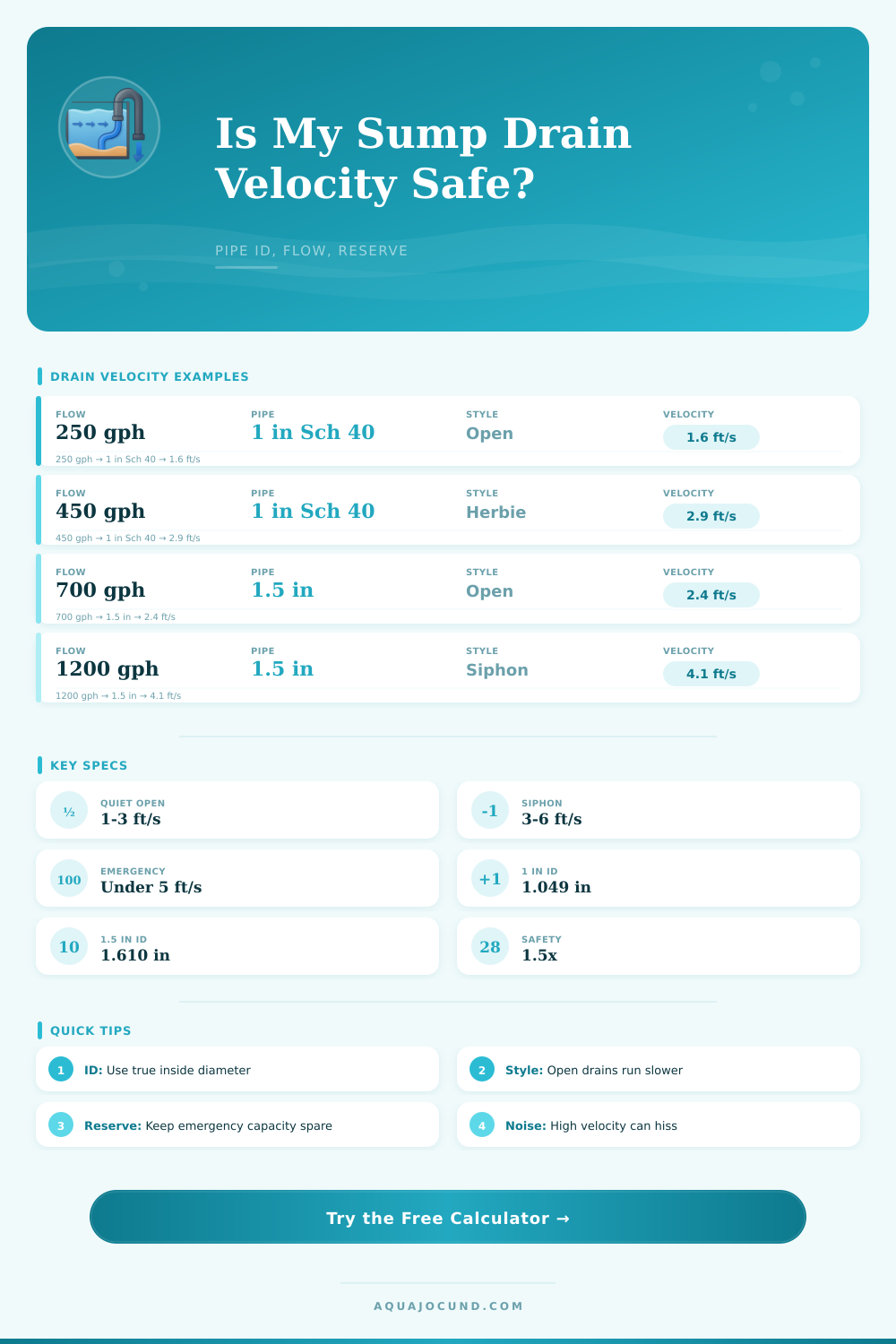
Sump Drain Pipe Velocity Calculator
Check sump drain speed from return flow, true pipe ID, schedule, drain style, vertical drop, fittings, safety reserve, and target velocity band.
💧Flow and pipe ID
Use measured return flow after head loss, not the pump box rating.
⚙Drain style, drop, and restrictions
Calculation breakdown
📊Pipe and drain quick grid
📘Reference tables
| Nominal size | Sch 40 ID | Sch 80 ID | Typical use |
|---|---|---|---|
| 3/4 in / 20 mm | 0.824 in / 20.9 mm | 0.742 in / 18.8 mm | Nano return or small drain |
| 1 in / 25 mm | 1.049 in / 26.6 mm | 0.957 in / 24.3 mm | Small to medium sump drain |
| 1 1/4 in / 32 mm | 1.380 in / 35.1 mm | 1.278 in / 32.5 mm | Quiet mid-size drain |
| 1 1/2 in / 40 mm | 1.610 in / 40.9 mm | 1.500 in / 38.1 mm | Common reef main drain |
| 2 in / 50 mm | 2.067 in / 52.5 mm | 1.939 in / 49.3 mm | Large display or emergency |
| 2 1/2 in / 63 mm | 2.469 in / 62.7 mm | 2.323 in / 59.0 mm | High-flow remote sump |
| 3 in / 75 mm | 3.068 in / 77.9 mm | 2.900 in / 73.7 mm | Very large shared drains |
| Drain style | Good velocity range | Planning capacity factor | Comparison note |
|---|---|---|---|
| Durso / air-mixed | 1.0 to 3.0 ft/s | 0.55 | Air and water share the pipe, so quiet capacity is lower. |
| Quiet open channel | 1.0 to 2.5 ft/s | 0.45 | Best when only a thin trickle goes down the open channel. |
| Open channel | 1.5 to 4.0 ft/s | 0.65 | Accepts more flow but gurgle risk rises with speed. |
| Herbie siphon | 3.0 to 6.0 ft/s | 0.95 | Quiet when tuned with a separate emergency line. |
| BeanAnimal siphon | 3.0 to 6.0 ft/s | 1.00 | Main siphon runs full while open and emergency pipes protect the system. |
| Emergency dry standpipe | 0.5 to 5.0 ft/s | 0.60 | Should pass return flow without relying on a tuned valve. |
| Flexible hose drain | 1.5 to 4.5 ft/s | 0.70 | Barbs, curves, and ribbing often lower real ID. |
| Long horizontal run | 1.5 to 3.5 ft/s | 0.55 | Low slope and air pockets reduce stable gravity flow. |
| Fitting or condition | Equivalent length used | Velocity effect | Note |
|---|---|---|---|
| 90 degree elbow | 30 pipe diameters | Moderate loss | Two sweeping 45s are usually calmer than one tight 90. |
| 45 degree elbow | 16 pipe diameters | Light to moderate loss | Useful for smoother sump entries. |
| Valve, union, strainer | 20 pipe diameters | Variable loss | Gate valves are smoother for siphon tuning than abrupt restrictions. |
| Normal biofilm | 90% clean factor | Small loss | Planning with a small derate avoids razor-thin capacity. |
| Screen or guard buildup | 70% to 80% clean factor | Large loss | Snail guards and strainers should be easy to inspect. |
| Tank scenario | Typical return flow | Common drain pipe | Velocity target |
|---|---|---|---|
| 20 gallon sump display | 100 to 180 gph / 379 to 681 L/h | 3/4 to 1 in | 1 to 3 ft/s open drain |
| 40 breeder reef | 180 to 300 gph / 681 to 1136 L/h | 1 in | 1.5 to 3 ft/s quiet open |
| 75 gallon reef | 350 to 550 gph / 1325 to 2082 L/h | 1 to 1.5 in | 2 to 5 ft/s depending on style |
| 120 gallon mixed reef | 500 to 800 gph / 1893 to 3028 L/h | 1.5 in | 3 to 6 ft/s siphon or 2 to 4 ft/s open |
| 180 gallon remote sump | 700 to 1200 gph / 2650 to 4542 L/h | 1.5 to 2 in | Keep long runs below harsh velocity |
| Large fish room loop | 1200 to 2200 gph / 4542 to 8328 L/h | 2 to 3 in | Size for low friction and emergency reserve |
💡Drain velocity tips
The sump tank make a low, rhythmic gurgle. Either your system is tuned or the drain is clogged. Velocity are the difference.
Hobbyists concentrate on flow rate (gallons per hour). They neglect the fact that water require both speed and space to flow quiet. Too small of a pipe for volume cause water to rush. It forces air out of the siphon with such force as to break the prime and flood display.
Why Pipe Speed Matters for Your Aquarium
Too small of a pipe for volume causes water to rush through too fast. It is slow enough that it does not remove debris, which form a sludge trap.
Calculation provide the right balance. Enter your pipe size and return flow into the calculator and let it do math. You don’t need to remember hydraulic coefficients, which save you time. Because you know how it works, you will be able to identify potential issues ahead of leaks.
Start with true ID. Nominal sizes are useless. They don’t take into account wall thickness. For example, a one inch Schedule 40 PVC has approximately a 1.05 inch inside diameter. Schedule 80 bring it down to around 0.96 inches. That may sound minor but its a decrease of nearly 20% of its cross-sectional area. The water flows through the hole; the plastic thickness doesn’t matter. If you use incorrect diameter, you won’t be operating the system as it actualy works under load.
The difference with drain style. With an open Durso standpipe, you have slow moving water but that’s because it’s mixing with air in the same space. That’s what it does, it expands into the space it need to mix air. Because of this, capacity factors is way lower then with a full-bore siphon.
When ready, Herbie or BeanAnimal drains goes full bore. There’s no battle for space between air and water, so they pushes water quietly at four or five feet per second. Match the speed to the style. An open channel pushed too hard will splash and be noisy, a siphon choked too tightly may cavitate.
Flow is affected by fittings as well. Each union, valve, and elbow is essentially a partial wall that increase friction. To take this into account, the tool treat each fitting as an equivalent length of pipe added to your run. Three ninety-degree elbows don’t sound like much. Essentially they add thirty feet of opposing straight pipe resistance to a small vertical drop. Your calculated velocity will then be greater than what actualy happens. You could easily be on the edge of breaking siphon and believe you has plenty of capacity.
Don’t forget biofilm either. Fresh out of the box, a pipe flow better than one that has had a coat of algae for half a year. Plan conservatively with one and a half times the anticipated flow. This way, even minor buildup won’t result in a major failure.
Get peace of mind by knowing how fast your plumbing moves. Velocity impacts how well your sump tank functions and how quietly it function. When you increase velocity (by moving water through a restriction too quickly) you increase noise. Water going too fast causes the hiss youve heard after dark. Reducing speed typically requires either reducing a tight turn or upsizing a length of pipe. I know, adding more plastic seem counterintuitive when trying for less noise, but it works. You want a system that gets the waste out there quickly while being quiet enough so you can ignore it during dinner.
Inspect the flow pattern of your sump. Is it quiet? Is it steady? You can’t tell? Plug your details into calculator. Does it tell you if you has sufficient reserve for a filter change/power surge? Does it show you where you can add redundancy? An emergency drain sized correctly protects you from a flooded basement.
Keep the velocity in check and size it right. You should of enjoy the silence of a system moving at the correct speed.