🐟 Sulfur Denitrator Media Volume Calculator
Estimate sulfur pellet volume, aragonite buffer volume, nitrate load capacity, flow ramp targets, expected nitrate reduction, and practical maintenance intervals for aquarium sulfur denitrators.
Calculation Breakdown
| Media style | Bulk density | Planning capacity | Best use |
|---|---|---|---|
| Round sulfur pellets | 1.10 kg/L | 125 mg NO3-N/L/day | General aquarium reactor sizing |
| Small prilled sulfur beads | 1.05 kg/L | 150 mg NO3-N/L/day | Compact chambers with controlled flow |
| Coarse sulfur chips | 0.95 kg/L | 95 mg NO3-N/L/day | Larger low-clog chambers |
| Mixed sulfur and aragonite bed | 1.18 kg/L | 110 mg NO3-N/L/day | Simple single-column builds |
| High surface sulfur pearls | 1.12 kg/L | 170 mg NO3-N/L/day | Systems needing smaller media volume |
| Seeded mature sulfur bed | 1.10 kg/L | 180 mg NO3-N/L/day | Established reactors with stable effluent |
| System | Typical dimensions | Net volume | Example sulfur at 1 ppm/day |
|---|---|---|---|
| 20 long | 30 x 12 x 12 in / 76 x 30 x 30 cm | 18-20 gal / 68-76 L | 0.3-0.5 L sulfur media |
| 40 breeder | 36 x 18 x 16 in / 91 x 46 x 41 cm | 34-40 gal / 129-151 L | 0.6-0.9 L sulfur media |
| 75 gallon | 48 x 18 x 21 in / 122 x 46 x 53 cm | 65-75 gal / 246-284 L | 1.1-1.6 L sulfur media |
| 125 gallon | 72 x 18 x 22 in / 183 x 46 x 56 cm | 105-125 gal / 397-473 L | 1.8-2.7 L sulfur media |
| 180 gallon | 72 x 24 x 24 in / 183 x 61 x 61 cm | 150-180 gal / 568-681 L | 2.6-3.8 L sulfur media |
| Ramp stage | Flow fraction | What to watch | Use when |
|---|---|---|---|
| Start week | 15% of mature flow | Nitrite, odor, pH drop | Fresh sulfur, new biofilm, or restart |
| Early ramp | 35% of mature flow | Effluent nitrate trend | After nitrite is zero for several tests |
| Mid ramp | 60% of mature flow | Alkalinity and effluent pH | When nitrate is falling but not unstable |
| Mature bed | 100% of mature flow | Stable NO3 reduction | Established reactor with clean outlet |
| Polishing mode | 70% of mature flow | Do not strip nitrate to zero | Low target nitrate systems |
| Check item | Short interval | Normal interval | Trigger |
|---|---|---|---|
| Effluent nitrate and nitrite | 2-7 days | 1-2 weeks | During ramp or after flow changes |
| Effluent pH and alkalinity | 1 week | 2-4 weeks | Low buffer ratio or low tank alkalinity |
| Flow and clogging check | 2 weeks | 1-2 months | Flow drop, channeling, or gas pockets |
| Aragonite top-up inspection | 1 month | 3-6 months | Visible media loss or falling alkalinity |
| Sulfur bed volume review | 3 months | 6-12 months | Rising nitrate at unchanged flow |
Many reef and densely stocked fish tanks suffers from high nitrates. You provide food for the livestock so they grows and do well, but the waste outpace removal methods. A biological method to address this issue is called a sulfur denitrator because it use bacteria that consume nitrate while metabolizing sulfur as its energy source.
However, this is a passive process so there’s a bit of guesswork in determining correct size of the media bed. Under-fill the reactor and it won’t operate efficienty. Over-fill it and you run the risk of a crash in pH (which harm your livestock) or oxygen depletion. Finding the sweet spot between safety and capacity mean finding the right volume. Simply feed it your system parameters and the calculator will do all of the work for you.
How to Use Sulfur Denitrators Correctly
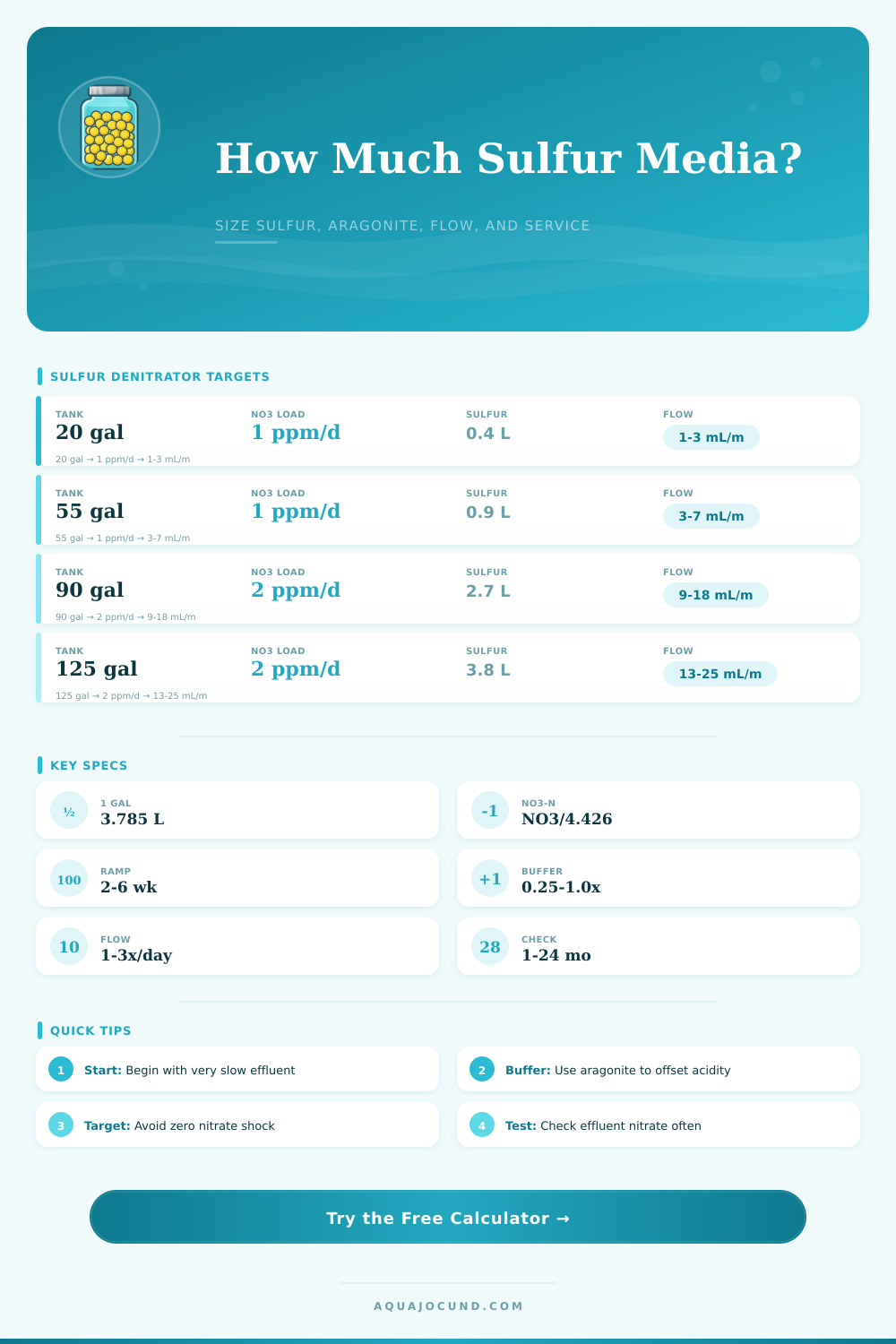
You won’t have to guess how much aragonite/sulfur to add. It takes into account amount of water displaced by sand/rocks. That’s important since live rock displace water that doesn’t take part in the filtration. It then considers your existing nitrate level as well as rate of decrease desired.
It’s tempting (and risky) to try to rush the process. But remember, biofilm must be given time to develop on the sulfur pellets before it can accommodates high flow rates. To help ensure colony growth, the tool recommends a ramp up period during which you begin with very low flow rates and gradualy increase as effluent testing reveals no nitrite. By taking this slow approach, you prevent potentially deadly toxic intermediates from poisoning your tank while the colony establish itself.
Why is the aragonite buffer used? Because the bacteria generate sulfuric acid as a by-product, you MUST use some sort of pH control for these reactors. You can’t do it without. The table below indicate the aragonite mix required depending on amount of sulfur added to the reactor. As the aragonite dissolves over time, it will neutralize the sulfuric acid generated by the bacteria and stabilize the alkalinity of the water in your aquarium. Without this aragonite buffer step, your pH would of plummet within a few days no matter how perfectly you size your media.
How much aragonite is needed will depend based off the natural buffer capacity of your tank. The more alkaline your tank needs to be, the higher the percentage of aragonite may be (e.g., a reef tank). Conversely, a planted freshwater set up with strong carbonate hardness may need less. You are adjusting how much chemicals you need to match your system’s chemistry.
Most hobbyists mess up on flow dynamics. They think sulfur denitrifiers operate like mechanical filters in terms of withstanding high turnover rates. Nope. The nitrate-denitrifiying bacteria is strictly anaerobic, meaning they’ll die if exposed to free oxygen. Higher flows will strip away their protective slime layer and expose them to oxygen which kills the reaction. Instead, you want low, smooth flow that lets the water sit within the media bed long enough to allow the reaction to occur. Based off the ramp stage you select, the calculator gives you flow targets. These flow target range from a gentle trickle during startup to mature capacity several weeks later. Patience is both a virtue and a mechanical necessity.
Frequency of maintenance depend on the load. If your system is very lightly loaded then your sulfur media should last longer than a heavily fed system. Remember, your sulfur media is used as a source of fuel to remove nitrate. If you’re not seeing any reduction in nitrates while flow stays constant, this typically indicates that the sulfur was converted to sulfate which requires replacement. Routine testing of your effluent alkalinity and pH provide clues to impending problems before they occur in a big way. This transforms an emergency response issue into a planned maintenance item.
By sizing properly you’ll have fewer days spent chasing parameters and more days enjoying your tank. You want to maintain consistent (and nearly undetectable) cleaning that preserves the pristene nature of the water all the time without frequent attention. So go slow, be sure to buffer well, and let the biology work for you.