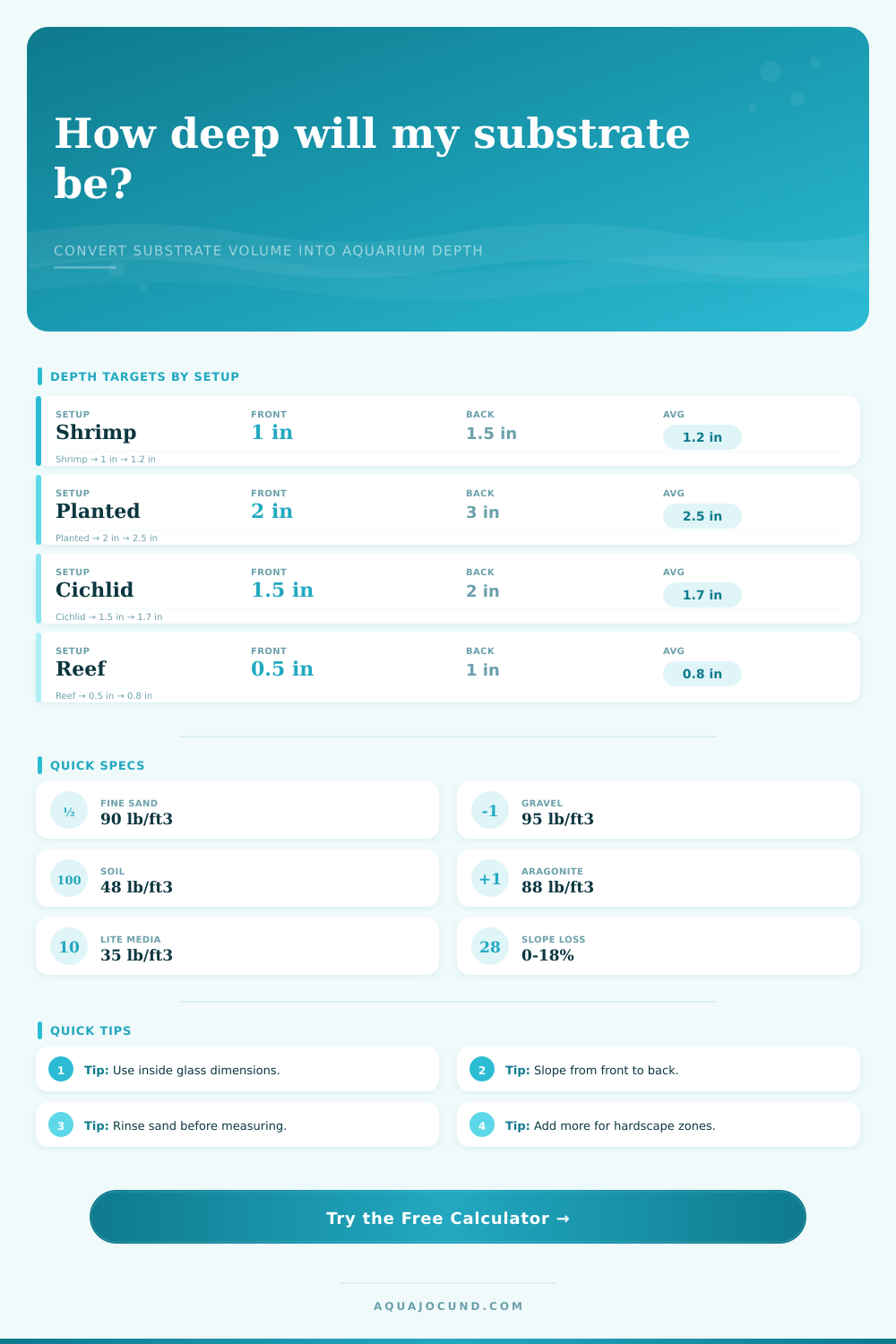
Substrate Depth for Volume Calculator
Convert a known amount of sand, gravel, soil, or aragonite into aquarium substrate depth with tank footprint, slope, and settling adjustments.
📏Units and Presets
🐟Tank Footprint and Substrate Volume
Substrate Depth Estimate
🧪Selected Material Reference
📊Substrate Type Comparison
| Substrate | Typical Dry Bulk Density | Common Depth | Calculation Notes |
|---|---|---|---|
| Fine aquarium sand | 85-95 lb/ft³ | 0.5-2 in | Settles tightly; anaerobic pockets are easier in deep undisturbed zones. |
| Coarse sand | 88-100 lb/ft³ | 1-2.5 in | Good for corydoras and planted foregrounds; moderate settling. |
| Rounded aquarium gravel | 90-105 lb/ft³ | 1.5-3 in | Loose voids make the bed appear deeper before mulm fills spaces. |
| Active planted soil | 42-55 lb/ft³ | 2-3.5 in | Light pellets crush over time; depth can drop after saturation. |
| Aragonite sand | 82-92 lb/ft³ | 0.5-2 in | Used in reef or hard-water tanks; depth affects detritus trapping. |
| Crushed coral | 72-88 lb/ft³ | 0.5-2 in | Large grains have open spaces; rinse volume can shrink visibly. |
| Porous planted media | 30-42 lb/ft³ | 2-4 in | Lightweight media gives more volume per pound than gravel. |
| Soil capped with sand | 60-80 lb/ft³ | 2-3 in | Depth is usually split between nutrient layer and inert cap. |
📐Common Tank Footprints
| Tank | Inside Footprint | 1 in Bed Volume | 2 in Bed Volume |
|---|---|---|---|
| 5 gallon | 16 x 8 in / 41 x 20 cm | 2.2 qt / 2.1 L | 4.4 qt / 4.2 L |
| 10 gallon | 20 x 10 in / 51 x 25 cm | 3.5 qt / 3.3 L | 6.9 qt / 6.6 L |
| 20 long | 30 x 12 in / 76 x 30 cm | 6.2 qt / 5.9 L | 12.5 qt / 11.8 L |
| 29 gallon | 30 x 12 in / 76 x 30 cm | 6.2 qt / 5.9 L | 12.5 qt / 11.8 L |
| 40 breeder | 36 x 18 in / 91 x 46 cm | 11.2 qt / 10.6 L | 22.4 qt / 21.2 L |
| 55 gallon | 48 x 13 in / 122 x 33 cm | 10.8 qt / 10.2 L | 21.6 qt / 20.5 L |
| 75 gallon | 48 x 18 in / 122 x 46 cm | 15.0 qt / 14.2 L | 29.9 qt / 28.3 L |
| 125 gallon | 72 x 18 in / 183 x 46 cm | 22.4 qt / 21.2 L | 44.9 qt / 42.5 L |
🌱Depth Targets by Aquarium Goal
| Goal | Average Depth | Front / Back Example | Why It Matters |
|---|---|---|---|
| Bare-bottom accent sand | 0.25-0.75 in | 0.25 / 0.75 in | Looks natural while staying easy to siphon. |
| General community gravel | 1.5-2.25 in | 1.25 / 2.5 in | Enough depth to cover decor bases and hold plant weights. |
| Rooted planted tank | 2.25-3.25 in | 1.75 / 3.75 in | Root feeders need deeper zones near the rear and hardscape. |
| Walstad or capped soil | 2-3 in | 1.5 / 3.25 in | Allows a nutrient layer plus a stable sand or gravel cap. |
| African cichlid sand | 1-2 in | 0.75 / 2.25 in | Digging fish rearrange beds, so avoid precision scapes. |
| Reef shallow sand bed | 0.5-1.5 in | 0.5 / 1.5 in | Shallow beds reduce trapped detritus in high-flow systems. |
| Deep sand bed zone | 4-6 in | 4 / 6 in | Used deliberately in specialized filtration layouts. |
| Show aquascape terrace | 3-5 in | 1.5 / 6 in | Terraces consume more substrate than a simple average suggests. |
💡Calculation Notes
How much you get from a package of substrate always disappoints when it’s poured into your tank because the layer ends up much thinner than you expected due to settling. Usually new aquarists emphasizes quantity when purchasing this item.
In fact, depth is what matters to fish. Substrate depth matter to shrimp so they can graze. It matters to corydoras so they can sift without hitting bare glass. It also matters to rooted plants so they can anchor themselves without being suffocated in a pocket of oxygen-free soil.
How to Calculate Substrate for Your Aquarium
Most estimates breaks down at point between the bag size and final layer thickness. After you’ve entered the footprint of your tank and the loose volume of substrate, the calculator above does the rest. You’ll learn a lot about setting up the tank if you understand what those numbers represents.
The most important thing is the settling adjuster. Pouring dry sand in the tank creates an air gap between grains. When you rinse the sand and pour it wet into the water, the air vanishes and the bed compacts. Voila! Bed compacts. Fifteen to twenty percent shrinkage happen.
So what? Well, calculating by loose volume alone means you’re missing 15-20% of the volume and, therefore, last layer will end up being less thick than desired. Many folks think they can buy a bag that’s as tall as their tank and get that height in their tank. No. Water weigh something. Plus, grains lock together making height less than the bag.
Density matters too. Soils (even active planted ones) is porous and lightweight. It is typicaly pelletized and made of some kind of organic material that will crush when pressed. A quart of soil goes much further then a quart of dense aragonite sand. Soil will settle much faster though.
On the page is a reference table of the bulk densities of various materials. Remember: it’s not just about color but about physical structure. Sand, especially fine sand, compacts down. Gravel takes up more space per pound because its gaps is larger.
A twenty-pound versus a ten-pound bag? Do you need something that expands or contracts? It also draws down your volume reserve. By dividing area by volume, you get your level bed. And most of us don’t want a level bed. We want something deeper in the back for deep-rooted plants and shallower toward the front for swimming space or perhaps foreground grasses. Those gradients require additional substrate.
A modest slope costs you a little bit of a margin. Double that for a terraced aquascape with deep root zones and rock pockets, it’s going to take twice the amount of material vs. Just laying down a flat layer. To account for those types of profiles, the tool estimate how much you lose out on average depth. You’ll see a realistic front-to-back range instead of a misleading single number.
Also consider tank size and tank shape. For example, bow front tanks appear larger on the outside but are generally smaller inside where the glass meets. Measuring the outside will mean you overestimate how deep bed will be. Always measure within the rim. This can make all the difference when aiming for that exact one-inch mark needed for a colony of shrimps.
Geometric considerations intersect biological concerns when considering how much substrate to plan for. Too little and nothing will grow out of it. If it is too deep, there won’t be enough oxygen in the lower levels. This allows hydrogen sulfide to build up which can be toxic to livestock. You’ll need to find that sweet spot where physical tank size meets livestock requirements.
Begin with math and tweak for desired slop. Having some spares on hand as a patch for low areas is good. A thin layer which isn’t compacted move each time you vac. You should of measured twice, pour once. The rest is left to settling.