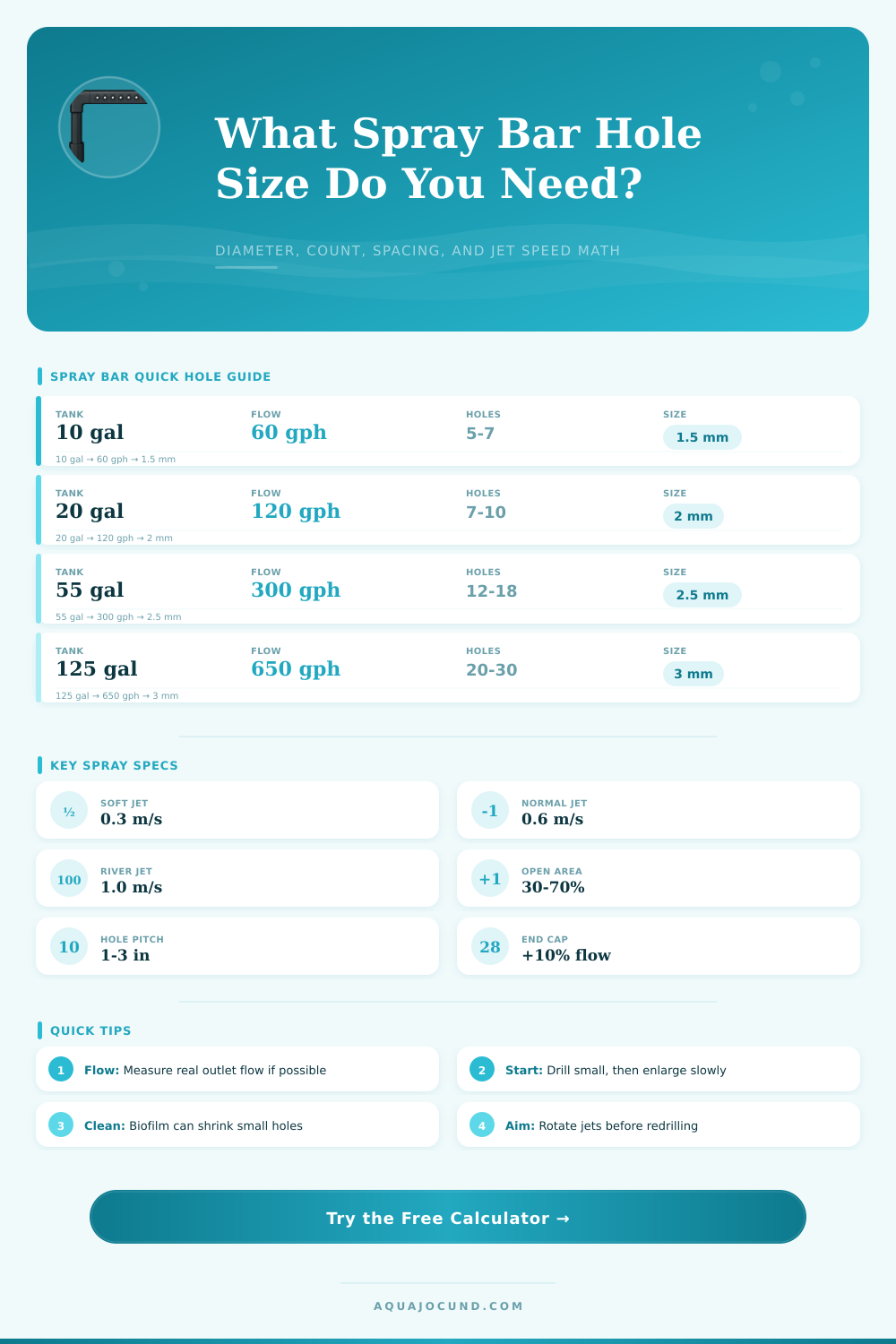
💧 Spray Bar Hole Size Calculator
Estimate spray bar hole diameter, hole count, jet speed, spacing, open area, pipe velocity, and pump margin from real aquarium filter flow.
| Hole Diameter | Typical Flow Per Hole | Best Use | Drilling Note |
|---|---|---|---|
| 1.0-1.5 mm / 0.039-0.059 in | Very gentle at low flow | Nano tanks, fry, shrimp, bettas | Clogs fastest; clean during filter service. |
| 1.8-2.2 mm / 0.071-0.087 in | Moderate community flow | 10-40 gallon planted or community tanks | Common starter size for many DIY bars. |
| 2.5-3.2 mm / 0.098-0.126 in | Broad medium-high flow | Large canisters, cichlids, reef returns | Use more holes if jets feel too sharp. |
| 3.5-5.0 mm / 0.138-0.197 in | Soft high-volume discharge | Long bars, sumps, manifolds, ponds | Needs enough pump flow to avoid weak dribble. |
| Target | Range | What It Feels Like | Adjustment |
|---|---|---|---|
| Soft livestock flow | 0.8-1.5 ft/s / 0.25-0.45 m/s | Gentle ripple, low plant movement | Add holes or enlarge holes if jets are sharp. |
| Normal community flow | 1.5-2.7 ft/s / 0.45-0.82 m/s | Visible circulation without blasting fish | Good default for most filter returns. |
| High oxygen flow | 2.7-4.0 ft/s / 0.82-1.22 m/s | Strong surface movement and detritus lift | Angle along glass or lengthen the bar. |
| Open area ratio | 30-70% of pipe area | Useful balance of pressure and distribution | Below 30% is punchy; above 90% can be weak. |
| Tank | Bar Length | Delivered Flow | Starting Pattern |
|---|---|---|---|
| 10 gallon / 38 L | 8-12 in / 20-30 cm | 50-90 gph / 190-340 L/h | 5-8 small holes aimed at the surface. |
| 20 long / 76 L | 18-24 in / 46-61 cm | 100-180 gph / 380-680 L/h | 8-12 holes along the back wall. |
| 40 breeder / 151 L | 28-34 in / 71-86 cm | 180-320 gph / 680-1210 L/h | 12-18 holes or two staggered rows. |
| 75 gallon / 284 L | 36-48 in / 91-122 cm | 350-550 gph / 1325-2080 L/h | 18-26 holes with an end bleed hole. |
| 125 gallon / 473 L | 48-72 in / 122-183 cm | 550-850 gph / 2080-3220 L/h | 24-36 holes or split dual bars. |
| Symptom | Likely Math Cause | Fix | Check First |
|---|---|---|---|
| Jets blast one area | Hole area too small or count too low | Add holes or enlarge existing holes gradually. | Confirm filter flow after media and tubing. |
| Only first holes flow well | Pipe velocity is high or bar is too long | Use a larger bar ID, split bars, or reduce end restriction. | Look for clogged far-end holes. |
| All holes dribble weakly | Open area is very high for the pump | Plug some holes or use a shorter bar section. | Clean impeller, intake, and tubing. |
| Bar traps air or gurgles | Dead-end pressure or high point pocket | Add a tiny end bleed or rotate the bar slightly. | Check the outlet is fully submerged. |
To create the perfect spray bar, the amount of water that comes out of each hole and the velocity of the water through each hole must be correctly. If there is too many holes in the bar and the water through each of those holes is too low, then the water current will be too weak. If the holes in the bar are too small in size, but the velocity of the water through the holes is too great, the bar will create jet of water that may stress the inhabitants of the aquarium.
Finding the perfect balance between weak jet and high velocity water is crucial, and the type of balance that will work best with your aquarium will depend upon the type of tank that you have and the current that your filter will provide to the spray bar. The three specific measurements that will go into the spray bar calculator are the flow that is delivered to the bar, the length of the bar, and the inside diameter of the pipe. These three measurements is crucial in determining the total area in which the water from the aquarium filter will exit the bar.
How to Make the Right Spray Bar for Your Aquarium
The flow of water that you should use in the calculator will not be the rating of the filter that you are using in your aquarium, as the filter ratings will be higher than the actual flow that the filter will create. By measuring the actual gallons of water per hour that your filter creates and directs to the spray bar, you can ensure that you will not drill too many hole in the bar, and that the bar will not create a weak dribble of water from the aquarium. Another factor in the consideration of the spray bar is the shape of the tank and the height of the water in the tank.
If the aquarium tank is long and shallowly, then the spray bar will have to distribute the water differently than if the tank is tall and shallow. The calculator includes different layout options for the bar so that you can adjust the number of holes in the bar based upon the flow of water and the size of the aquarium. The layout options allow for the creation of either a staggered two-row layout of holes or a single row of holes that is angled towards the aquarium.
Each of these layouts can create a similar outcome, so the appropriate layout for the aquarium you are setting up will depend upon your desired water movement in the tank. Another of the critical factors in the creation of an efficient spray bar that does not cause any stress to the inhabitants of the tank is the velocity of the water through the bar. Velocity is often a factor that people ignore when setting up a spray bar, but if the velocity of the water through the bar is too high, the fish may avoid the tank.
Depending upon the species of fish and the other livestock for the tank, there will be different velocities of water that will be required through the spray bar. For instance, shrimp and fry will require the water to have a soft output of approximately one third of a meter per second, but other fish like hillstream loaches will be able to tolerate a velocity of one meter per second. The percentage of the area of the bar that will be open to the tank will determine if the velocity of the water will meet your requirements.
If the percentage of the open area of the bar is below thirty percent, then the jets of water that exit the bar will feel sharply. However, if the percentage of the open area is above seventy percent, the bar will not be able to push the water to the far corner of your tank. Another of the factors that can change the performance of the spray bar over time is the formation of biofilm and potential clogs in the small holes of the bar.
The more clogs that form in the holes of the bar, the less water will emerge from the bar. Clogs will form more in small holes than in large holes. To account for these potential clogs, the spray bar calculator allows you to establish a margin for the number of small holes in the bar that may get clogged over time.
It is best to start with fewer holes than you would like in your finished spray bar so that you can enlarge the holes after a few weeks of the spray bar being active in your tank. It is not a safe option to drill too many hole in the spray bar during the initial setting up of the bar. In addition to these considerations, an end-cap bleed hole can be established at the end of the spray bar that is the farthest from the aquarium filter.
This end-cap bleed hole will help to even out the water pressures in the bar. However, some of your total flow will be used for this end-cap bleed hole. The spacing between each of the holes in the spray bar is also crucial to ensuring the even distribution of water in the tank.
If the holes in the spray bar are too far from each other, there will be stripes of strong water movement and stripes of weak movement within the tank. You can adjust the spacing between the holes in the bar by a few millimeters from the measurement that the calculator suggests. The suggested distance between each hole is based upon the length of your spray bar.
This measurement can be tested in a bucket of water before you drill any holes in your tank. Using a spray bar calculator will allow you to avoid guesswork in creating your ideal spray bar. This calculator will tell you whether drilling additional holes or enlarging the holes will help to even out the velocity of the water through the bar.
This calculator will also allow you to determine if the inside diameter of the pipe may be limiting the even distribution of water from the filter to the tank before you begin drilling the holes in the bar. Furthermore, after installing the bar into your aquarium, you can always make adjustments to the size of the holes, using either a file or a larger drill bit.