Specific Gravity Temperature Correction Calculator
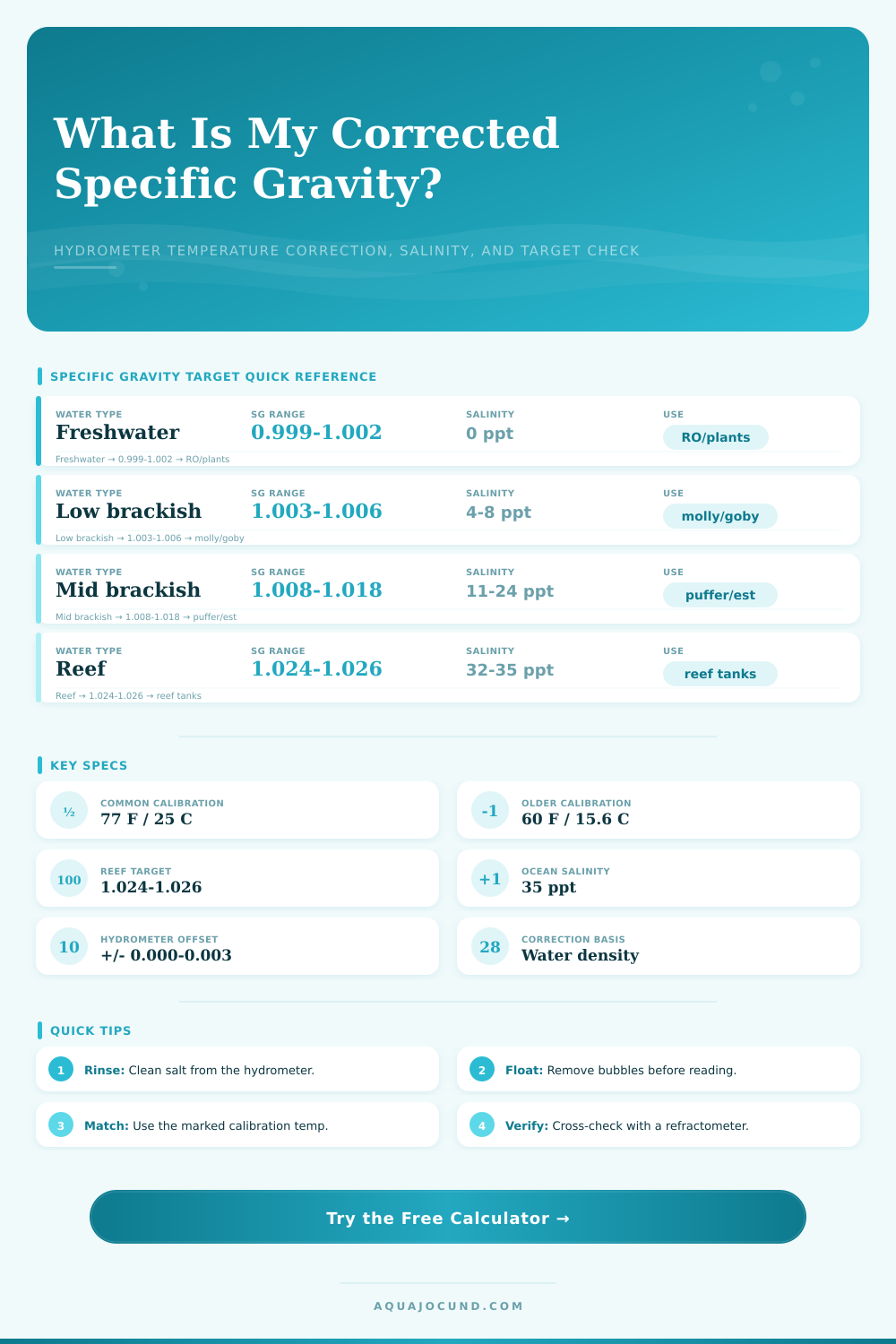
Correct hydrometer specific gravity for sample temperature, calibration temperature, hydrometer offset, salinity estimate, and target range.
| Profile | Corrected SG | Estimated salinity | Comparison note |
|---|---|---|---|
| Freshwater check | 0.999-1.002 | 0 ppt | Confirms the hydrometer is near baseline water. |
| Low brackish | 1.003-1.006 | 4-8 ppt | Useful for light estuary-style aquariums. |
| Mid brackish | 1.008-1.018 | 11-24 ppt | Compare slowly because the range is broad. |
| Hyposalinity QT | 1.008-1.010 | 10-13 ppt | Requires careful instrument verification. |
| FOWLR marine | 1.020-1.023 | 27-31 ppt | Often kept lower than reef-strength water. |
| Mixed reef | 1.024-1.026 | 32-35 ppt | Common reef target band for stable salinity. |
| High-salinity reef | 1.026-1.028 | 35-38 ppt | Use only when intentionally targeting a high band. |
| Sample temp | Calibration temp | Water density factor | Example at 1.0250 |
|---|---|---|---|
| 68 F / 20 C | 77 F / 25 C | 0.9988x | Corrects near 1.0238 |
| 77 F / 25 C | 77 F / 25 C | 1.0000x | No temperature correction |
| 82 F / 27.8 C | 77 F / 25 C | 1.0007x | Corrects near 1.0257 |
| 60 F / 15.6 C | 77 F / 25 C | 0.9975x | Corrects near 1.0224 |
| Profile | Expansion coefficient | Best use | Correction behavior |
|---|---|---|---|
| Standard glass hydrometer | 0.000025 per C | Most aquarium floating hydrometers | Small body expansion adjustment |
| Borosilicate lab glass | 0.000010 per C | Low-expansion glass instruments | Very small expansion adjustment |
| Certified lab hydrometer | 0.000012 per C | Calibrated laboratory glassware | Use with a known correction certificate |
| Plastic swing-arm hydrometer | 0.000080 per C | Plastic pointer or arm style | Offset checks matter more than expansion |
| Digital density meter check | 0.000000 per C | Instrument already temperature-compensated | Uses manual offset only |
| Refractometer cross-check | 0.000000 per C | When SG comes from a corrected refractometer | Disables body expansion adjustment |
| Scenario | Measured SG | Sample temp | Typical target |
|---|---|---|---|
| RO/freshwater baseline check | 1.0000 | 68-78 F / 20-26 C | 0.999-1.002 |
| Low brackish livebearer mix | 1.0040 | 76-80 F / 24-27 C | 1.003-1.006 |
| Brackish puffer aquarium | 1.0120 | 78-82 F / 26-28 C | 1.008-1.018 |
| Marine fish-only tank | 1.0215 | 76-79 F / 24-26 C | 1.020-1.023 |
| Mixed reef aquarium | 1.0250 | 77-80 F / 25-27 C | 1.024-1.026 |
Drop the hydrometer into water and what’s that number? You grab a sample of water out of your reef tank and place it under the hydrometer. Looks like 1.025, right? So you tuck thing back away. Then you realize glass is calibrated at 77 degrees but your water in the tank are 82 degrees. Oops! Water density changes with temperature and that impacts water quality… How high or low the hydrometer float depends on the temperature. Without correcting for this difference, you aren’t really measuring anything; you are just guessing.
After putting those values into the calculator above (which does all of the math), you’ll get an answer based off the entered value of the hydrometer reading and the corresponding values from the temps you selected. To begin, you simply need three values. The manufacturer’s calibration temperature… The default is usually 77 degrees F or 25 C these days. It’s possible that it may be 60 if you have an old tool. Water temp. When you drew the sample; Obviously, this will change depending on where you live. Hydrometer reading. What did you read?
Why You Must Fix Hydometer Readings for Heat
Why? Because if you use a tool calibrated in cold water and then use it to read warm water, it won’t be correct. The correction does two things. First, it compensate for the fact that the density factor isn’t right because you’re not testing at standard temperature. Second, it eliminates variable of heat so that you can compare apples to apples.
Temperature also affect the tool itself. Hotter temperatures cause an increase in volume or expansion of glass. A typical glass hydrometer that’s made from soda lime glass will expand at a higher rate then one made of borosilicate laboratory glass. Even a swing-arm style in plastic will expand further. With the calculator, you can choose what kind of instrument you’re working with. Seems like small potatoes, right? But in order to get precise readings you have to take into account how the thing doing measuring works. In other words, if I’m using a plastic hydrometer in warm water, the plastic will expand, push more water out and I’ll read scale as though there’s less on top. How much the material expands with heat is accounted for here so that the end number stays honest.
Why does all this matter? Because corals don’t like imprecision. Osmotic pressure makes them open or close their polyps. If your specific gravity are off, they’ll show it by growing stunted and/or having pale tissue. Specifically, reef keepers target a tight range around 1.024-1.026, a band of only a few hundredths. That’s ten percent of your entire allowable range. Ten percent is invisible in a freshwater tank; in a reef tank, it spells trouble.
The calculator outputs an estimate of salinity (in parts per thousand) and a corrected specific gravity. You can compare your output with typical goals and know whether you’re in the danger zone for your fish.
One final element is human error. While it sounds obvious, a dirty hydrometer will not give accurate reading due to its inherent fragility and propensity for getting dirty (salt crust can weigh it down and drag the reading down). Similarly, air bubbles can stick to the glass to lift the instrument upward. No amount of correcting for temperature will compensate for these real world oddities; you need to clean your tool and read the meniscus properly. Furthermore, allow your sample enough time to reach same temperature as the instrument prior to measurement. Any rushing here would of add noise which is impossible for any calculator to filter out. Rinse off the hydrometer and let it stop spinning before making a measurement.
The tank water temp is far more important then the tool brand. Specific gravity is not just about salt levels; it is a measure of density. Instruments will expand and contract with temperature. Other factors can alter specific gravity. They want to eliminate all those things to get at the salt only. Then they adjust it out to give you the actualy specific gravity of the salt/water mixture. That is what takes your wild guess and makes it a hard data point. You go from wondering if your salt mix is doing anything and now you know. The equations are just there to help us reach that point. So keep your readings constant. Adjust for the heat. Believe in the numbers left behind.