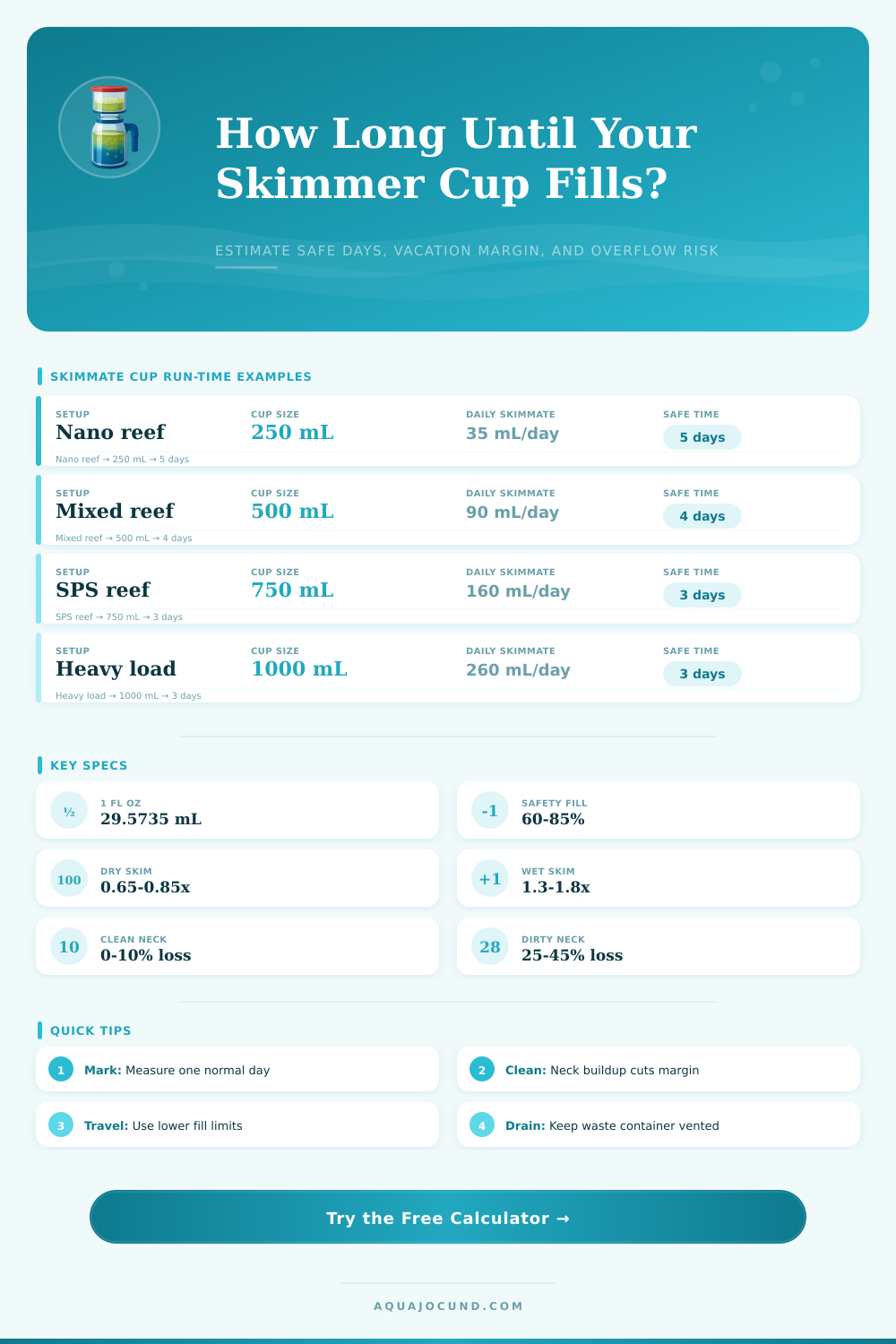
Skimmate Cup Capacity Days Calculator
Estimate how many safe days a protein skimmer collection cup can run before the planned fill line, including skim wetness, neck fouling, safety fill, and vacation risk.
Calculation Breakdown
| Skim Setting | Multiplier | Typical Cup Liquid | Best Use |
|---|---|---|---|
| Very dry | 0.65x | Thick, dark, slow accumulation | Long cup intervals and lower water export |
| Dry | 0.80x | Dark tea to coffee color | Routine reef skimming with stable water level |
| Balanced | 1.00x | Medium tea color | General baseline when using a measured daily value |
| Wet | 1.35x | Pale tea, faster fill | Nutrient export, cleaning after maintenance, heavy feeding |
| Very wet | 1.75x | Light skimmate, quick cup fill | Short-term export only when overflow is controlled |
| Break-in | 2.10x | Unpredictable surge or watery foam | Use extra supervision and a lower fill limit |
| Neck Condition | Fouling Input | Capacity Penalty | Planning Note |
|---|---|---|---|
| Freshly cleaned neck | 0-5% | Minimal | Use after wiping the riser and cup throat. |
| Light brown film | 8-15% | Small margin reduction | Typical after a few normal reef days. |
| Visible sludge ring | 20-30% | Moderate margin reduction | Foam head can climb unevenly and change fill rate. |
| Heavy coated riser | 35-45% | Large margin reduction | Clean before leaving the system unattended. |
| Erratic break-in foam | 50-70% | Severe uncertainty | Do not rely on the cup for long unattended periods. |
| Skimmer Class | Cup Size | Example Daily Skimmate | Safe Days at 75% |
|---|---|---|---|
| Nano hang-on | 6-10 fl oz / 180-300 mL | 25-50 mL/day | 3.5-9 days |
| All-in-one cube | 10-14 fl oz / 300-415 mL | 45-80 mL/day | 3-7 days |
| Mid-size in-sump | 16-24 fl oz / 475-710 mL | 70-140 mL/day | 3-8 days |
| Large reef skimmer | 25-34 fl oz / 740-1000 mL | 130-260 mL/day | 2-6 days |
| External waste collector | 64-128 fl oz / 1.9-3.8 L | 150-400 mL/day | 4-19 days |
| Vacation Coverage | Risk Band | What It Means | Typical Action |
|---|---|---|---|
| 0-70% of safe days | Low | Normal margin remains after the trip. | Clean neck, empty cup, leave current settings. |
| 70-90% of safe days | Watch | Minor surges could reach the fill limit. | Lower the cup water level or reduce wetness before leaving. |
| 90-110% of safe days | High | The trip is close to or past the planned fill point. | Use a waste collector or have the cup emptied. |
| Over 110% of safe days | Overflow likely | Entered unattended time exceeds calculated capacity. | Do not leave it this way without overflow control. |
When you get back from a short trip and realize there’s water perilously near the skimmer cup drain; yeah, you know the panic. But the fact is, protein skimmers are dynamic systems; they responds to each meal you offer your fish…which is why people treat them like set-and-forget devices. The tool above will help you determine exactly how many days you have before overflow using your existing setup. It transforms vague worry into real safety margins.
There are three moving pieces to the equation: how much liquid you produce, how much space is actualy available, and what conditions might change while you’re gone. For most folks, that’s measured one time when things is stable and then locked in place indefinitely. Never happens. Output can be dramatically influenced by feeding regimen, frequency of water changes, and even the types of bacteria/carbon additives you use.
How to Prevent Skimmer Overflow on Vacation
If you have a wetter export mode (which will pull more water and thus nutrients out but also accumulate faster), the calculator will adjust your base daily output accordingly. Conversely, if you’re in a very dry foam mode, less water are being pulled but skimmate concentration builds up faster. In this case, it will adjust the baseline output to account for that. Knowing the trade off is important, as running wetter may clean up your water a bit better but will drastically reduce your unattended safety window.
So working volume < physical capacity Cup height isn't as big of a deal as the gap between lid edge/drain lip and the bottom. Allow for some buffer (surge protection). Uneven foam head climb will always occur due to varying temperatures or biofilm accumulation in the riser neck. Don’t neglect the neck fouling. Because this leads you into thinking you’ve got more room than you do.
A thin brown layer within the neck can choke off flow and create unexpected surges past your estimated limit. These penalties is broken out in the reference tables below and illustrate how even light coatings reduce effective capacity by nearly 50%. This is where folks mess up…they look at an open cup and think “hey I got time” without factoring in their reduced functional volume due to debris.
Going on vacation is a whole other ball game. You know; you get to wake up in the morning and go check the cup, or even just top it off at the tap. On vacation, system needs to deal with its own problems without any help for the duration of your trip. To that end, the calculator also has a surge allowance that accounts for things going wrong.
Unexpected power glitches might reset the skimmer air pump and prevent it from turning back on until it’s too late. You might also wait too long between water changes so organics pile up. If your calculated safe number of days only exceeds your vacation time by a few days, you’re in the danger zone right now. Better to reduce the fill limit and take care of those cups before you leave then play Russian roulette.
In fact, if you’re in the low risk band, you still have some margin to breathe. Being in the high risk band means you must do something immediately. You should of either increase the fill limit by emptying the cup or extend the fill limit with an external waste container.
Don’t trust forum generalizations. Every skimmer has different efficiency, and every tank has a unique biological load. The only accurate way to establish your skimmer’s baseline is by measuring output for one complete day following a clean. Now that you know that value, use those numbers as input and you’ll get a reasonable projection (instead of just guessing).
After a while, you’ll realize that making small adjustments, like tightening the air valve to make the foam a bit drier, can give you an extra day or two of buffer time. You don’t need to perfect every variable…just be aware of when the breaking point occurs so you can plan accordingly. If you leave your skimmer with plenty of margin, it’ll continue operating well beyond your level of monitoring.