Shrimp TDS Target Calculator
Plan RO blending, shrimp strain targets, GH-to-TDS balance, and remineralizer dose for stable shrimp water.
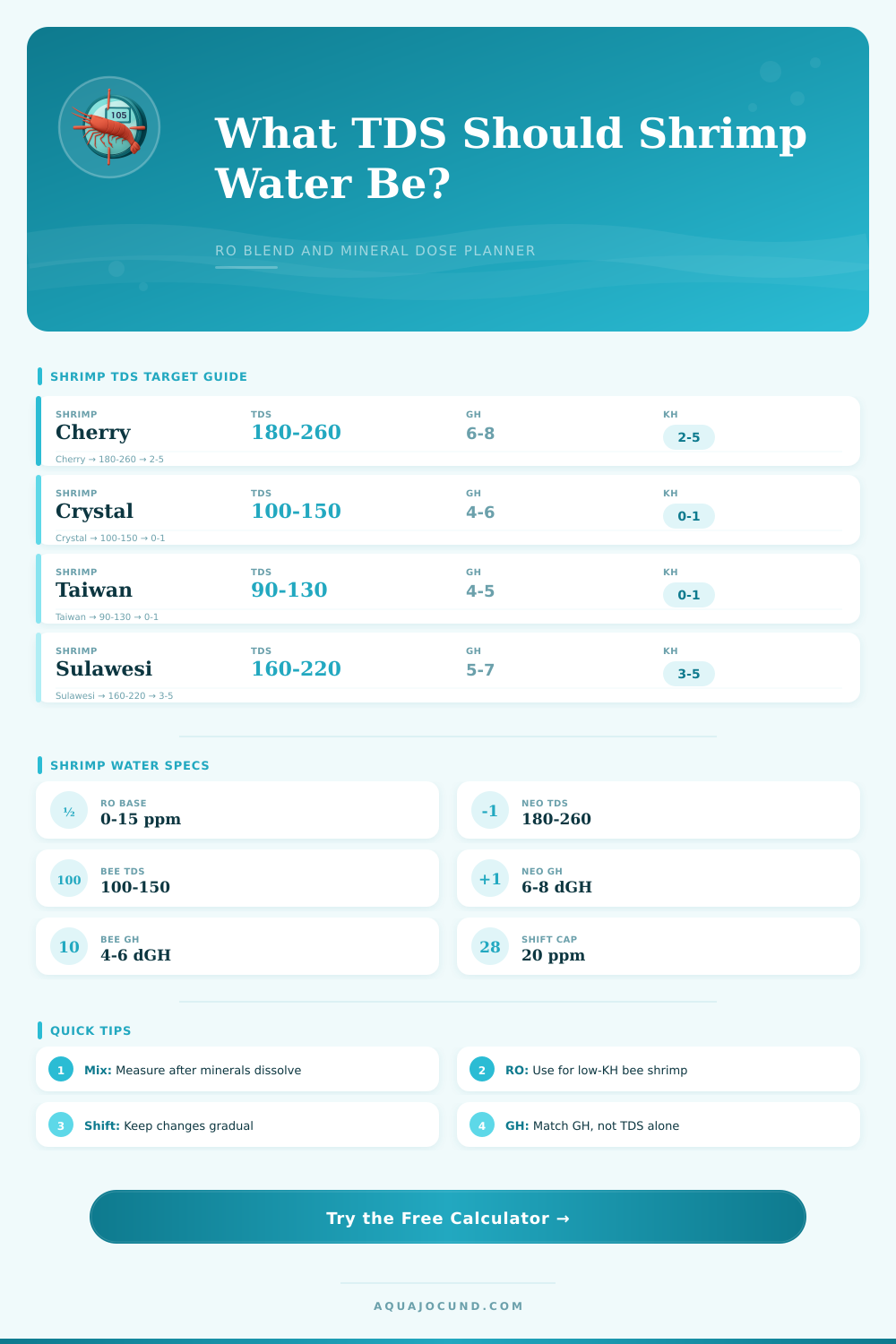
| Shrimp Type | Typical TDS | GH Target | KH Target | Notes For Calculator Use |
|---|
| Mineral Type | Approx. Strength | GH Effect | Best Match |
|---|
| Tank | Dimensions | Net Water | 20% Change | Use Case |
|---|
| Source TDS | Target TDS | Source Share | RO Share | Comment |
|---|
The concept of total dissolved solids are an important concept for shrimp keepers to understand, as total dissolved solids provide a measurement of the amount of material that is dissolved in the water. Although total dissolved solids does not tell the specific types of materials that is present in the water, total dissolved solids will tell the shrimp keeper if the water conditions is appropriate for the specific type of shrimp that the keeper is to be kept in the tank. Each species of shrimp require different water conditions from the tank water, so it is essential for shrimp keepers to understand these requirements.
For instance, shrimp of the genus Neocaridina can tolerate water with various different mineral levels, as they evolved in waters with hard and variable mineral content. In contrast, Taiwan bee shrimp requires water that is soft in relation to minerals, and dont do well with high level of those minerals. The calculator provide mathematical assistance in determining the proper amount of each type of water that should be added to the aquarium to achieve the desired results.
How to Use the TDS Calculator for Shrimp Tanks
The calculator can assist in determining both the ratio of tap water to RO water that should be added to achieve the desired total dissolved solids levels, as well as the amount of mineral products that should be added to the tank to achieve the desired total dissolved solids and GH levels. Additionally, the calculator considers the size of the tank that the user will use in the calculation of the total dissolved solids levels. Smaller tanks will have different results of adding the same amount of water to the tank as larger tank.
The calculator includes a “net water factor” that accounts for the amount of water that will not be used in the water change (due to the substrate and hardscape of the tank). The different types of mineral products will impact the total dissolved solids (and the GH) of the water in different ways. Some mineral products will increase the total dissolved solids levels of the water without increasing the GH levels of the water, while other mineral products will increase both the total dissolved solids and the GH levels of the water.
Thus, one benefit of using the calculator is that it will provide an estimation of how much each type of mineral product will increase the GH levels of the water. Monitoring the GH levels of the water is essential to provide for the shrimp, as they utilize the calcium and magnesium elements of the water during the molting process of the shrimp. Thus, total dissolved solids alone will not ensure that there is an appropriate amount of these elements in the tank water.
Water changes may impact the shrimp in different ways depending upon the amount of water that is changed. For instance, changing a large amount of the water in the tank may shock the shrimp if the new water is of a different temperature or pH than the water that is currently in the tank. On the other hand, changing small amounts of water frequent may lead to changes in the parameter of the water.
Thus, use of the calculator allows the shrimp keeper to determine if a water change is appropriate for their tank and it’s inhabitants. Generally, changes to the water should be made in a gradual fashion rather than abruptly and dramatic. One of the processes that will impact the total dissolved solids levels in the tank is evaporation.
As water evaporate from the tank, the minerals remains in the tank. Thus, the total dissolved solids will increase as a result. While the calculator does not calculate how much total dissolved solids is create each day due to evaporation, it does create a target total dissolved solids reading for the shrimp keeper to reach after performing a water change.
Thus, measuring the total dissolved solids with a TDS meter before and after a water change will allow the shrimp keeper to ensure that evaporation or dosing error are not changing the total dissolved solids levels of the tank water. Overall, the calculator allow the shrimp keeper to consider the water in the tank as a recipe. By entering the different parameter of the tank and the shrimp species that the keeper is to be kept, the calculator will provide the shrimp keeper with a plan for performing water changes.
However, the use of a TDS meter is still required for the shrimp keeper to make certain that the total dissolved solids levels are as targeted as possible, as well as to test for the level of GH and KH in the tank water. While the calculator can save the shrimp keeper the need to manually calculate the numbers needed for water changes, testing of the water is still required to ensure proper condition for the shrimp.