Shrimp Tank Stocking Calculator
Estimate a safe starting colony and mature shrimp capacity from tank volume, footprint, species, tank maturity, filtration, plant cover, and feeding load.
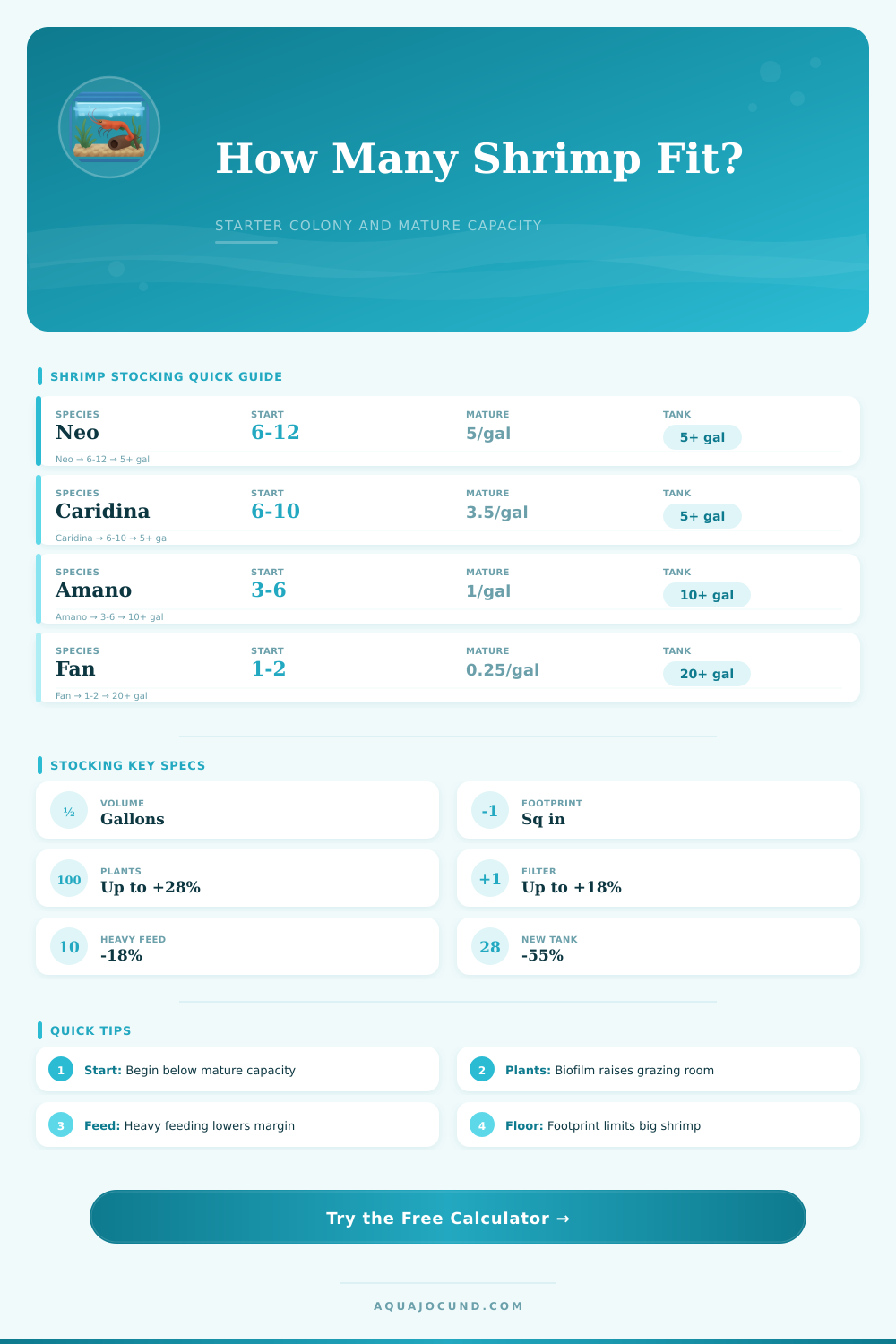
| Shrimp species | Starter colony | Mature baseline | Footprint check |
|---|---|---|---|
| Neocaridina davidi | 6-12 shrimp | About 5 per gallon in mature planted tanks | Roughly 10 sq in per adult |
| Caridina bee / crystal | 6-10 shrimp | About 3.5 per gallon with stable parameters | Roughly 14 sq in per adult |
| Amano shrimp | 3-6 shrimp | About 1 per gallon for adult algae grazers | Roughly 35 sq in per adult |
| Ghost / grass shrimp | 6-10 shrimp | About 2.5 per gallon | Roughly 18 sq in per adult |
| Sulawesi dwarf shrimp | 5-8 shrimp | About 2 per gallon in stable specialist tanks | Roughly 20 sq in per adult |
| Bamboo fan shrimp | 1-2 shrimp | About 1 per 4 gallons with feeding flow | Roughly 80 sq in per adult |
| Vampire fan shrimp | 1 shrimp | About 1 per 5-6 gallons for large adults | Roughly 110 sq in per adult |
| Small Macrobrachium | 1-3 shrimp | About 0.4 per gallon due to territorial behavior | Roughly 60 sq in per adult |
| Tank size | Dimensions | Volume | Typical Neocaridina range |
|---|---|---|---|
| 5 gallon | 16 x 8 x 10 in / 41 x 20 x 25 cm | 5 gal / 19 L | Start 6-10, mature 15-25 |
| 10 gallon | 20 x 10 x 12 in / 51 x 25 x 30 cm | 10 gal / 38 L | Start 8-15, mature 35-50 |
| 20 long | 30 x 12 x 12 in / 76 x 30 x 30 cm | 20 gal / 76 L | Start 12-25, mature 75-100 |
| 29 gallon | 30 x 12 x 18 in / 76 x 30 x 46 cm | 29 gal / 110 L | Start 18-30, mature 90-130 |
| 40 breeder | 36 x 18 x 16 in / 91 x 46 x 41 cm | 40 gal / 151 L | Start 25-45, mature 150-200 |
| 75 gallon | 48 x 18 x 21 in / 122 x 46 x 53 cm | 75 gal / 284 L | Start 40-70, mature 220-300 |
| Condition | Low setting | Middle setting | High setting |
|---|---|---|---|
| Colony maturity | New tanks use 45% capacity | Stable tanks use 85% capacity | Aged planted tanks use 115% |
| Filtration | Minimal filtration uses 78% | Sponge filtration uses 100% | Dual filtration uses 118% |
| Plant cover | Bare tanks use 70% | Moderate cover uses 100% | Jungle cover uses 128% |
| Feeding load | Light feeding allows 108% | Normal feeding uses 100% | Breeder feeding uses 72% |
Shrimp keeping require a certin amount of patience from those who care for these creature. The most important decision to be made in shrimp keeping is the decision of how many shrimp should live in a shrimp tank. Many individual choose a specific number of shrimp to live in their tank based off information provided to them from video and message boards.
However, these individuals often find their shrimp colony failing to grow or their water quality deteriorate as a result of having chosen the incorrect starting number of shrimp for there tank. Beyond the number of gallon of water that may be contained within a tank, several other factor will impact the number of shrimp that should be living within that aquarium. The surface area of the tank is one such factor.
How many shrimp should I put in my tank?
Shrimp live on the surfaces of tanks rather than within them. A tank that is tall and narrow will contain less surface area than a tank that is long and shallow and yet contain the same number of gallons of water. Additionally, the larger the shrimp species, the more surface area is required to provide for their need.
These dimensions can be entered into the calculator to determine the apropriate number of shrimp. Another such factor is the age of the tank. New tanks contain very little biofilm.
The lack of biofilm within a tank indicate that the tank is unable to provide food for the shrimp. As tanks contain items like moss or wood for several month, the biofilm that forms in the tank provide food for the shrimp. Thus, the individual should enter the age of the tank into the calculator so that the calculator calculates the number of shrimp according to the ability of the tanks biofilm to provide food for the shrimp population.
If the age of the tank is not accounted for, the individual may place too many shrimp into the tank, which may lead to stress for the shrimp due to a lack of food within the tank. The third factor to consider is the tanks filtration and plant density. The larger the surface area of the filter (such as a sponge filter), the more biofilm can grow, which provide food for the shrimp.
Dense moss provides more grazing area for the shrimp, indicating that more moss will permit for a greater number of shrimp to live within the tank. However, the feeding of shrimp is another factor that impact the number of shrimp that may live in the tank; the more shrimp are feeding in the tank, the more waste is introduced into the tank that may make it difficult for the shrimp to continue to live in such a tank. These factor can be adjusted in the calculator.
Another factor to consider is the difference between the starting number of shrimp in the tank and the mature number of shrimp in the tank. The starting number of shrimp in the tank should be less than the mature number of shrimp in the tank to provide the shrimp with the room to breed within the tank. If there are too many shrimp within the tank at the beginning, they may not have enough space to grow, and the water quality may rapidly deteriorate.
By calculating both the starting and mature numbers of shrimp, the calculator allow the shrimp keeper to account for the life cycle of the shrimp within the tank. In addition to calculating both the starting and mature numbers of shrimp, a range of shrimp is provided rather than a specific number. The number of shrimp that may be living within the tank can change due to different variables within the tank, such as temperature, the amount of algae that grows in the tank, and how often the shrimp tank is changed.
Additionally, the shrimp should be watched to ensure that their behavior indicate that they are not reaching the upper limit of the range of shrimp that should live within that tank. If the shrimp begin to exhibit behavior that indicate that they are very crowded, the individual should reduce the number of shrimp or the amount of plant life in the tank should be increase. Finally, the information provided from the calculator should not be treated as the specific number of shrimp that should live in the tank forever.
The behavior of the shrimp and the growth of the biofilm in the tank should be observed. If the shrimp and their colony become too large for the tank, adjustments must be made to the feeding of the shrimp or the amount of plant life within the tank. Through careful observation of both the shrimp and the tank, the shrimp keeper will be able to learn how to care for the shrimp such that their colony remain stable over long period of time.
Youll find that shrimp keeping is alot of work but it is worth it.