🦐 Shrimp Colony Growth Calculator
Project colony size from starting adults, sex ratio, berried females, survival, temperature, and carrying capacity.
Neocaridina
Usually the fastest freshwater colony builder, with short maturity time and forgiving survival in stable planted tanks.
Crystal Bee
Smaller broods and slower maturity make the projection more sensitive to survival, temperature, and stability.
Sulawesi
Warmer water and slower maturity can produce steady but more gradual growth when the tank is mature.
Amano
Amano shrimp do not create a normal freshwater colony, so the model keeps freshwater recruitment very low.
| Profile | Typical Hatch Count | Brood Interval | Maturity Delay | Planning Density |
|---|---|---|---|---|
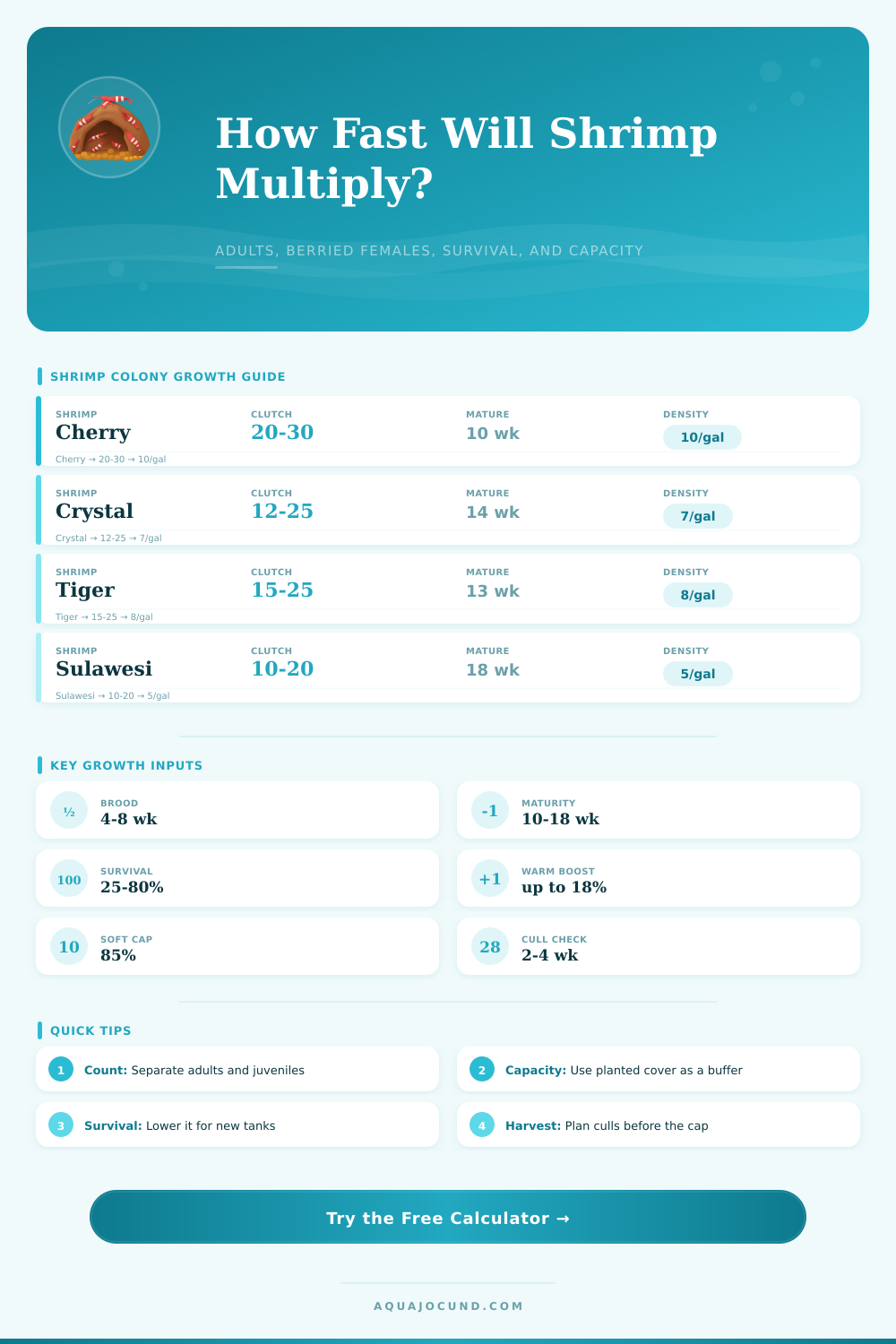
| Neocaridina davidi | 20-30 shrimplets | 4-5 weeks | 9-12 weeks | 8-12 per gal |
| Crystal red / black bee | 12-25 shrimplets | 5-7 weeks | 12-16 weeks | 5-8 per gal |
| Taiwan bee / fancy tiger | 10-20 shrimplets | 6-8 weeks | 14-18 weeks | 4-7 per gal |
| Tiger Caridina | 15-25 shrimplets | 5-7 weeks | 12-15 weeks | 6-9 per gal |
| Sulawesi shrimp | 10-20 shrimplets | 7-8 weeks | 16-20 weeks | 4-6 per gal |
| Ghost / grass shrimp | 20-40 larvae | 4-6 weeks | 8-12 weeks | 6-10 per gal |
| Condition | Model Effect | Use When | Planning Note |
|---|---|---|---|
| Sparse cover | 0.70 cover factor | Bare grow-out or clean display | Babies have less grazing area |
| Moderate cover | 0.90 cover factor | Plants, wood, and some moss | Good default for display tanks |
| Dense moss | 1.12 cover factor | Breeding tank with biofilm | Can raise visible survival |
| Cool water | Slower brood timing | Below species ideal range | Growth stretches across months |
| Warm water | Faster, capped boost | Near species upper comfort range | Watch oxygen and stability |
| Tank | Typical Dimensions | Neocaridina Capacity | Caridina Capacity | Cull Check |
|---|---|---|---|---|
| 5 gal | 16 x 8 x 10 in / 41 x 20 x 25 cm | 40-60 shrimp | 25-40 shrimp | Week 10-14 |
| 10 gal | 20 x 10 x 12 in / 51 x 25 x 30 cm | 80-120 shrimp | 50-80 shrimp | Week 14-20 |
| 20 long | 30 x 12 x 12 in / 76 x 30 x 30 cm | 160-240 shrimp | 100-160 shrimp | Week 18-26 |
| 40 breeder | 36 x 18 x 16 in / 91 x 46 x 41 cm | 320-480 shrimp | 200-320 shrimp | Week 24-34 |
| 75 gal | 48 x 18 x 21 in / 122 x 46 x 53 cm | 600-900 shrimp | 375-600 shrimp | Week 30-42 |
| Milestone | What It Means | Calculator Signal | Planning Response |
|---|---|---|---|
| First hatch | Berried females release babies | Week 3-5 rise | Protect intake and feed lightly |
| First maturity | Juveniles join breeders | After maturity delay | Expect growth to accelerate |
| Half capacity | Colony has momentum | Capacity used near 50% | Plan sales, culls, or splits |
| Soft cap | Growth slows from crowding | Capacity used near 85% | Reduce density or add tanks |
| At capacity | Projection meets tank limit | Capacity used near 100% | Stop expansion or remove shrimp |
The growth of shrimp populations occur in waves. Furthermore, the rate at which shrimp populations grow can be more faster or slower than the observer might expect. Shrimp population growth rely upon many different factors.
Some of these factor include water temperature, shrimp survival rates, and the carrying capacity of an aquarium in which the shrimp live. An individual must understand these factors to manage the shrimp population within the aquarium. Water temperature is one of the major factors that will impact the timing of shrimp breeding cycles.
Why Shrimp Numbers Change in an Aquarium
If the water temperature in the aquarium is higher than the ideal temperature for the shrimp species being maintained, then the time between breeding cycles will decrease. Additionally, higher water temperatures will increase the amount of oxygen that the shrimp require. Furthermore, higher water temperatures will also reduce the lifespan of the adult shrimp living in the tank.
If the temperature of the water in the aquarium is set lower than the ideal water temperature for the shrimp, then the shrimp will take longer to reach the breeding phase, and the young shrimp will take longer to grow to the required size to initiate breeding themselves. You can use the temperature calculator to calculate how the different water temperatures will impact the breeding cycles of shrimp in terms of real week. Another factor that will impact the population of shrimp in an aquarium is the survival rate of shrimp.
A female shrimp can contain many eggs, but not all the egg will develop into adult shrimp. There are various factors that can reduce the survival rate of shrimp, such as new aquarium setups, water movement in the aquarium, a lack of areas for shrimp to hide within the aquarium, and unstable water parameters in the aquarium. Because survival rates of shrimp can differ from aquarium to aquarium, the user can adjust the shrimp survival rate within the calculator.
The user can adjust the survival rate to ensure that the projections of the shrimp population within the aquarium matches the actual population of shrimp within the aquarium. The carrying capacity of an aquarium is the maximum number of shrimp that can live within the tank. The aquarium itself does not signal when the carrying capacity of the aquarium is reached.
However, there are various signs of when the shrimp are reaching the carrying capacity, such as shrimp growth slowing, shrimp colors fading, and young shrimp dying. The shrimp population projection calculator will indicate when the shrimp population is approaching the carrying capacity of the aquarium. At this time, an owner can decide to remove some of the shrimp from the aquarium, add a new aquarium to the population, or change the way in which the owner is to feed the shrimp in the aquarium.
The requirements for shrimp growth and survival can be different for each species of shrimp. For instance, Neocaridina shrimp populations can grow very quickly once the first generation of shrimp of that species reaches maturity. In contrast, species like crystal shrimp and Taiwan bee shrimp tend to have slower rates of growth.
Furthermore, the crystal shrimp and Taiwan bee shrimp are also more sensitive to changes in the chemistry of the water in which they live than the Neocaridina shrimp. Species like the Sulawesi shrimp require warmer water in their tanks and can live at lower densities than shrimp species like the Amano shrimp, which do not form self-sustaining colonies in freshwater environments. These different profiles of shrimp can be selected within the calculation tool so that the projections of shrimp population is accurate to the species of shrimp being kept in the aquarium.
A reference table is also included within the shrimp population projection calculator that contains information about the different shrimp species. The reference table does not contain rules for shrimp aquarium populations. However, the reference table does provide an understanding of the range of shrimp populations that can exist within an aquarium for each species.
Furthermore, the survival rate of shrimp may impact the number of shrimp that live within the aquarium to a extent that even a moderate survival rate can result in too many shrimp for the carrying capacity of the aquarium. Another way to increase the accuracy of shrimp population projections is to actualy count the number of shrimp in an aquarium according to the age of the shrimp. The number of shrimp can be divided into three separate populations.
The adult shrimp, berried female shrimp (which contain eggs), and the juvenile shrimp should all be counted separately. Furthermore, the shrimp population projections will be more accurate if these groups of shrimp are separated from one another because their contributions to the shrimp population will be tracked on a week-by-week basis. Using the shrimp population projection calculator can help an aquarist to make decisions regarding the shrimp population in their aquarium.
For example, an aquarist can use the calculator to determine when to begin planning to sell shrimp or to acquire a second aquarium to house these shrimp. Additionally, when the shrimp population reaches half of the carrying capacity of the aquarium, it is time to begin planning for shrimp sales. Furthermore, if the shrimp population enters the soft cap zone within the carrying capacity of the aquarium, it is time to decide whether to add more cover for the shrimp in the aquarium or to reduce the number of shrimp in the aquarium.
Finally, when the shrimp population reaches the hard limit of the carrying capacity, the shrimp population is at the maximum number of shrimp that can live in the aquarium. However, the shrimp population should of been checked every few weeks to ensure that an aquarist is prepared for these major decisions regarding their aquarium and its shrimp population.