🦐 Shrimp Breeding Yield Projection Calculator
Project berried females, hatch survival, grow-out load, cull percentage, monthly juvenile count, and tank capacity for a shrimp breeding colony.
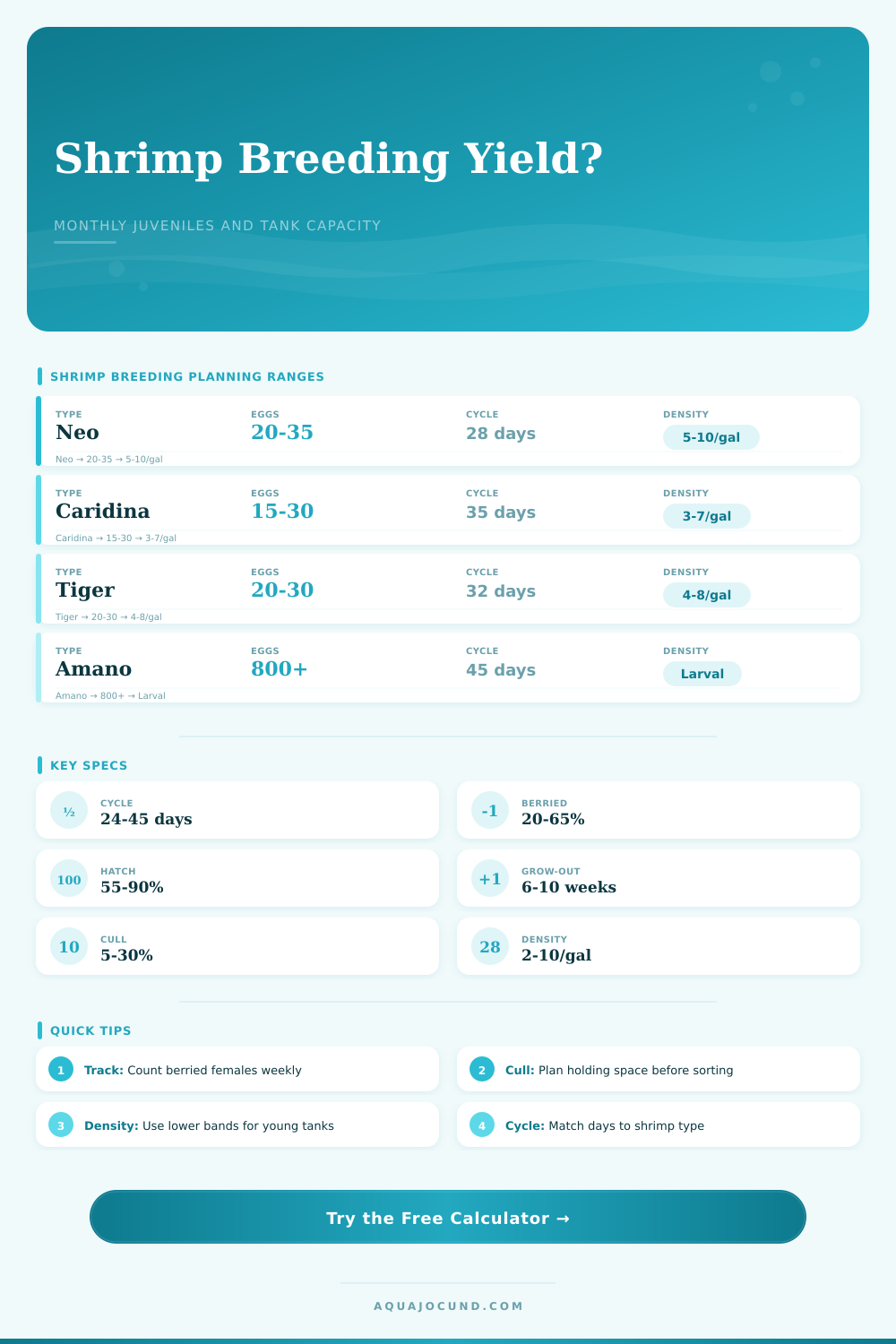
| Profile | Eggs / Female | Cycle Days | Capacity Density |
|---|---|---|---|
| Neocaridina Colony | 20 to 35 eggs; young females often lower | 24 to 32 days between berried batches | 5 to 10 juveniles per gallon, 1.3 to 2.6 per liter |
| Caridina Bee / Taiwan Bee | 15 to 30 eggs; slower but steady in stable water | 28 to 40 days depending on temperature | 3 to 7 juveniles per gallon, 0.8 to 1.8 per liter |
| Tiger Shrimp Line | 20 to 30 eggs with moderate hatch counts | 28 to 36 days in typical shrimp-room ranges | 4 to 8 juveniles per gallon, 1.1 to 2.1 per liter |
| Sulawesi Shrimp Colony | 10 to 20 larger eggs; lower batch counts | 32 to 45 days in warm mineralized water | 2 to 5 juveniles per gallon, 0.5 to 1.3 per liter |
| Amano Larval Batch | Hundreds of larvae; stage changes are separate | 35 to 50 days through larval grow-out | Larval density should be set from the rearing vessel |
| Ghost / Grass Shrimp | 40 to 80 eggs with variable larval survival | 24 to 35 days for repeating brood cycles | 4 to 9 juveniles per gallon, 1.1 to 2.4 per liter |
| Macrobrachium Dwarf Shrimp | 20 to 60 eggs with more spacing needed | 30 to 45 days depending on species and temperature | 2 to 6 juveniles per gallon, 0.5 to 1.6 per liter |
| Tank | Dimensions | Usable Volume | Juvenile Capacity Range |
|---|---|---|---|
| 5 Gallon Nano | 16 in x 8 in x 10 in / 41 x 20 x 25 cm | About 4.5 gal / 17 L at 90% | 18 to 45 juveniles at 4 to 10 per gallon |
| 10 Gallon Standard | 20 in x 10 in x 12 in / 51 x 25 x 30 cm | About 9.3 gal / 35 L at 90% | 37 to 93 juveniles at 4 to 10 per gallon |
| 20 Gallon Long | 30 in x 12 in x 12 in / 76 x 30 x 30 cm | About 16.8 gal / 64 L at 90% | 67 to 168 juveniles at 4 to 10 per gallon |
| 29 Gallon | 30 in x 12 in x 18 in / 76 x 30 x 46 cm | About 25.2 gal / 95 L at 90% | 101 to 252 juveniles at 4 to 10 per gallon |
| 40 Breeder | 36 in x 18 in x 16 in / 91 x 46 x 41 cm | About 40.4 gal / 153 L at 90% | 162 to 404 juveniles at 4 to 10 per gallon |
| 55 Gallon Rack Tank | 48 in x 13 in x 21 in / 122 x 33 x 53 cm | About 51.1 gal / 193 L at 90% | 204 to 511 juveniles at 4 to 10 per gallon |
| Step | Formula | What It Represents | Use In Capacity Plan |
|---|---|---|---|
| Mature Females | Breeders x female share | Estimated females able to become berried | Sets the maximum repeating batch size |
| Berried Females | Mature females x berried rate | Females carrying eggs in one cycle | Best tracked by weekly visual counts |
| Hatched Young | Berried females x eggs x hatch survival | Young shrimp reaching first free-moving stage | Shows hatch output before grow-out losses |
| Selected Juveniles | Hatched young x grow survival x after-cull share | Juveniles kept after nursery loss and sorting | Feeds the monthly juvenile count result |
| Active Load | Monthly juveniles x holding weeks / 4.345 | Juveniles occupying grow-out space at once | Compare directly with tank capacity |
| Tank Capacity | Volume x density x capacity buffer | Practical juvenile spaces in grow-out tanks | Flags whether more grow-out space is needed |
That’s why most people begin their journey with shrimp: to have a alive tank. The tank is full of red or blue shrimp darting in and out of plants like a dense carpet. Sounds easy? Until you begin to plan to expand it.
There is a big distinction between a hobbyist who keeps a few pet for enjoyment versus one who runs a serious colony. Often, it isn’t due to talent but rather math.
How the Shrimp Calculator Helps You Plan
How many juveniles do you expect to drop into the tank per month? Will there be enough room in your grow-out tanks? The stress from overfilling the tanks impact everyone.
After plugging in your breeding profile and tank dimensions into the tool (above), it takes care of all the math for you. No guessing. Instead, it factors in the biological fact that not all females breed each cycle.
After inputting your number of breeder, the calculator uses the female share percentage. Then it calculates the actual production ceiling using the berried rate. Most new breeders fall prey here.
If they have thirty adult shrimp, they think they’ll produce thirty offspring per cycle. Not usually. In a stable Neocaridina colony, only about forty percent of the females will be carrying eggs during any given month. The remaining ones is either too young or they’re simply resting.
The calculator accounts for that variation for you. It provides a realistic number of juvenile per month, not some best-case fantasy.
The other variable is hatch survival. This seems like an abstract variable when you are not losing a batch but if you do, it can help. Maybe you have all the right water parameters. But maybe you don’t have enough hiding place. Or maybe your flow is too strong for neonates. In this case, those little shrimplets go missing.
With the nursery survival variable you can account for how your set up is arranged in your tank. If your tank has heavy planting and gentle sponge filters, then your survival rate might be around 82%. If you have a bare bottom tub with aggressive filtration, that number could go down to 60 or so.
I mean you know your water more than some generalized guideline. So having the ability to plug in what you actualy observe will make the projection meaningful. It is not just theoretical.
Next we get to the cull percentage. That’s the business aspect of this hobby. When you breed cherries, for example, you’ll end up with some fish that aren’t so good. Maybe they’re too pale. Maybe they’re slightly deformed.
By keeping them, you water down the genetic quality of your colony. You also use up precious space. So how many do you cull? There’s no easy answer here. The presets help guide you a little bit based off typical sorting criteria.
With the calculator, you can set your own cull rate. This is the percent of your juveniles that you’ll remove from the equation before moving them into the main grow-out phase. This is where ambition meets reality.
What can you fit in the space you have? That’s where capacity planning comes in. How much volume does your tank hold? How many shrimp will fits in there as juveniles? The calculator takes your tank volume, applies some breathing room (because you shouldn’t overstock), and turns it into how many juvenile shrimp can go in the tank.
Why is this important? Young shrimp don’t jump out the first day. It’ll take them several weeks to get big enough to sell/display. They’re taking up space during that time.
So if you’re producing 100 juvenile shrimp per month and keeping them in the tank for eight weeks, then you’ll have something like 300 shrimp in the tank at any point in time. That’s what the calculator shows you (the amount of actual load on your tank).
And if that number is bigger than your tank, then you’re gonna overcrowd your grow-out tanks before you know it.
There are also some reference tables on the page that will show you the baseline data for various species. For example, Caridina need specific water conditions and longer cycle times, while Neos breed much more quickly and often. The tiger shrimp is in between.
This alters the default inputs pretty dramatically when you know what profile your stock falls under. A tank that is too large for a slow-breeding Sulawesi line could be the perfect size for a fast-turning cherry colony.
So this is ultimately a tool to help plan. This isn’t a crystal ball. This won’t predict a spike in nitrates. This won’t predict equipment failure.
What it will do, however, is let you know whether or not you’re physically capable of maintaining a large colony given your current set up. The numbers will tell you if you’ve overshot your capacity. Then you can add an additional tank before you start to breed.
The numbers will tell you if you have few juveniles. You’ll know to fix your breeding conditions instead of purchasing more stock.
Every time, planning trumps panic.