💧 Shallow Tank Volume Calculator
Estimate shallow rimless water volume from low fill depth, wide footprint, substrate bed, hardscape displacement, evaporation reserve, and surface gas exchange.
| Shallow layout | Footprint behavior | Volume behavior | Gas exchange note |
|---|---|---|---|
| Wide Lagoon reef | Large front-to-back area | Moderate gallons at low depth | High exchange when rippled; evaporation reserve matters. |
| Stable 20 long river | Long rectangular footprint | Predictable depth-to-volume change | Good surface per gallon even with gentle flow. |
| Broad Frag tray | Very high surface area | Small depth changes move many gallons | Excellent gas exchange, faster top-off demand. |
| Compact Shallow cube | Balanced square footprint | Less reserve than a lagoon of same volume | Agitation has a bigger effect on the final metric. |
| Common shallow size | Inside dimensions | Typical fill | Approx gross volume |
|---|---|---|---|
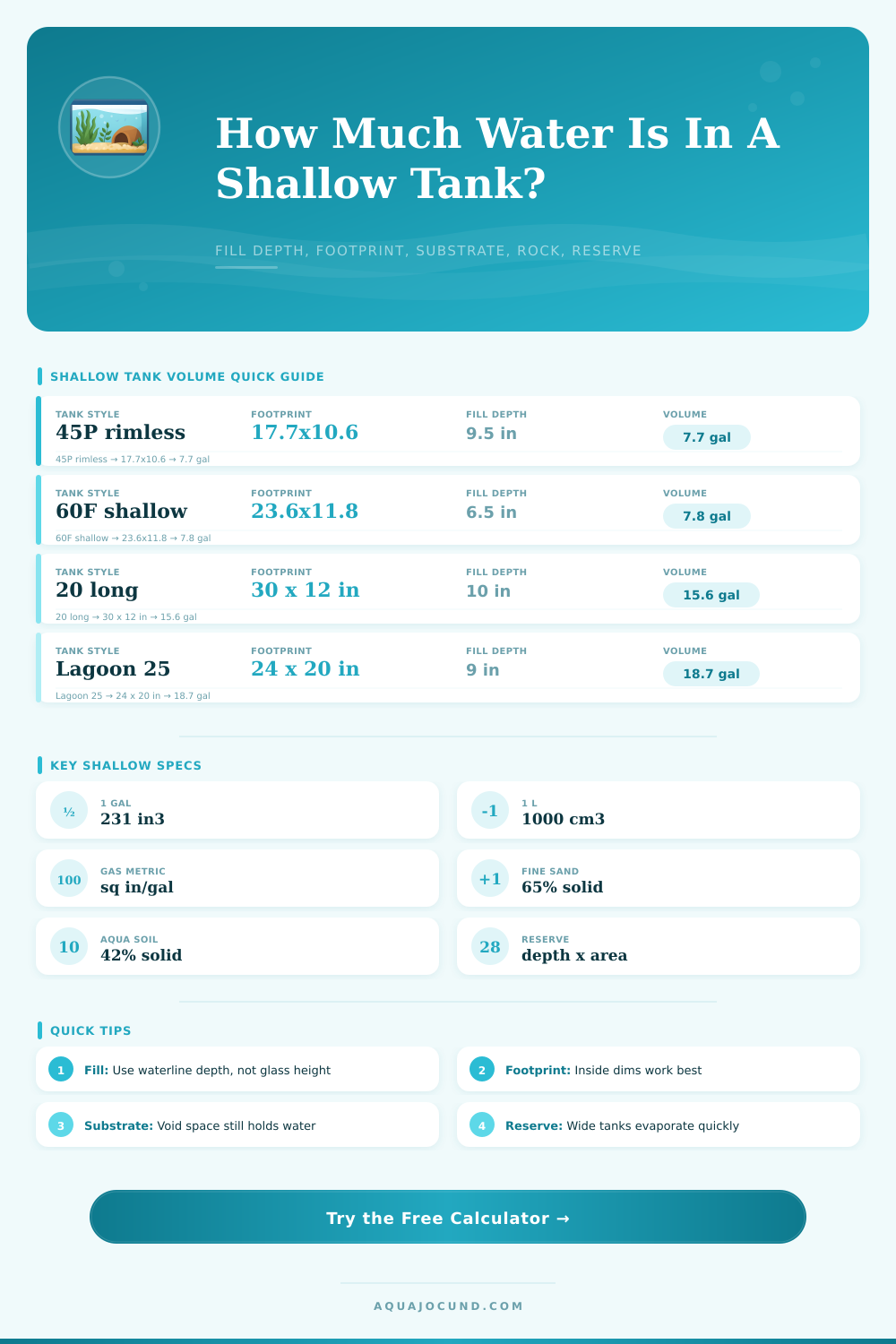
| 45P rimless | 17.7 x 10.6 x 11.8 in / 45 x 27 x 30 cm | 9.5 in / 24 cm | 7.7 gal / 29 L |
| 60F shallow | 23.6 x 11.8 x 7.1 in / 60 x 30 x 18 cm | 6.5 in / 16.5 cm | 7.8 gal / 29 L |
| 20 long low fill | 30 x 12 x 12 in / 76 x 30 x 30 cm | 10 in / 25 cm | 15.6 gal / 59 L |
| 25 lagoon | 24 x 20 x 12 in / 61 x 51 x 30 cm | 9 in / 23 cm | 18.7 gal / 71 L |
| 40 breeder shallow | 36 x 18 x 16 in / 91 x 46 x 41 cm | 12 in / 30 cm | 33.7 gal / 128 L |
| Bed or hardscape input | Default data | Calculator use | Best measuring method |
|---|---|---|---|
| Fine sand | 65% solid fraction | Counts 65% of bed volume as displacement | Average the front and back bed depth. |
| Aqua soil | 42% solid fraction | Leaves more pore water in the net volume | Use settled depth after wetting and leveling. |
| Seiryu stone | 19 lb/gal, 6% porosity | Dense stone displaces more water per pound | Weigh dry stone before placing it in the tank. |
| Driftwood | 5.5 lb/gal, 20% pore credit | Lower density, partly water-filled pores | Use soaked weight for a conservative estimate. |
| Gas exchange metric | Adjusted surface area | Typical reading | Volume planning note |
|---|---|---|---|
| Below 12 sq in/gal | Low for a shallow display | Usually deep for its footprint | Use stronger ripple and avoid overestimating reserve. |
| 12 to 18 sq in/gal | Moderate | Common in low long aquariums | Good general target for routine volume estimates. |
| 18 to 28 sq in/gal | High | Typical lagoon or frag footprint | Expect faster evaporation than a standard tall tank. |
| Above 28 sq in/gal | Very high | Tray, riparium, or paludarium style | Small waterline changes may be large percentage swings. |
When most of us started keeping fish we used a regular tall tank. Now many people are selecting a wide shallow set up. While there is nothing wrong with a tall tank, it does not provide the same panoramic view of reef or plants as a wide, shallow system do. One problem with such vessels, they don’t hold as much and water level changes matter. If your tank has a 1″ change in water height it is a huge portion of your overall capacity.
You want to know your net volume, not just what is on the manufacturers sticker. This is where the calculator on this page come in handy, distinguishing between numbers used for marketing versus those that reflect reality. If I purchase a 45 liter tank, then 45 is generaly referring to gross capacity (assuming it’s full). But of course, you don’t fill it to the brim because of aesthetics and/or equipment placement. Then you throw in some rock and substrate, and suddenly what was once a 45 liter tank might only be a 30 liter tank. This tool takes all that into account and allows you to know how much you have without having to guess while trying to calculate filter turnover rate and such as well as how much chemical to dose.
How to Find Your Real Tank Volume
Remember: In shallow tanks, a little bit goes a long way. Every input needs to be precise. Don’t measure the outside dimension. Use inside dimensions. The glass thickness matter. Rimless tanks have thicker glass compared to braced tanks. That reduces your available interior space. Also, measure the inside corner to the opposite inside corner.
Next, calculate your actual fill depth, also known as the operating depth. This is height of water in the tank, measured from the bottom up. Leave room above the water line (the freeboard) for your skimmers and splashing. This freeboard space doesn’t contain any fish. It’s all air.
Most folks lose sight when they start thinking about substrate displacement. Even a thin two inches of sand, which doesn’t sound like much, displaces quite a bit of water in a large tank. That’s where the solid fraction percentage comes into play with the calculator. Fine sand packs tightly, meaning more volume is taken up by silica and there is less water. Aquatic soils are also porous, leaving more water space inside the bed. This becomes important when thinking about bacterial colony size and nutrient export. You’ll want to account for how much the porous aquatic soil holds so that you don’t overestimate the displacement (think dense gravel) and subsequently underestimate the water.
Weight enters the equation when looking at hardscape. Some rocks are denser (e.g., dragon stone) than others (e.g., lava rock). This means they has more mass for a given volume. Because of this, every pound of dense rock in your tank displaces less water then its lighter counterparts. To accurately determine how much void space there really is, the tool will ask for density and weight of your rocks. Some rocks are porous, so they’ll retain water within their inner makeup. While that water isn’t available for free flow, it does count towards the overall volume of your system. Considering this porosity help you understand what your filtration system needs to work with.
Another thing that affects shallow tanks bad is evaporation. You lose water more quickly with a broad surface area compared to a narrow one; e.g., sitting next to a heater or in a warm room. The reserve calculation accounts for evaporative losses during a few days. That way you can size your auto-fill reservoir and determine how frequently to do a top-off. If you run out of reserve time between top offs, your water level may drop too low for the skimmer inlet or your salinity could increase. This is bad because fixing it is a messy job to do after hours.
All of that relates back to gas exchange efficiency. The more surface area relative to water volume, the more efficient it will be at getting oxygen into the water while off-gassing CO2. In general, that’s great for coral health and plant growth. A wide surface area is also why it evaporates so quickly. That gas exchange number in the results will help you sort through those competing requirements. Higher numbers will result in more efficient surface agitation benefits but faster water loss.
If you’re planning to set up a shallow tank, know going in that your tank volume is dynamic. Each rock you put into it displaces some water; each inch of substrate reduce it. If you want your biological load to match your real world water capacity, take exact measurements (of both depth and displacement). Don’t depend on what’s printed on the box. You should of gotten out your scale and measuring tape and leave the math to the numbers. Your fish will appreciate the accuracyl.