🪨 Seiryu Stone Aquascape Calculator
Estimate Seiryu stone weight, displacement, KH effect, tank load, and iwagumi visual balance.
| Stone Grade | Density | KH Factor | Best Use |
|---|---|---|---|
| Standard Seiryu | 2.65 g/cm³ | 1.00 | Main hardscape |
| Dense Blue Gray | 2.78 g/cm³ | 1.10 | Tall oyaishi |
| Mini Landscape | 2.55 g/cm³ | 0.95 | Nano accents |
| Weathered Porous | 2.42 g/cm³ | 1.20 | Texture detail |
| Mixed Box | 2.60 g/cm³ | 1.05 | Budgeted layouts |
| Acid Rinsed / Aged | 2.62 g/cm³ | 0.55 | Softwater tanks |
| Tank | Dimensions | Volume | Typical Seiryu |
|---|---|---|---|
| 10 Gallon | 20 × 10 × 12 in / 51 × 25 × 30 cm | 38 L | 9-17 lb / 4-8 kg |
| 20 Long | 30 × 12 × 12 in / 76 × 30 × 30 cm | 76 L | 20-35 lb / 9-16 kg |
| 40 Breeder | 36 × 18 × 17 in / 91 × 46 × 43 cm | 151 L | 45-75 lb / 20-34 kg |
| 55 Gallon | 48 × 13 × 21 in / 122 × 33 × 53 cm | 208 L | 55-95 lb / 25-43 kg |
| 75 Gallon | 48 × 18 × 21 in / 122 × 46 × 53 cm | 284 L | 80-140 lb / 36-64 kg |
| 125 Gallon | 72 × 18 × 22 in / 183 × 46 × 56 cm | 473 L | 135-230 lb / 61-104 kg |
| Role | Weight Share | Height Target | Placement Cue |
|---|---|---|---|
| Oyaishi main stone | 40-55% | 55-70% tank height | Near 0.382 length |
| Fukuishi second stone | 18-28% | 45-60% main stone | Opposite lean support |
| Soeishi accent stones | 12-22% | 25-45% main stone | Lead viewer eye line |
| Suteishi detail stones | 8-18% | 10-30% main stone | Partly buried foreground |
| Rock Load | Approx Rate | Monitoring | Risk |
|---|---|---|---|
| Under 1 kg per 40 L | 0.1-0.3 dKH/week | Weekly | Low |
| 1-2 kg per 40 L | 0.3-0.8 dKH/week | Twice weekly | Medium |
| 2-4 kg per 40 L | 0.8-1.6 dKH/week | Twice weekly | High |
| Over 4 kg per 40 L | 1.6+ dKH/week | Frequent testing | Very high |
Seiryu stone is often used in aquascaping layouts to add elements with a gray tone and sharp edges to the otherwise bright aquatic environments. Many people use Seiryu stone in there home aquariums. However, few people is aware that using this stone will change the chemistry of the water in the tank.
To assist with this, calculators are available to determine the chemistry of the Seiryu stone in your tank by entering the dimensions of the aquarium and the type of aquascaping layout you will use for your Seiryu stone. To use the calculator, you will need to input the length, the width, and the height of your aqua tank. The calculator will use these dimension to determine the volume of your tank.
How Seiryu Stone Affects Your Aquarium Water and Weight
Additionally, you will need to input the grade of the Seiryu stone that you will use in your aquascaping layout. The grade determine the density of the stone and how much it will contribute to the carbonate hardness of the water. You will also need to input the style of aquascaping layout that you will use.
Finally, you will need to input the number of Seiryu stones that you will use in your aquascaping project and the height of the main stone in your layout. Using these inputs, the calculator will provide four specific results for your aquascaping project. The first result will be the total weight of the Seiryu stone and water that your tank will contain.
This help to ensure that the stand upon which you place your tank can support the weight of the tank and its contents. The second result will be the displacement of the Seiryu stone. This will help you to understand how much water your tank will contain.
The third result will be the estimated rise of the KH of your tanks water. The fourth result will be the visual ratio score of your aquascaping project. Seiryu stone contain minerals that will dissolve in the water once the Seiryu stone becomes wet.
These minerals contain carbonate, which will increase the KH of the water over time. The higher the amount of Seiryu stone in your tank and the lower the water change rate, the faster the KH of the water will rise. High levels of KH affect the availability of nutrients to the plants in your tank and may also negatively impact the livestock living in the tank.
However, the calculator will factor in these variable as well, as the change of the water in your tank and the CO2 levels in that water will also affect the KH of the water. Beyond the aquarium chemistry that the calculator will calculate, the calculator will also determine the total weight of the Seiryu stone in the tank. Seiryu stone is a dense stone, weighing approximately 2.5 times as much than water.
This value will help you to understand if the stand of your aquarium can support the total weight of the aquarium. Additionally, the calculator will determine how much water the Seiryu stone will displace. Because the livestock live in the water, it is important for you to understand how much water your tank will contain.
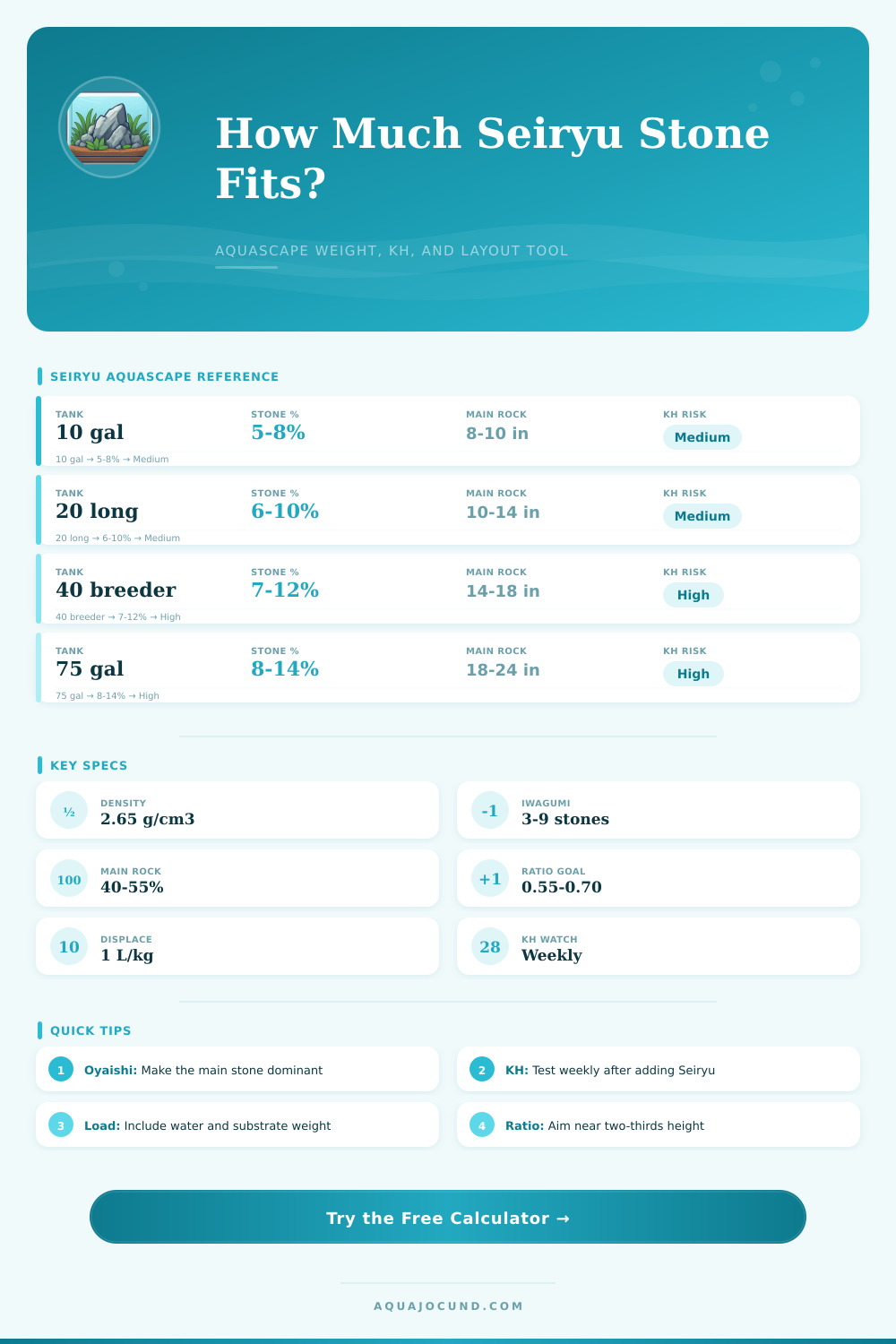
Beyond providing the four specific results for your aquascaping project, the calculator will also include tables that provide additional information for your project. One table will display information about the different grade of Seiryu stone and their impact upon the chemistry of the tank. Another table will display the weight of different amounts of Seiryu stone for different sizes of aquatonic tanks.
Another table will show the role that each stone plays within the projects aquascaping design and the weight and height of each of these stones. These tables are not strict rule to the project, but they provide information about the proportions of each role in the project. Aquascapers should avoid using Seiryu stone in a manner that treats the main stone within an iwagumi layout as merely a tall rock.
Instead, the main stone, or the oyaishi, should occupy between 55 and 70% of the height of the tank. Additionally, it should sit within the golden section of the length of the tank. Supporting stones should be arranged along the angle of the oyaishi stone, not directly in the path of the main stone.
The calculator will calculate the visual ratio score of your project to reward you for adhering to these guidelines. Projects that has an odd number of stones tend to score higher on the visual ratio score. Additionally, if your visual score is low, it is likely due to the fact that the height of the main stone in your project is too short or the spread of your stones within the project is too narrow.
Another mistake that aquascapers should avoid is using the Seiryu stone to displace the volume of water in the tank. The depth of the substrate that is used in the aquarium will displace some of the water in the tank. However, the calculator account for this.
With the information provided by the calculator, aquascapers can gain an understanding of how much water is in the tank after the Seiryu stone and substrate have displaced some of the water in the aquarium. Because the livestock live in the aquarium water, it is important to understand the total volume of water in the tank. If aquascapers use the calculator with the intention of understanding how the Seiryu stone will chemically impact the water in the tank, the calculator will allow those aquascapers to decide if using Seiryu stone in the aquarium is the right choice for that specific aquarium.
You should of used it to be sure. It’s actualy very helpfull.