🧪 Seachem Equilibrium Dosing Calculator
Calculate Equilibrium™ grams, teaspoons, GH rise, potassium, calcium, magnesium, water-change batches, display corrections, and staged split dosing.
| Constant | Value Used | Calculator Use | Practical Note |
|---|---|---|---|
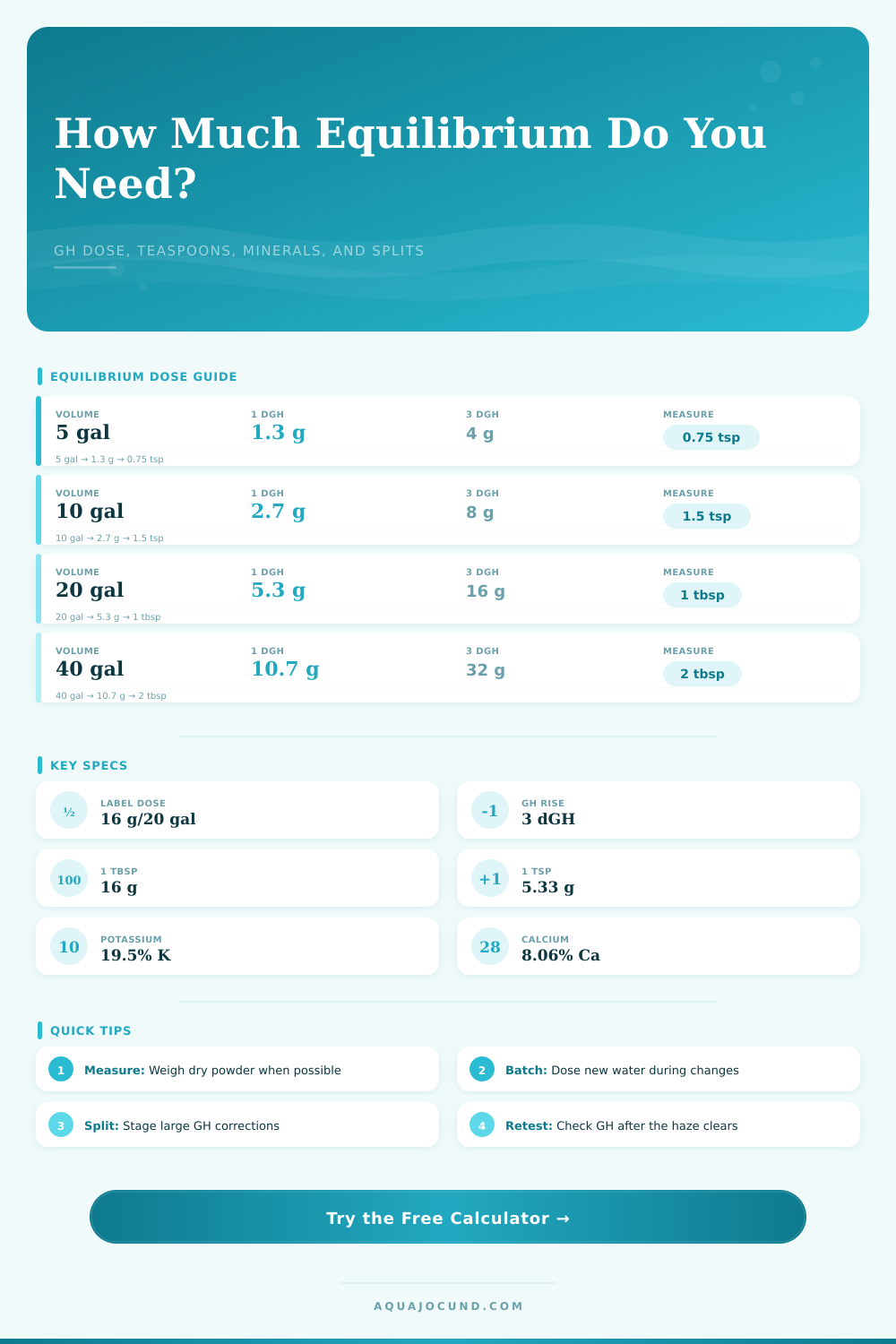
| Label dose | 16 g per 20 gal | Raises GH by 3 dGH | Same as 1 tablespoon by label volume |
| Per 1 dGH | 5.33 g per 20 gal | Linear dose scaling | Works from current GH to target GH |
| Teaspoon estimate | 5.33 g per tsp | Converts grams to tsp | Powder compaction changes spoon accuracy |
| Tablespoon estimate | 16 g per tbsp | Converts grams to tbsp | Use a scale for precise dosing |
| Solubility mix | 1 qt or 1 L | Pre-mix planning | Temporary white haze is expected |
| Component | By Weight | Per Gram Product | How Calculator Uses It |
|---|---|---|---|
| Potassium as elemental K | 19.5% | 195 mg | Estimated K ppm contribution |
| Calcium | 8.06% | 80.6 mg | Estimated Ca ppm contribution |
| Magnesium | 2.41% | 24.1 mg | Estimated Mg ppm contribution |
| Iron | 0.11% | 1.1 mg | Trace estimate in breakdown |
| Manganese | 0.06% | 0.6 mg | Trace estimate in breakdown |
| Aquarium Profile | Common GH Target | Equilibrium Role | Watch Point |
|---|---|---|---|
| Soft planted | 3 to 5 dGH | Adds Ca, Mg, and K | Do not chase KH with this product |
| General planted | 3 to 6 dGH | Matches common plant range | Retest after mixing clears |
| Community fish | 5 to 10 dGH | Corrects soft source water | Make large changes gradually |
| Neocaridina shrimp | 6 to 8 dGH | Supplies calcium and magnesium | Stage corrections to reduce stress |
| Hardwater plants | 8 to 12 dGH | Can raise GH without sodium chloride | Potassium rises with every dose |
| Batch Or Tank | Volume | Dose For +1 dGH | Dose For +3 dGH | Typical Use |
|---|---|---|---|---|
| Nano change | 5 gal / 19 L | 1.3 g | 4 g | Small planted batch |
| Shrimp change | 10 gal / 38 L | 2.7 g | 8 g | Measured RO/DI refill |
| Label reference | 20 gal / 80 L | 5.3 g | 16 g | One tablespoon label dose |
| Large change | 40 gal / 151 L | 10.7 g | 32 g | Large planted water change |
| Display correction | 75 gal / 284 L | 20 g | 60 g | Split into smaller additions |
If you’re experiencing lethargic shrimp, particularly with a water test showing zero hardness, be careful. Using an equilibrium can fix this problem, but you should of use it sparingly. To avoid guesswork that can cause osmotic shock or cloudy water, follow the directions on package.
Enter your parameters (hardness target, volume of water) into the calculator tool, which will tell you exactly how much you should use. You are not just adding salt; you are rebuilding the ionic structure of your water. It also rebuilds the ionic structure of your water. Calcium, magnesium, and potassium ions was part of the freshwater environment from which all life emerged. When you use reverse osmosis, it strips those ions out of your water resulting in blank water.
How to Use the Water Hardness Calculator Correctly
The amount of product required depend on the gap between your starting and ending GH values. You will need less product if your water is hard. You get more product if you start out with distilled water. A common mistake by new aquarists is that they dose based off their target GH value instead of the gap. This assumes a blank canvas, ignoring existing hardness of your water. Dose what you’re replacing, not the total amount of water in your tank.
A lot of folks think that when it’s time for a water change, they need to dose the whole tank. That’s not true. Always dose the replacement water to match the existing water prior to putting it into the tank. Display dosing vs. Batch dosing is how the calculator makes this distinction. It maintains the chemical stability. Each week, you will be overdosing by a factor of five or six if you dose all the water in the tank.
When you understand that you’re just adding gallons of fresh water, the math get simpler. To make larger corrections use the split dosage. It’s important to not shock your sensitive invertebrates with too much hardness all at one time. The tool has a max rise setting on it so you can break up a big correction into something more manageable. You’ll mix part of what’s needed, wait an hour or two, test again, then add another portion. It is slow but being patient leads to stability.
When you mix it, there will be a haze to the water that is temporary. That’s because minerals is dissolving. Don’t confuse clarity with safety. Minerals matter a lot, particulary potassium. Plants like it. Potassium is present at high levels in Equilibrium. Magnesium and calcium are provided as well. Those minerals will be used to make plant cell walls and shrimp shell.
If they aren’t in a tank with this product, shrimp simply won’t molt properaly over time. Why? Because they don’t have what they need to grow. How many minerals do you get from every gram of powder? The chart tells you that too. There’s a table on the page for all of the minerals. Know that it isn’t just about hardness. Balance is key.
Always use a scale when weighing powders if possible. Powder compacts with each measure so measuring spoons can be very inaccurate. Digital scales take that out of the equation. You will get an estimate in spoon sizes as well as grams, but the scale is much more consistent. It’s all about accurate dosing. When you do it, there is no more guessing.
After a few weeks you have a routine down and the panic subsides. Panic turns into maintaining parameters. Plants grow, water clears up and shrimp molt without issue. That is the power of careful chemistry, not magic.