🐟 Schooling Fish Minimum Number Calculator
Estimate the minimum and better group size for social aquarium fish using species behavior, tank space, and stress factors.
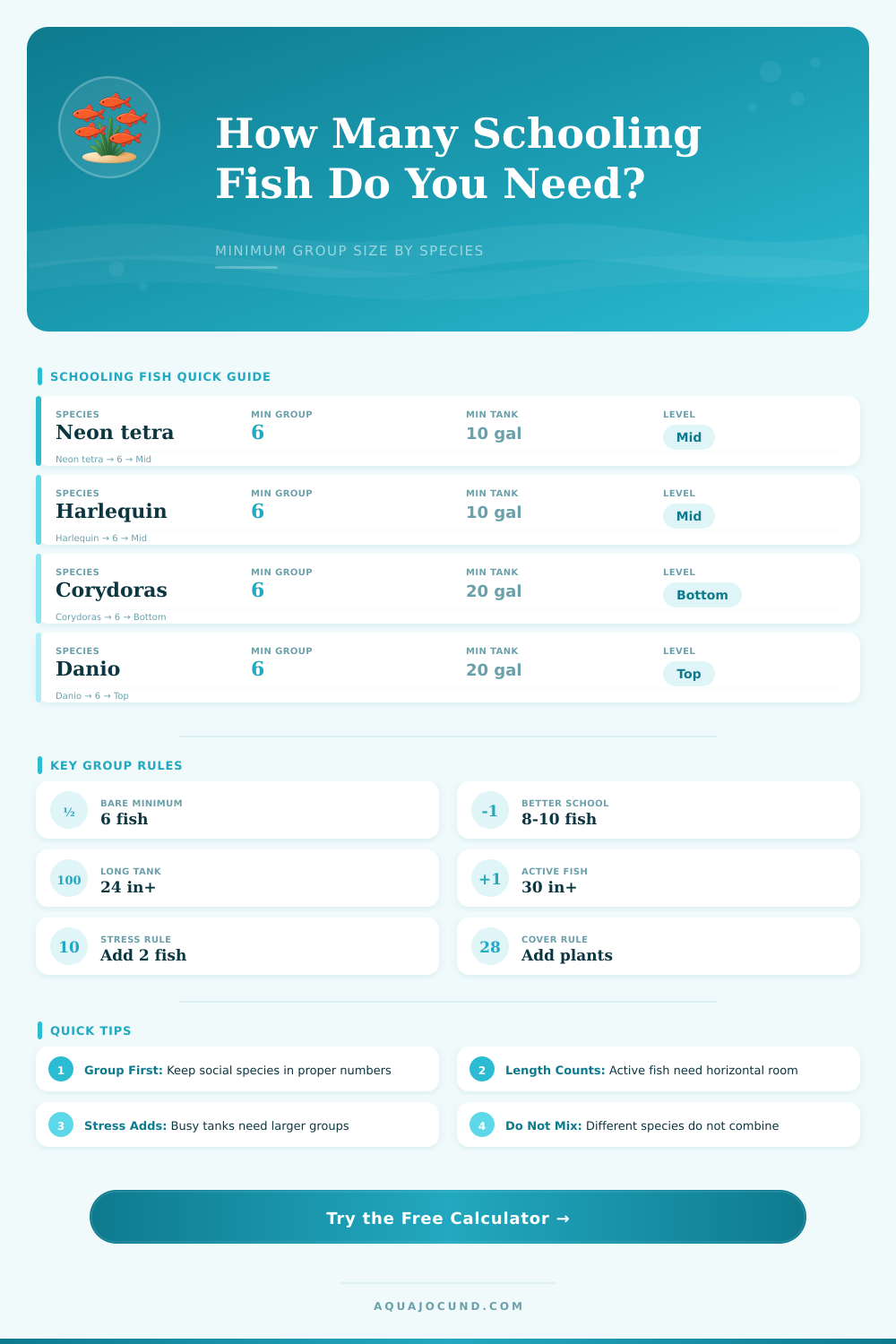
| Species | Minimum | Better Group | Adult Size | Min Tank | Swim Level | Schooling Need |
|---|---|---|---|---|---|---|
| Neon Tetra | 6 | 10+ | 1.5 in | 10 gal | Mid | Moderate |
| Cardinal Tetra | 6 | 10+ | 2 in | 20 gal | Mid | Moderate |
| Rummy Nose Tetra | 8 | 12+ | 2 in | 20 gal | Mid | High |
| Harlequin Rasbora | 6 | 10+ | 1.8 in | 10 gal | Mid | Moderate |
| Cherry Barb | 6 | 8+ | 2 in | 20 gal | Mid | Social |
| Tiger Barb | 8 | 10+ | 3 in | 30 gal | Mid | High |
| Zebra Danio | 6 | 10+ | 2 in | 20 gal | Top | Active |
| Corydoras Catfish | 6 | 8+ | 2.5 in | 20 gal | Bottom | Social |
| Pygmy Corydoras | 8 | 12+ | 1 in | 10 gal | Bottom/Mid | High |
| Congo Tetra | 6 | 8+ | 3.5 in | 55 gal | Mid | Active |
| Silver Dollar | 5 | 6+ | 6 in | 75 gal | Mid | Nervous |
| Marbled Hatchetfish | 6 | 8+ | 1.5 in | 20 gal | Surface | Social |
| Tank | Typical Dimensions | Best School Types | Comfortable Group Range | Watch For |
|---|---|---|---|---|
| 10 Gallon | 20 × 10 × 12 in | Neons, chili rasboras, pygmy corys | 6 to 10 small fish | Limited swim length |
| 20 High | 24 × 12 × 16 in | Tetras, rasboras, corys | 8 to 14 small fish | Height is less useful than length |
| 20 Long | 30 × 12 × 12 in | Danios, corys, rummy nose | 10 to 16 small fish | Excellent length for small schools |
| 29 Gallon | 30 × 12 × 18 in | Barbs, tetras, rasboras | 10 to 18 small fish | Keep top, mid, bottom balanced |
| 40 Breeder | 36 × 18 × 16 in | Corys, barbs, larger rasboras | 12 to 24 small fish | Strong footprint for bottom schools |
| 55 Gallon | 48 × 13 × 21 in | Congo tetras, barbs, danios | 14 to 30 small fish | Narrow front-to-back space |
| 75 Gallon | 48 × 18 × 21 in | Large tetras, rainbows, barbs | 18 to 36 small fish | Allow open swim lanes |
| 125 Gallon | 72 × 18 × 22 in | Silver dollars, congos, rainbows | 6+ large or 30+ small fish | Large species still need room |
| Factor | Low Stress | Neutral | High Stress | Group Effect |
|---|---|---|---|---|
| Tankmates | Peaceful nano fish | Mixed community | Large or boisterous fish | Add 1 to 2 fish when stress is high |
| Cover | Dense plants, driftwood | Some plants | Bare, bright layout | Cover can reduce visible panic |
| Current | Matches species | Acceptable flow | Too weak or too strong | Mismatch raises schooling stress |
| Tank Maturity | Stable and filtered | Mature baseline | New or unstable | Do not push ideal counts in new tanks |
| Species Need | Loose social group | Regular shoal | Tight schooler | High-need species start higher |
| Swim Style | Examples | Minimum Length | Footprint Priority | Notes |
|---|---|---|---|---|
| Calm midwater | Neons, harlequins | 20 to 24 in | Moderate | Plant edges help confidence |
| Tight schooler | Rummy nose, cardinals | 24 to 30 in | High | Keep larger groups for best behavior |
| Fast top swimmer | Zebra danios, hatchets | 30 in+ | High | Long tanks beat tall tanks |
| Bottom social | Corydoras | 24 in+ | Very high | Sand/open bottom improves foraging |
| Large shoaler | Congos, silver dollars | 48 to 72 in | Very high | Large fish need both group and room |
- Use one species at a time: Six fish means six of the same schooling species, not six mixed community fish.
- Minimum is not ideal: Many schooling fish survive at six but show calmer, tighter behavior at eight to twelve.
- Add gradually: If the tank is mature, adding the rest of a school at once often works better than adding one fish every few weeks.
- Watch body language: Hiding, glass surfing, faded color, and scattered panic often mean the group is too small or too exposed.
- Length matters: A longer tank usually supports schooling behavior better than a taller tank with the same volume.
- Keep levels separate: A midwater tetra school and a bottom cory group can coexist because they use different space.
- Barbs need numbers: Tiger barbs and similar active fish become less nippy when kept in larger same-species groups.
- Large shoalers are demanding: Silver dollars and Congo tetras need both group size and open swimming lanes.
Most new aquarists walk into a store imagining a peaceful aquarium world filled with colorful fish. They then exit carrying a bag of six neon tetras for their ten gallon tank because it’s all they can fit. You see them dashing around the tank frantically but never able to settle down enough to really school. So what is wrong? Why do your fish seem stressed out? Typically, it has less to do with how much water is in the tank than the amount of space there is to swim in and the number of other fish who shares his space. Fish are social creatures, and the dynamic of that relationship plays a large role in keeping them safe. Once you remove that equation, everything about him change.
After choosing your species and entering your tank’s dimensions into the calculator above, you don’t have to guess if your set-up will realy be OK or not, the calculator do all the work for you! But in order to understand how to make a school of fish happy, you’ll also need to know that they’re much more concerned with their horizontal space than their vertical space. Yes, a 10g is a 10g, but a tall ten gallon cube isn’t going to help a zebra danio any more then a flat plate would let a bird fly. Fish need length; specifically the length to allow them to cruise straight lines without colliding into the front glass. As such, the requirements asks for both specific dimensions and shape of tank instead of just total volume. A longer, lower aquarium is going to support their natural schooling behavior better than a taller, narrower tank of equal size since it resembles the river current they evolved to live in.
How Many Fish Should You Keep?
The number also depends on the behavior of species. Cherry barbs are less tight shoaling than rummy nose tetras, so they require fewer companions to feel comfortabley. Because the tool accounts for the social requirements of your chosen species, you can’t just go with absolute minimum number of fish. Three rummy noses in a tank would spends their days picking on one another or hiding. Six begin to behave as fish should. Ten actualy chill out and display their natural colors.
That’s the gradient where most errors occur, folks purchase the absolute minimum and declare that “it works” unaware that they failed to reach the comfort zone for any individual. How many fish do you really need? Aside from meeting the minimum number of fish, tank mate-induced stress is another important factor. Even if your shy tetras fit the bill, they’ll still be exposed to aggressive behavior by active barbs or boisterous corydoras. To make up for such stressors, the calculator provides higher numbers (i.e., more conspecifics) when other species co-exist in the same tank. More friends = less stress = fewer fish. Simple tradeoff.
Another way to achieve this is through dense planting. Cover provides nervous fish an escape route when overwhelmed. Less fish + more plant = possible. No conspecifics + more plant = nope. In addition, newly set up tanks are naturaly unstable, which adds further things to think about. A large number of fish will place significant pressure on your biological filtration. This tool also takes into account the age of the tank to advise against overstocking recently cycled systems. Instead, begin with a smaller amount and gradually increase as the environment becomes stable. Not only does this avoid ammonia spikes but it provides first group of fish friends to make them feel secure. A fully established tank can handle far more fish than a brand new tank. Patience pays here.
So at the end of the day, good aquarium keeping boils down to providing a home for your fish where they can’t tell that they’re in a box. A sign that you did well is when they explore all corners of your planted landscape, move like a tight school, and act as if there’s no boundary between themselves and what lies outside the tank. Fish are not hiding out of fear, but comfort; they’re comfortable enough with their surroundings to be curious. That behavior grows upon the foundation of getting the numbers right. It transforms an isolated collection of pets into a coordinated, thriving community which brings life to the room each time you pass by. You should of seen them thrive.