Sand Slope Volume Calculator
Estimate sloped aquarium sand volume, dry weight, compaction, and retaining rock margin.
🐟Presets
📏Calculator Inputs
Calculation Breakdown
🧪Substrate Density Grid
📊Sand Density Comparison
| Substrate | Typical dry density | Metric density | Best slope use |
|---|---|---|---|
| Silica aquarium sand | 95 lb/ft³ | 1.52 kg/L | General sloped displays |
| Pool filter sand | 95 lb/ft³ | 1.52 kg/L | Clean, even grades |
| Washed play sand | 100 lb/ft³ | 1.60 kg/L | Heavy low-budget layers |
| Aragonite sand | 88 lb/ft³ | 1.41 kg/L | Marine and high-KH layouts |
| Black blasting sand | 105 lb/ft³ | 1.68 kg/L | Steeper visual contrast slopes |
| Crushed coral | 84 lb/ft³ | 1.35 kg/L | Buffering pockets and banks |
| Aqua soil | 50 lb/ft³ | 0.80 kg/L | Planted terraces |
| Plant substrate blend | 70 lb/ft³ | 1.12 kg/L | Rooted background mounds |
📐Common Tank Slope Estimates
| Tank | Footprint | Volume | 1 to 3 in silica slope |
|---|---|---|---|
| 10 gallon | 20 x 10 in / 51 x 25 cm | 10 gal / 38 L | 2.3 gal / 28 lb |
| 20 long | 30 x 12 in / 76 x 30 cm | 20 gal / 76 L | 4.2 gal / 53 lb |
| 29 gallon | 30 x 12 in / 76 x 30 cm | 29 gal / 110 L | 4.2 gal / 53 lb |
| 40 breeder | 36 x 18 in / 91 x 46 cm | 40 gal / 151 L | 7.5 gal / 95 lb |
| 55 gallon | 48 x 13 in / 122 x 33 cm | 55 gal / 208 L | 7.2 gal / 91 lb |
| 75 gallon | 48 x 18 in / 122 x 46 cm | 75 gal / 284 L | 10.0 gal / 126 lb |
🧮Slope Formula Reference
| Item | Formula | What it means | Used in result |
|---|---|---|---|
| Average slope depth | (front + back + left + right) / 4 | Four-edge blended bed depth | Installed volume |
| Base layer volume | footprint x shallowest depth | Flat layer below every slope | Breakdown |
| Triangular prism extra | footprint x (average - shallowest) | Extra wedge above the base layer | Slope volume |
| Loose fill volume | installed x margins / (1 - compaction) | Dry amount before settling | Main result |
💡Practical Tips
If there’s anything most aquascapers discover about slopes, it’s this: what they look like on paper isn’t necessarily how they appear in the tank. A gentle incline from the front glass to the rear corner sounds nice, but what arrives is typicaly a bunch of randomness or a flat plane. There are always a few factors at play, but here’s the primary one: sand compacts. Under heavy rock loads, it move around, and when you plant things, it gets shoveled into position. This means that if you do not plan for some loss (you will lose sand), the gradient you envisioned will vanish by Week 1 of cycling.
The above tool removes the guesswork from the math by turning a theoretical inches number into a shopping list. However, knowing the “why” behind the math can save your design. Because it simulates what happens in a real tank, each input mimics what really exists.
Why You Need More Sand Than You Think
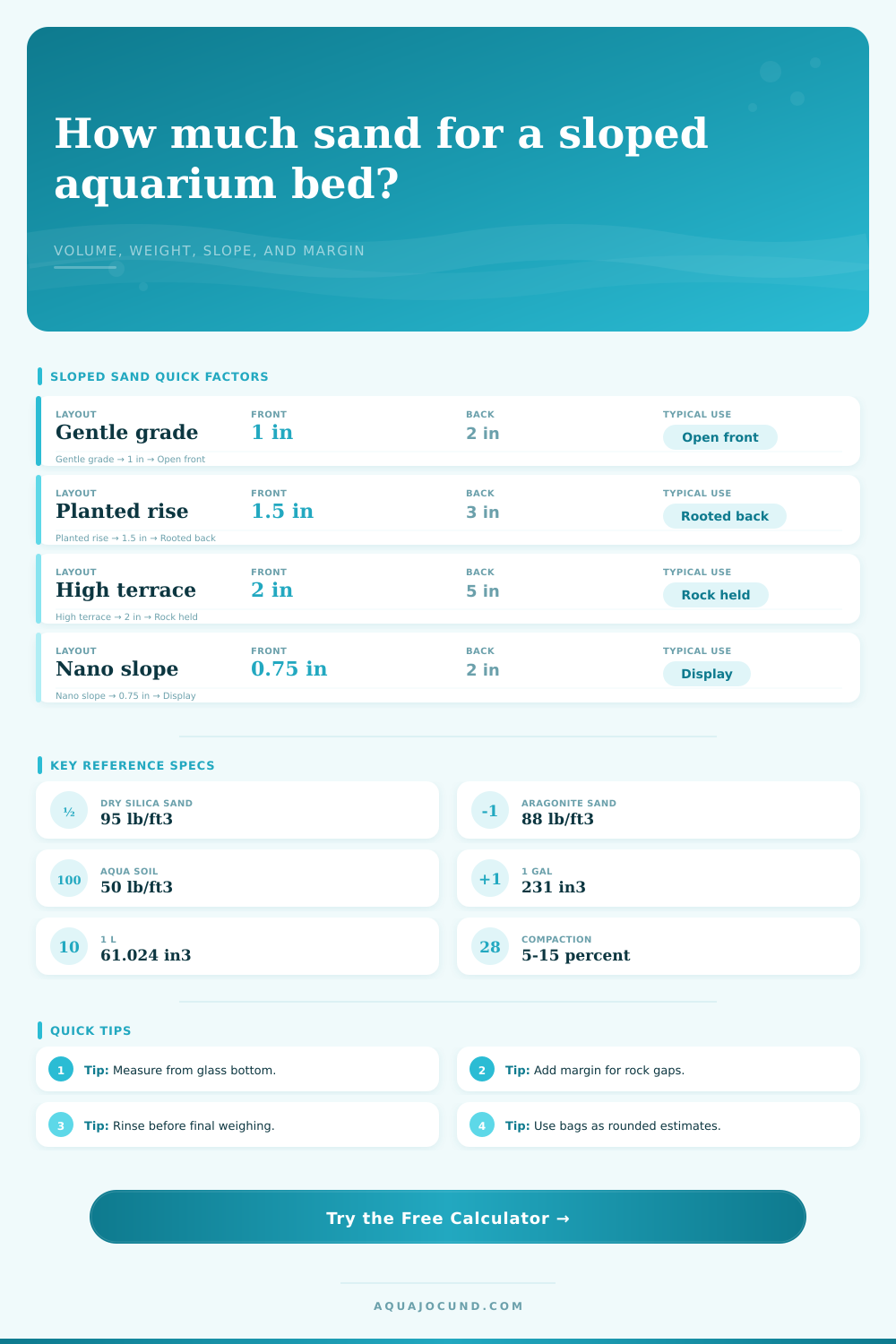
First, there’s the footprint. Depending on your tank style (e.g., bowfront vs. Rectangle) changes this. Second, there’s the slope. Third, there’s the depth, at four spots. Why four? Because most tanks aren’t exactly flat at the bottom. One inch deep at the front means I can see into my tank and the fish don’t dig up their dinner. Three inches deep at the back gives the roots some space to develop without smothering them. The software averages those four corner depths and calculates how much more volume is needed to form the triangular prism shape.
That’s a minor geometry tweak. But it is the difference between something that looks like a hill and something that looks like a steep wall that will collapse under its own weight.
The materials differ. Sand is silica sand, which weighs roughly 95 pounds per cubic foot. Aragonite weighs a little less than that, more like 88 pounds per cubic foot. Aqua soil is much lighter, typically hovering near 50 pounds per cubic foot. Black blasting sand can be very heavy (over 100 pounds per cubic foot). The substrate density is what powers the weight calculation in the results section. While it’s fun trivia, it isn’t trivia. Heavy substrates applies greater force on the stand and need stronger support structures. Lighter substrates will float if you’re not careful when rinsing them off. Select your specific substrate type so the calculator can adjust how many bags you’ll need. This ensures you aren’t guessing how much you’ll really have to move.
There’s also one variable that trips people up: compaction. Dry sand takes up more space than wet sand in your tank. Compaction allowances vary but are typically five to fifteen percent. You can adjust that with the tool. If you’re layering something that packs very tightly (e.g., fine grains), then you may wish to increase that number. If you’re using loose, coarse gravel, then you’ll keep that number low.
There’s also the matter of a rock margin. Voids exist under hardscape. Water moves around the stone, taking sand with it to fill the tiniest gaps behind it. An eight percent retaining rock margin is a good baseline. This allows for sand that always dissapears into the nooks and crannies where you cannot see it. Not accounting for this results in inevitable second visit to the pet store to purchase an additional bag because the front of the tank appears bare.
Here’s a look at how those margins break down. You have the base layer volume, this is the volume of just the sheet of sand spread across the whole floor. Next, you have the additional volume required to form the slope. And finally, you have the loose fill volume; which also accounts for the buffer margins around the rocks and compaction. This transparency allows you to see what it’s costing, and where your money goes. Your money is going towards additional sand used to fill out the gaps. That’s a good thing; it means your finished design won’t shift.
The price per pound is always cheaper when buying in bulk (bags). But handle carefuly! Most folks will find a 20 pound bag doable. Try a 50 pound bag of wet sand? That’s a back injury waiting to happen. Match what your local stores offer and use the bag size input. Before you ever leave home, you’ll be able to see the logistics.
Also, make sure you rinse the sand well before putting it into the tank. If fine particles are still present, they may float in the tank water and make it cloudy. This could make it hard to see for weeks. Keep in mind the calculator assumes you are buying dry weight. Rinse first, then weigh it if you have a scale. Otherwise, estimate how many bags you need based on amount found in a standard commercial product.
This is the bottom line. A decent slope shouldn’t be noticeable at all. There shouldn’t be a clear line between shallow and deep. Instead, there should be something that looks like a naturaly gradual decline leading your eye across the aquascape. The calculator provides those ingredients for creating that illusion. It takes the guesswork out of how much rock you need and how much it weighs so you can concentrate on where things go and how plants flow.
Now measure twice and buy once. Let the sand settle in place as you intended. That’s what folks mess up on. They hurry the set up. Take your time and the view will thank you.