Sand Pounds Per Gallon Calculator
Estimate aquarium sand weight from sand volume, tank footprint, bed depth, material density, settling, and extra reserve.
📌Common Aquarium Presets
⚙Sand Volume Inputs
📊Selected Sand Specs
🧪Sand Density Comparison
| Sand type | Bulk density | Typical grain | Best use |
|---|---|---|---|
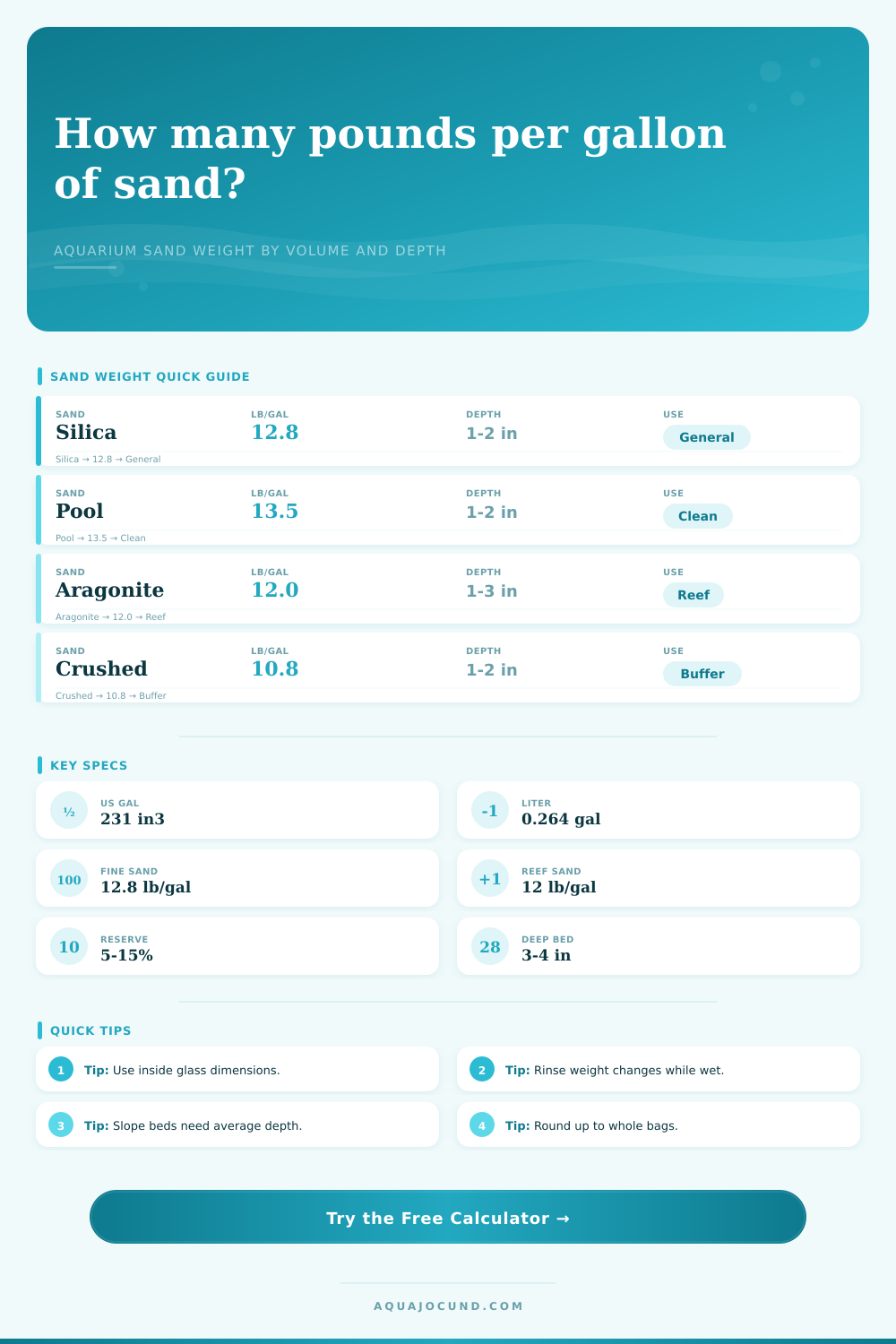
| Fine silica aquarium sand | 12.8 lb/gal | 0.3-1.0 mm | Community tanks, corydoras, small fish |
| Pool filter sand | 13.5 lb/gal | 0.45-0.85 mm | Clean-looking freshwater layouts |
| Aragonite reef sand | 12.0 lb/gal | 0.5-2.0 mm | Marine tanks where buffering is useful |
| Oolitic sugar reef sand | 11.3 lb/gal | 0.1-1.0 mm | Shallow reef beds and burrowing animals |
| Black blasting sand | 14.3 lb/gal | 0.2-1.0 mm | High-contrast freshwater aquascapes |
| Washed play sand | 12.7 lb/gal | 0.2-2.0 mm | Large displays after thorough rinsing |
| Planted aquarium sand | 12.4 lb/gal | 0.5-2.5 mm | Decorative planted caps over soil |
| Crushed coral sand | 10.8 lb/gal | 1.0-3.0 mm | African cichlids and hard-water tanks |
📏Common Tank Size Estimates
| Tank | Inside footprint | 2 in sand volume | Silica sand weight |
|---|---|---|---|
| 5 gal standard | 16 x 8 in | 1.11 gal | 14.2 lb before reserve |
| 10 gal standard | 20 x 10 in | 1.73 gal | 22.2 lb before reserve |
| 20 long | 30 x 12 in | 3.12 gal | 39.9 lb before reserve |
| 29 gal standard | 30 x 12 in | 3.12 gal | 39.9 lb before reserve |
| 40 breeder | 36 x 18 in | 5.61 gal | 71.8 lb before reserve |
| 55 gal standard | 48 x 13 in | 5.40 gal | 69.1 lb before reserve |
| 75 gal standard | 48 x 18 in | 7.48 gal | 95.8 lb before reserve |
| 125 gal standard | 72 x 18 in | 11.22 gal | 143.6 lb before reserve |
🌊Depth Planning Reference
| Bed purpose | Average depth | Weight multiplier | Planning note |
|---|---|---|---|
| Thin cosmetic cover | 0.5-1 in | 0.25-0.5 of 2 in | Good for bare-bottom style tanks with a light sand look |
| General freshwater | 1-2 in | 0.5-1 of 2 in | Easy to vacuum and deep enough for rooting decor plants |
| Planted soil cap | 1.5-2.5 in | 0.75-1.25 of 2 in | Use average depth if the back is sloped higher |
| Cichlid digging bed | 2-3 in | 1-1.5 of 2 in | Allows rearranging without exposing the glass bottom |
| Deep sand bed | 3-4 in | 1.5-2 of 2 in | Plan extra carefully because compacted sand gets heavy |
💡Calculation Notes
Substrate is where your casual optimism about choosing furniture meets actual choice of substrate. You want something that goes well with decor you prefer, so you select some sort of sand because it’s pretty in the bag and pour it in until bottom of the tank is covered.
While sand is great, the fact remain that it’s heavy. How much are you going to put in? What do you need to cover the bottom of the tank? What is the volume/density/depth of the sand you intend to use? That bag of silica is now going to be a serious load bearing structure. This means you need to factor all this stuff into your decision.
How to Choose the Right Sand for Your Tank
Before you go out and purchase any amount of sand, get the pounds per gallon ratio correct; otherwise you’re going to have a bad time (a.k.a., back breaking nightmare). After you enter your internal tank measurements, the calculator above will do all the number crunching for you. It’ll save you from having to worry about coefficients and unit conversions, which tend to mess most people up on their initial try.
What does all this mean? Well, it depend on what material you use. Most freshwater tanks uses silica sand, which weighs about twelve point eight pounds per gallon. Pool filter sand is heavier still, reaching as high as thirteen and a half pounds per gallon. So for the same visual depth, you’re carrying extra weight. Reef tank aragonite and oolitic substrates is lighter still, hovering at about twelve pounds per gallon. When you have a big bed to build, especially one designed to hold live rock, lighter is better. The tool accounts for these differences automaticly, but knowing why things change makes it easier.
What’s the grain size? The finer the grain, the tighter it will pack, leaving less air space and weighing more for every unit of volume. The coarser the grain, the bigger the gaps, resulting in a lighter but perhaps less stable substrate for delicate plants. Not a big deal, but something to consider if you want your backside protected from weight and your wallet protected from expense.
Most folks get it wrong on depth. One inch isn’t anything but cosmetic, good if you have a bare bottom tank and don’t want to see all of your gravel. Or maybe you just want a thin colored accent. Two inches works best for most general freshwater tanks. Roots can start growing without making it hard to siphon during water changes. Three plus inches work well if you’re housing shrimp that require some detritus to break down, or cichlids that love to excavate.
The average depth is what you enter into the calculator. Why? Because this is critical for a sloping bed. Do you want a low front (for viewing) and a higher back (for aquascaping)? If so, then you don’t enter the max depth. You enter the average. So, for example, a bed that’s one inch deep in front and three inches deep in the back averages two. Most folks skip over that, resulting in either too little substrate or way too much.
The reserve factor refers to substrate plans having their own safety nets, such as settling and reserves. Water flows through sand, fish kick around, etc., and sand compacts. A loose pour settles down. That means the glass and decorative stones you put so much effort into placing might get exposed. Add a five to ten percent reserve to compensate for this compaction along with the certain waste that comes during rinses. Sand holds onto fines and dust that gets washed out on the first few changes. Don’t get halfway through the cycle and realize you are three pounds short of what you need to cover the bottom. You should of rounded up to the next whole bag, don’t just suggest it. You need it.
The calculator lists the total weight and how many bags to consider. Now you can buy them all at once without multiple trips.
The reserve factor. The last limitation comes from the tank itself. Not all glass tanks can hold that much weight. For example, a very long display tank or a big bow-front may not be able to handle a four-inch deep layer of heavy silica sand. The calculator shows the total weight so you can verify it against your stand and tank specifications. You can use this information to compare it with size of your tank and the specs of your stand. If you’re concerned about the figures being too high, adjust the substrate depth or change to a less heavy sand. Cracking up your aquarium isn’t a good way to go.
The typical weights for common tank sizes appear in the reference tables on the page. These provide a quick sanity check prior to ordering.
Sand isn’t just a cosmetic addition to your tank. In fact, it’s the foundation of the ecosystem. How much should you get? Well, enough for weight. Too little weight makes the substrate not work. Too much weight puts the tank at risk. Start with dimensions. Choose your density. Use the tool to do the work. You can concentrate on the fish.