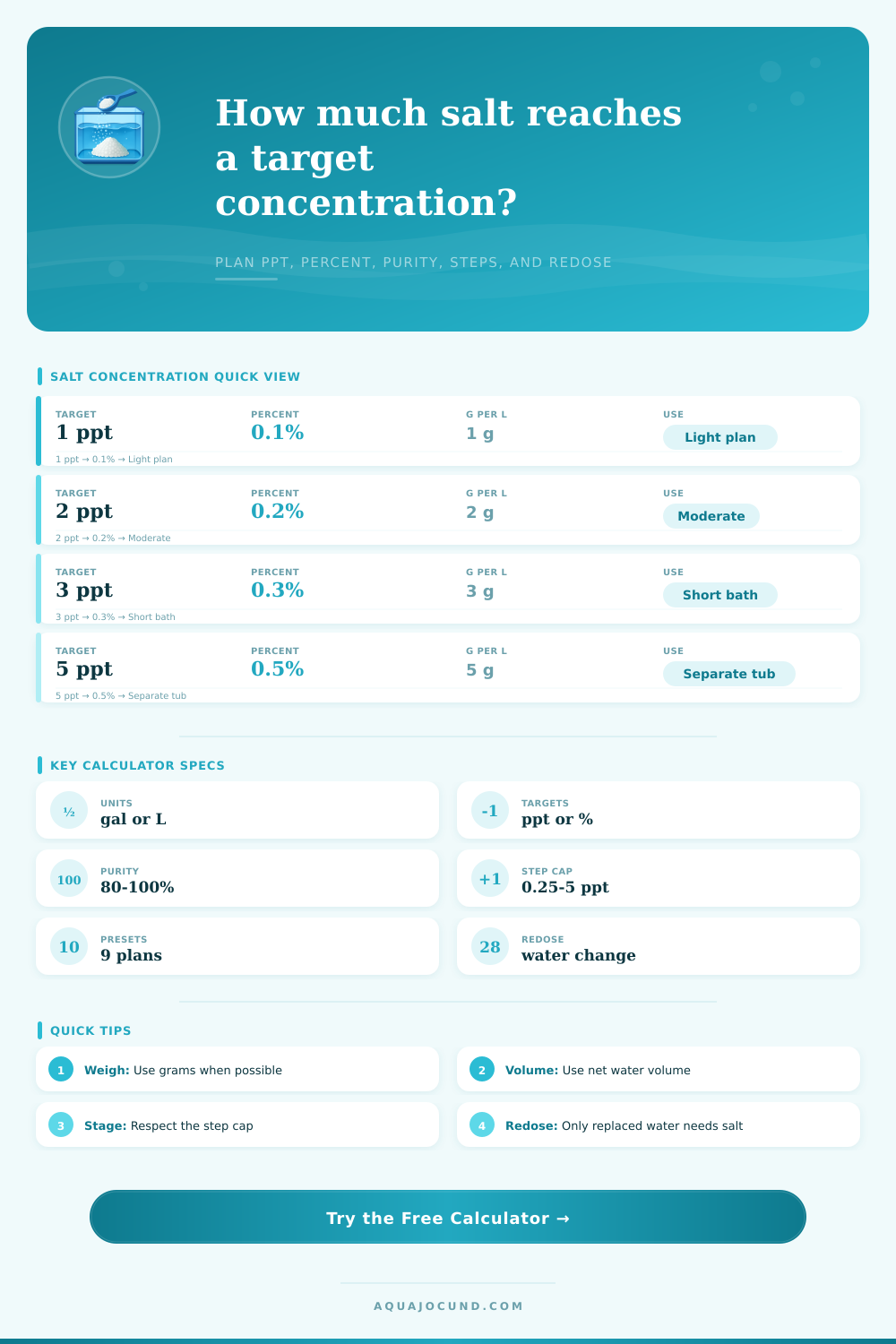
Salt Treatment Concentration Calculator
Plan aquarium salt concentration by water volume, target ppt or percent, salt purity, staged additions, duration, and water-change redose.
| Product style | Typical purity | Measuring note | Calculator use |
|---|---|---|---|
| Aquarium salt crystals | 98 to 99.8% | Coarse crystals vary by scoop | Best entered by weight |
| Solar evaporated salt | 97 to 99% | Check for additives | Adjust purity field |
| Coarse kosher salt | 97 to 99% | Very scoop-dependent | Weigh before dosing |
| Fine non-iodized salt | 99% or higher | Denser teaspoons | Works with purity check |
| Marine salt mix | Blend, not pure NaCl | Adds buffer and minerals | Use only for mix planning |
| Epsom salt | Different compound | Magnesium sulfate | Separate from NaCl plans |
| Lower-purity pond salt | 80 to 96% | Moisture or insolubles possible | Purity adjustment matters |
| Custom measured salt | Label value | Use a gram scale | Enter known purity |
| Tank size | Typical dimensions | Net volume estimate | Salt for 1 ppt |
|---|---|---|---|
| 5 gal | 16 x 8 x 10 in / 41 x 20 x 25 cm | 4.5 gal / 17 L | 17 g / 0.6 oz |
| 10 gal | 20 x 10 x 12 in / 51 x 25 x 30 cm | 9 gal / 34 L | 34 g / 1.2 oz |
| 20 long | 30 x 12 x 12 in / 76 x 30 x 30 cm | 18 gal / 68 L | 68 g / 2.4 oz |
| 29 gal | 30 x 12 x 18 in / 76 x 30 x 46 cm | 26 gal / 98 L | 98 g / 3.5 oz |
| 40 breeder | 36 x 18 x 16 in / 91 x 46 x 41 cm | 36 gal / 136 L | 136 g / 4.8 oz |
| 55 gal | 48 x 13 x 21 in / 122 x 33 x 53 cm | 49 gal / 185 L | 185 g / 6.5 oz |
| 75 gal | 48 x 18 x 21 in / 122 x 46 x 53 cm | 67 gal / 254 L | 254 g / 9.0 oz |
| 125 gal | 72 x 18 x 21 in / 183 x 46 x 53 cm | 113 gal / 428 L | 428 g / 15.1 oz |
| Sensitivity class | Suggested step cap | Planning pace | Use in calculator |
|---|---|---|---|
| Delicate or unknown | 0.5 ppt | Slowest staged increase | Calculator limits steps to 0.5 ppt when selected |
| Standard community | 1 ppt | Moderate staged increase | Good default planning class |
| Hardy fish planning | 2 ppt | Broader step allowance | Still limited by your max step input |
| Salt-tolerant or brackish | 5 ppt | Highest planning allowance | For systems already managed around salinity |
| Target concentration | Changed volume | Fresh replacement | Salt to restore target |
|---|---|---|---|
| 1 ppt | 10 L / 2.6 gal | 0 ppt | 10 g pure salt |
| 2 ppt | 20 L / 5.3 gal | 0 ppt | 40 g pure salt |
| 3 ppt | 25 L / 6.6 gal | 1 ppt | 50 g pure salt |
| 5 ppt | 40 L / 10.6 gal | 2 ppt | 120 g pure salt |
When a freshwater fish clenches its fins or flashes at glass, you tend to find out that there’s a problem. What do you think caused it? Was it stress due to poor water quality, a parasite, or some sort of bacterial infection? For decades, the answer was salt, readily available, inexpensive, and (relatively) effective for minor ailments. But salt isn’t as simple as dumping crystals into the bucket; it’s precise chemistry. Only a few gram difference can mean a healing tonic versus a deadly shock. To get correct amount of salt, you need to know how much will dissolves in your water given your volume.
A common mistake most hobbyists commit is estimating the tank’s capacity. You purchase a 20g tank and guess that it contain 20g of water. So you dose as if it were a 20g. Except your tank doesn’t contain 20g of usable water. There’s rocks, substrate, filter media, etc. Add all those and the net capacity of your tank is much less. Dosing based off the nominal capacity (i.e., what the tank is called) instead of net capacity results in overshooting your goal. More salinity mean more stress on the fish you’re hoping to rescue. It is a tiny thing, yet it is critical to success.
How to Use Salt Correctly for Your Fish
With this input, salt treatment concentration calculator takes care of math. There’s no memorizing any conversion factors. You won’t wonder how many dissolved ions are in a certain volume of salt crystal. Just input your real world water size, input how strong you want it to be, and let the calculator handle the rest. It’ll even take into account salt purity because, well, not all white cubes is created equal. Aquarium salts are typically sodium chloride (refined table salt) whereas kitchen salt may include anti-caking agents and/or iodine. Pond salt may include moisture so the effective weight is less then what the label says. Setting the purity field adjusts for the fact that you’re dosing active salt… not iodine, anti-caking agents, or other additives and fillers.
Because these two terms are often used interchangeably, you can choose to set the treatment strength as a percent or in parts per thousand. A key element many miss is how you stage out your dose. For example, adding 5 parts per thousand of anything immediately to a tank will shock even hardy fish such as livebearers and goldfish due to osmotic shock. Rapid shifts in water chemistry impact fish. With this tool you specify a “window” for how long you want the change to occur as well as the max increment by step. So instead of changing the concentration in minutes, it gradually increases over hours. That provides the fish time to adapt its own internal salt balance systems. Then you specify your starting salinity (zero or higher, perhaps, if you’re topping off an already treated tank) and it produces a step-by-step plan for dosing.
Once you’ve made your first dose, it’s easy to forget about maintenance. After all, you might do a water change to clear up water or provide better nitrogen cycling. You are also reducing the amount of salt in the water. Say you treat with a three parts per thousand solution for a week. Replacing 25% of the water significantly reduce the concentration. Redosing tells you precisely how much salt should of been added to the new replacement water to restore the tank to the target concentration level. By default, it assumes zero salinity in the fresh tap water (the norm for most municipal water). That way, the concentration doesn’t drift lower gradually over time and the treatment continues as expected during the prescribed period.
Not all species are tolerant of the same level of salinity. Even one part per thousand may be too much for some (e.g., delicate tetras) and not nearly enough for others (e.g., brackish-adapted killifish). By allowing you to set the sensitivity class of your fish, this input limits the step size so that you don’t accidently overdose fragile setups. It’s a safety net in the logic. While it does require that you know your fish, it also requires you to be cautious if you choose the delicate option. And that’s a good thing because it forces you to go slow… Something stressed animals need.
In the end, salt treatment is not a blunt tool. Salt has been shown to increase the immune function in some compatible species as well as interfere with the life cycle of some parasites. However, that doesn’t happen unless you dose correctly and keep it stable. You don’t guess…you measure and plan. This will lead to a good result. Treating it like a recipe instead of a “rough estimate” removes the guessing from the equation and provides your fish with their best opportunity to get back to normal. It is simple math but requires careful execution.