Salt Needed for New Batch Calculator
Estimate dry salt mix for a fresh RO/DI batch from target salinity, SG, yield, temperature, source TDS, moisture reserve, and measuring unit.
🎯Quick Presets
⚙Batch Inputs
📊Batch Target Comparison Grid
🧂Salt Mix Yield Reference
📋Salt Yield Table
| Salt profile | Yield used | Best calculator use | Adjustment note |
|---|---|---|---|
| Standard reef mix | 35g/L @35ppt | General reef batches | Baseline 1 g/L per 1 ppt |
| High alkalinity reef mix | 36 g/L at 35 ppt | Pro reef salts | Slightly more dry mass |
| Natural seawater style | 34.5 g/L at 35 ppt | Lean NSW targets | Lower dry mass estimate |
| Fish-only mix | 35.5 g/L at 35 ppt | FOWLR WCs | Use label yield when known |
| Brackish marine salt | 34 g/L at 35 ppt | Low and mid brackish | Scaled down by target ppt |
| Humid stored salt mix | 36.5 g/L at 35 ppt | Clumped bucket estimates | Pair with moisture reserve |
🌊Common Batch Targets
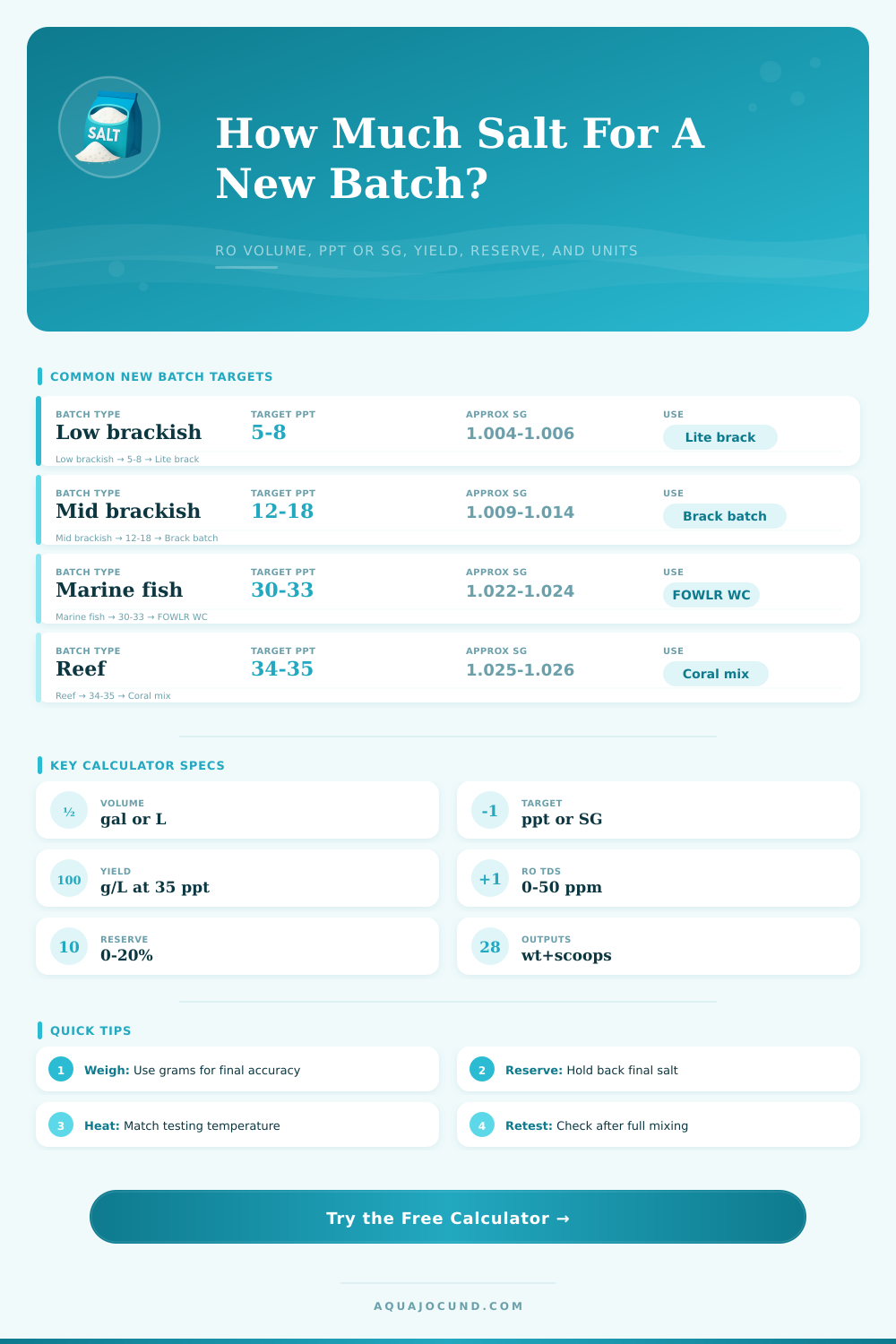
| Batch target | Typical ppt | Approx SG at 77°F | Calculator note |
|---|---|---|---|
| Low brackish | 5-8 ppt | 1.004-1.006 | Use ppt mode for small changes |
| Mid brackish | 12-18 ppt | 1.009-1.014 | Mix, aerate, then test |
| Hyposalinity QT | 12-16 ppt | 1.009-1.012 | Use calibrated SG tools |
| Fish-only | 30-33 ppt | 1.022-1.024 | Often lower than reef targets |
| Reef aquarium | 34-35 ppt | 1.025-1.026 | Best checked with calibrated refractometer |
📏Common New Batch Amounts
| Batch size | Water volume | Salt for 35 ppt at 35 g/L | Approx scoop equivalent |
|---|---|---|---|
| Nano change | 5 gal / 18.9 L | 662 g / 23.4 oz | 3.7 cups at 180 g/cup |
| Small reef batch | 10 gal / 37.9 L | 1325 g / 46.7 oz | 7.4 cups at 180 g/cup |
| Brute trash can | 32 gal / 121.1 L | 4239 g / 149.5 oz | 23.5 cups at 180 g/cup |
| Service vat | 50 gal / 189.3 L | 6624 g / 233.7 oz | 36.8 cups at 180 g/cup |
| Metric reef bin | 120 L / 31.7 gal | 4200 g / 148.2 oz | 23.3 cups at 180 g/cup |
🌡Temperature And Measuring Notes
| Measuring condition | Why it matters | Recommended calculator setting | Practical check |
|---|---|---|---|
| Cold fresh mix | SG reads differently before heating | Enter actual mixing temperature | Retest after heating |
| Humid or clumped salt | Scoops weigh less active salt per cup | Add 2-8% moisture reserve | Break clumps and weigh |
| Unknown RO TDS | Starting solids slightly reduce salt delta | Enter 0-10 ppm if unsure | Flush and test RO/DI |
| Scoop-only mixing | Cup density varies by brand and humidity | Set dry salt density | Weigh one level cup |
With just half-an-hour to go until next water change and no mixing bin in sight, you’re panicking. The water needs to be perfect, but how much salt do you add? It’s complicated… adding too little will cost you time; adding too much could kill fish.
The new batch calculator fills that void… It do all the maths for you, leaving you free to attend to your fish rather than performing sums in your head.
How to Use the Salt Calculator
It’s not all about volume either. Salt mix density make a huge difference. Many brands differs in density, and many has taken on water during humid storage settings. Therefore it requests yield data. For instance, a typical reef mix may call for thirty-five grams per liter to achieve a specific gravity of 1.026. But a more natural seawater style may call for just thirty-four point five grams. That doesn’t sound like much until you’re mixing up fifty gallons and miss your target by a half-percent. After choosing the proper profile, the calculator will do the math for you. It ensures that the dry mass align with actual chemistry of the bag in hand.
The other important part about reading salinity is the impact temperature has on it. If you test warm water that was mixed from cold water, it will read different because heat impacts specific gravity. To adjust for that, you can enter the temperature you are mixing and the tool should adjusts the calculated value based off what happens when it sits down to reach your target. This means you aren’t needlessly adding water to a batch that came out high when you mixed it. Knowing state of the water, aside from its contents, is key to being precise.
It gets even trickier when considering quality of your source water. Reverse osmosis water is usually assumed to be totally free of total dissolved solids. Not quite. If there are any lingering mineral, you will need fewer grams of salt to reach same target concentration. To account for this, the calculator prompts you with your start TDS so it can subtract that credit from final salt mass.
You can also adjust for moisture reserve as a percentage. This comes into play if you live in a humid climate or store your salt in a basement prone to high humidity. Water-saturated salt weighs less (active) mineral per cup; it clumps up. A couple percent to five percent buffer allow you to account for heavier than appearing bags without coming up short. It will calculate how much to hold back and how much of your first dose you should of add. This makes it very useful in real world.
Never ever pour in all the amount that’s calculated. Add the starting amount and then just let the pump dissolve it. When it’s dissolved check your water. If it’s too high you don’t need to re-dose, just leave it alone. If it’s too low, add your reserved salt. No wasting, no waiting, and less stress.
You can see from the reference table on the page what the scoop/cups equates to based off the size of your tank and its weight. Choose weighing over scooping. Always weigh, never scoop. Not every cup is the same. Packing density vary between brands and humidity levels. A gram is still a gram no matter what. Use a scoop? Calibrate it on a scale first. Then enter its density in the tool so it converts to grams based off how you measure.
Want a repeatable batch? Want it to work with your tank’s conditions? Don’t want any drama? Start measuring and stop guessing. Get rid of the stress of maintaining. Fill the bin and see the number. Then go about your day trusting the process. That’s peace of mind. It’s better than any one water change.