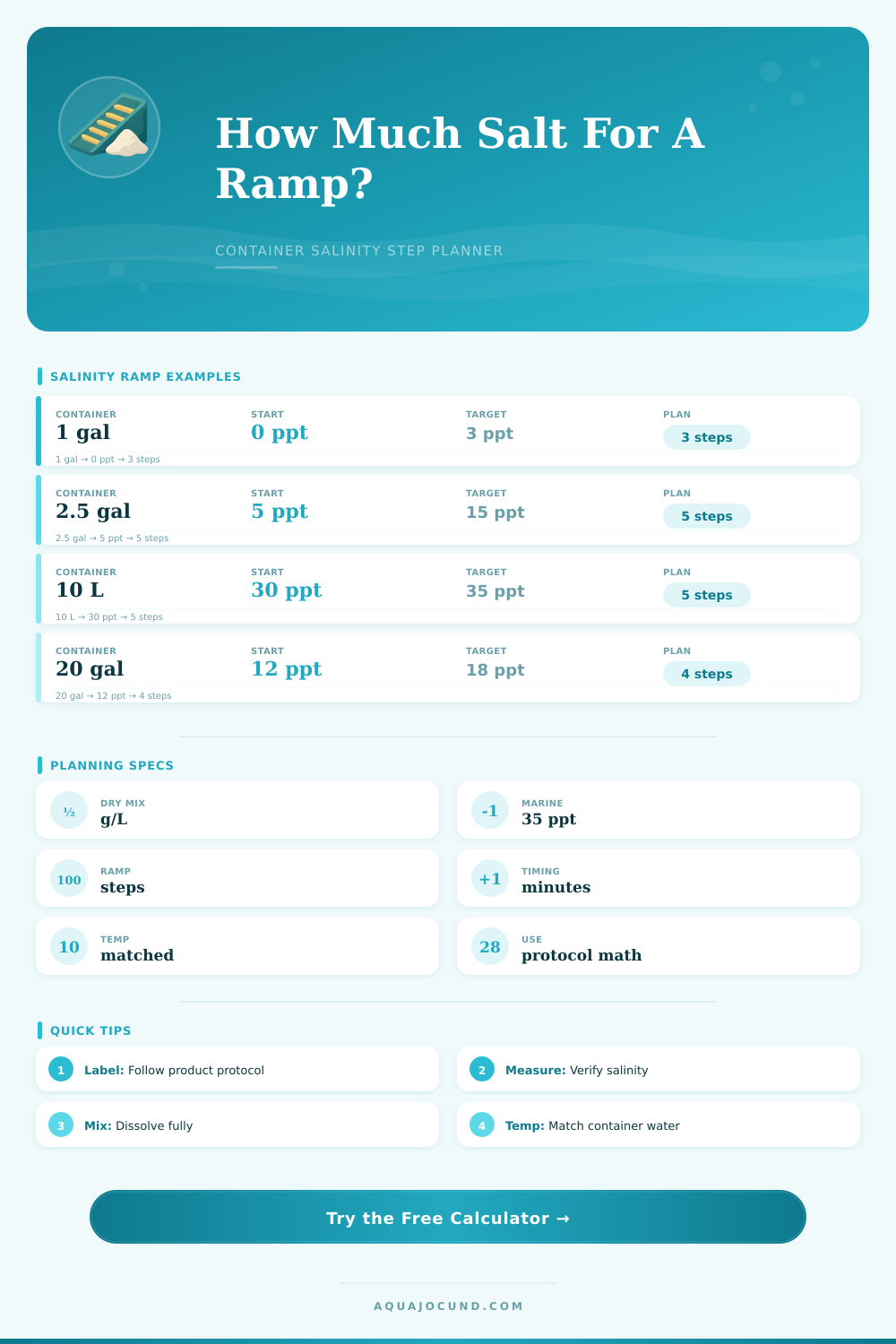
Salt Dip Salinity Ramp Calculator
Plan a separate-container salinity ramp from current salinity, target salinity, container volume, salt mix strength, step count, timing, tolerance class, and water temperature.
⚙Ramp Presets
📏Container And Salinity Inputs
Ramp Plan
🧪Salinity Method Comparison Grid
⚖Salt Mix Reference
| Salt reference | Default strength | Planning use | Important boundary |
|---|---|---|---|
| Marine salt mix | 35 g/L for 35 ppt | Standard salinity batch planning | Verify with instrument after dissolving |
| Reef salt mix | 36 g/L for 35 ppt | Higher mineral dry mix estimate | Not a substitute for label directions |
| Brackish marine mix | 35 g/L for 35 ppt | Low-to-mid salinity ramp math | Scale from measured target ppt |
| Aquarium tonic salt | 33 g/L for 35 ppt | Generic sodium chloride planning | Use product label when supplied |
| Plain coarse salt | 34 g/L for 35 ppt | Dry weight planning only | No additives assumed by calculator |
| Epsom salt by label | 35 g/L placeholder | Protocol math when label defines salinity | Enter custom strength from label |
📊Container Examples
| Container example | Volume | 0 to 3 ppt salt | 0 to 35 ppt salt |
|---|---|---|---|
| Small specimen cup | 1 L / 0.26 gal | 3 g | 35 g |
| One gallon container | 3.8 L / 1 gal | 11 g | 132 g |
| Five gallon bucket half full | 9.5 L / 2.5 gal | 28 g | 331 g |
| Ten liter tub | 10 L / 2.6 gal | 30 g | 350 g |
| Twenty gallon holding tub | 75.7 L / 20 gal | 227 g | 2,650 g |
🌡Tolerance And Temperature Planning
| Tolerance class | Default max step | Default temp band | Calculator note |
|---|---|---|---|
| Delicate / strict protocol | 0.25 ppt | 74-78°F / 23-26°C | Use more steps if protocol is tighter |
| Softwater freshwater fish | 0.5 ppt | 74-80°F / 23-27°C | Slow ramp planning default |
| Community freshwater fish | 1 ppt | 72-80°F / 22-27°C | Moderate step planning only |
| Brackish species protocol | 2 ppt | 75-82°F / 24-28°C | Match written acclimation plan |
| Marine fish protocol | 1 ppt | 76-80°F / 24-27°C | Use calibrated salinity reading |
| Invertebrate strict protocol | 0.25 ppt | 76-79°F / 24-26°C | Small increments and retesting |
📝Ramp Step Reference
| Total change | 3 steps | 5 steps | 10 steps |
|---|---|---|---|
| 1 ppt | 0.33 ppt/step | 0.20 ppt/step | 0.10 ppt/step |
| 3 ppt | 1.00 ppt/step | 0.60 ppt/step | 0.30 ppt/step |
| 5 ppt | 1.67 ppt/step | 1.00 ppt/step | 0.50 ppt/step |
| 10 ppt | 3.33 ppt/step | 2.00 ppt/step | 1.00 ppt/step |
| 35 ppt | 11.67 ppt/step | 7.00 ppt/step | 3.50 ppt/step |
Water parameter changes freak most aquarium keeper out. Most have a fear that the act will “shock” their tank residents, dump it in, hope for the best. Guess what? That works well to make good fish memories into bad ones.
Use a salt dip salinity ramp calculator to use chemistry math instead of guesswork. This let you plan a gradual shift without a sudden shock. You’ll go from feeling anxious about this process to just following a measured step-by-step checklist.
How to Change Salt Levels Slowly and Safely
Fish do not die as fast from poor water quality than they do from osmotic pressure changes. Moving them from fresh water into water with any amount of salt cause their bodies to struggle to match internal ions to the ions in the surrounding water. A rapid shift in the salinity around the fish disrupt that balance inside the fish.
Use the tool on this page to determine exact amount of your own dry salt mix to add at each small increment so it occurs slowly enough for both kidneys and gills to adjust. First you define your parameters, current tank size and condition. Volume is easy enough to understand until it occurs to you that a five gallon bucket filled halfway with water have only 2.5 gallons in it. Always measure the actual volume of water present rather than use the full rated value, big overdosing mistake!
Next you enter your existing salinity and your desired salinity. Your goal may be to go from fresh to a mild brackish water mix or all the way up to marine strength. The difference between these two numbers determine the total amount of salt needed. How much salt you need is simply the difference between the two numbers. However, how fast you get there matter to their survival.
But here’s where it gets interesting: The amount of the jump (the “step”) are more critical than most folks recognize. If you jump from 0 to 35 ppt all at once, you’ll kill just about everything that hasn’t been exposed to seawater. Instead, break that increase up into small increments like five or ten and allow the aquatics some time to adjust. That’s what the calculator does. It takes your total amount of salt and divides it by your chosen steps. This will tell you exactly how much to mix at each step. Depending on the species’ tolerance, you can modify accordingly. Hardy brackish species may tolerate a bigger jump just fine, whereas delicate inverts will require tiny increments.
There’s another interesting element to this equation: temperature. Salt dissolves more quickly in warm water then cold water. If you don’t adjust for this, your solution may still be sitting undissolved on the bottom of whatever container you’re mixing it in. To give you an idea of how it all comes together, there are temperature inputs in the planner. It prompts you to remember that patience is as vital as weight on your gram scale and that stirring is necessary too. You won’t get accurate salinity readings if salt hasn’t dissolved by the time you pour in the next batch.
Digital sensors and fancy refractometer is expensive, whereas cheap ones can be a crap shoot. There is wide variance in instrument tolerance. On the calculator, you can adjust the measurement error factor as well. That puts a bit of a cushion on your salt addition. It won’t matter if your equipment sucks and you end up under dosing because of poor equipment. You’re not only doing a chemical calculation but also adjusting for your equipment limitations and human error.
This ultimately boils down to control. Salinity is a concept that, when shown in real forms like grams and minutes, becomes something you can realy understand. Looking at the cumulative time necessary for a gradual ramp may convince you that it just isn’t worth it to rush things. The plan will help make you more disciplined by forcing you to stop and think, measure twice, and follow the biological limitations of your livestock.
This discipline is what divides successful keepers from those who always wonder what happened to their new additions. Those animals just didn”t make it past the first week. You should of used a more moddern method for better results.