🧂 Salt Dip Concentration Calculator
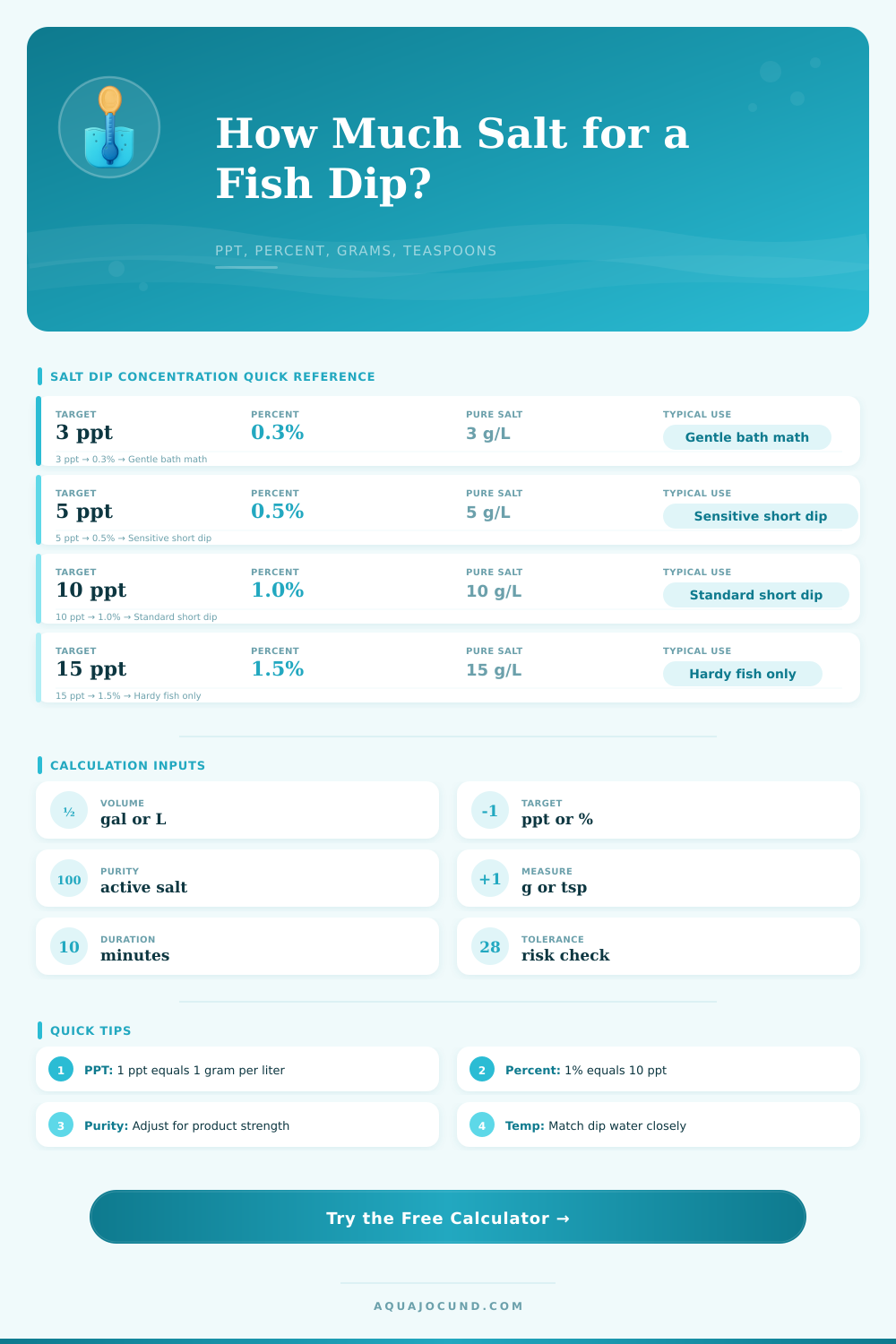
Convert dip bucket volume and a ppt or percent target into pure salt, adjusted product grams, teaspoon measures, staged prep, and a tolerance check.
| Salt type | Typical purity | Approx grams per tsp | Planning note |
|---|
| Container | Imperial volume | Metric volume | Pure salt at 10 ppt |
|---|
| Category | Conservative max | Time check | Calculator flag |
|---|
Salt dips is used to reduce stress in fish as well as to reduce the presence of external parasite in fish. Salt dips are a low-cost method of treating fish. Additionally, salt dips are a fast method of treating fish.
However, salt dips can be difficult to perform if the person dont understand how to achieve the correct salt concentration for the fish to be treated. If the salt concentration are too low, the salt dip will not be effective. If the salt concentration is too high, the fish may lose it’s equilibrium while being salt-dipped or the fish may roll in its tank.
How to Use a Salt Dip Calculator for Fish
The calculator provides the person with the information necessary to determine the correct amount of salt to add to the tank to achieve the target concentration. Thus, the calculator eliminate the need for math by the person and prevents errors regarding the amount of salt to be used in the salt dip. Target concentration can vary depending off the kind of fish in the tank and the reason for the salt dip.
If the person is to use the salt dip for fish that are especially sensitive to salt, an target concentration of three to five parts per thousand can be used. If the target species in the tank are typical freshwater species, a concentration of ten parts per thousand can be used. However, if the person is to use the salt dip for hardy fish species, a concentration of fifteen parts per thousand can be used, though only for brief period of time.
The calculator will display the percentage of the concentration to be prepared and will also warn the person if the concentration and the length of the salt dip may be too much for the fish in the tank. The purity of the salt that is to be used in the salt dip can have an effect upon the effectiveness of the treatment. If aquarium grade salt is used, which is usually 99% sodium chloride, no adjustments is necessary.
However, if the person uses marine salt, which may only contain 85% sodium chloride, the salt dip formula will adjust for the lower concentration of the active ingredient in the salt. If the salt has a lower purity, the amount of salt necessary to achieve the desired concentration will be higher in the salt dip recipe. The difference in purity matters if a person is preparing many gallon of salt dips; for instance, using salt that is 10% less pure will require an extra tablespoon or two of salt for a five-gallon salt dip; adding even an extra tablespoon or two of salt to the tank may cause the fish to go beyond there established limit.
The duration of the salt dip can vary depending upon the type of fish in the tank and the reason for the salt dip. For fish that are experiencing stress, for example, a 30-minute dip at a low concentration may be appropriate. For fish that are exhibiting symptoms of illness, such as parasites, a five-minute exposure to a higher concentration of salt may be used.
Additionally, the temperature of the salt dip should be within one or two degrees of the temperature of the water in the tank; if the temperatures differ from one another, the fish may experience more additional stress from the temperature difference. An option for preparing the salt dip is to use the staged-prep option, which allows for the addition of the salt in two or four steps. Using this option allows for the concentration of salt to increase gradually instead of all at once when the fish are placed into the tank.
The physical condition of the fish being treated can impact the success of the salt dip. Fish that are recently shipped or that have damaged fins may require a lower concentration of salt than species with healthy fin. Additionally, scaleless fish, such as certain types of catfish or loaches, may require the lowest concentration of salt because their protective mucus layer are absent.
Finally, plants and invertebrates in the tank should not be exposed to salt dips. The best way to measure the salt for the salt dip is by weight. However, if a person chooses to measure the amount of salt by teaspoons, the spoon may not be accurate in measuring the amount of salt; teaspoon measurements may differ according to the size of the salt crystals.
The calculator provides both gram and kitchen-spoon measurements of salt so that the person avoids making error in the preparation of the salt dip. Additionally, if volume is to be used instead of weight to measure the amount of salt to be added to the tank, the same brand and size of salt should be used every time the salt dip is prepared. Additionally, the salt should be dissolved in the tank before placing the fish into the salt dip; the strength of the salt dip can be tested prior to placing the fish into the salt dip.
The container that will be used to hold the fish after the salt dip should have the same temperature as the salt dip and should contain plenty of aeration. Additionally, the fish should be able to be floated in the recovery water after the salt dip for several minutes to allow the fish to become re-acclimated to the water conditions in the tank without being exposed to thermal shock. Additionally, during the salt dip, the person should watch the fish for abnormal breathing rate or abnormal posture in the tank.
If any of these condition are exhibited by the fish, the salt dip should be ended early. Thus, while the calculator can provide the correct amount of salt to add to the tank, it is up to the person who prepares the salt dip to ensure the well-being of the fish during the salt dip process.