Salt to Add to Existing Volume Calculator
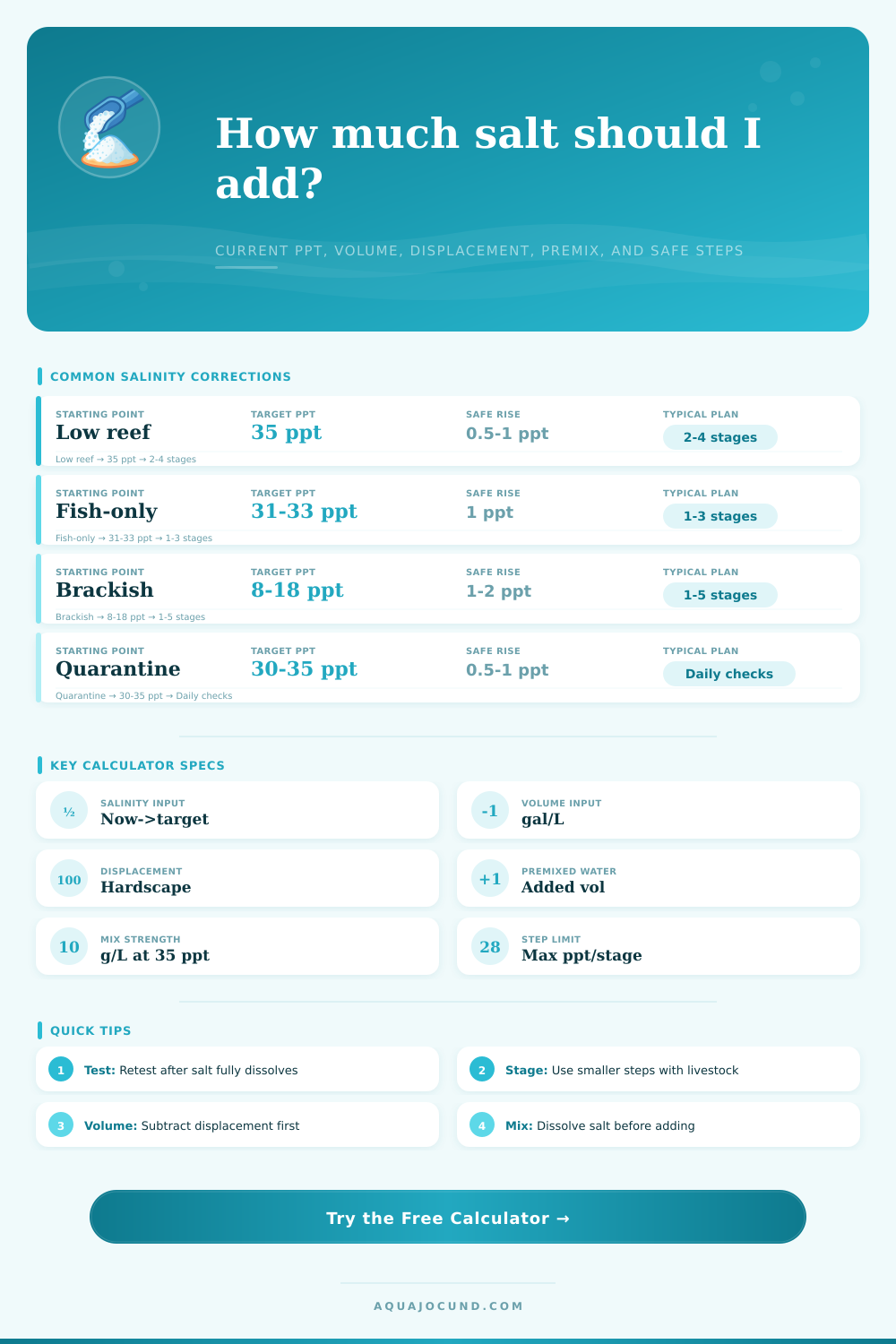
Estimate dry salt needed after displacement, premixed water, temperature correction, and safe staged salinity limits.
🌊Presets
⚙Inputs
| Scenario | Steps | Salt / step | Rise / step |
|---|
🧪Salt Mix Reference
📋Mix Profile Table
| Profile | Concentration at 35 ppt | Dry density | Best fit |
|---|---|---|---|
| Balanced marine salt | 35.0 g/L | 285 g/cup | General marine corrections |
| High-mineral reef mix | 38.0 g/L | 275 g/cup | Reef systems with elevated elements |
| Low-residue reef mix | 36.0 g/L | 290 g/cup | Clear-mixing reef batches |
| Natural seawater style | 34.5 g/L | 295 g/cup | NSW-style 35 ppt mixes |
| Brackish marine blend | 33.0 g/L | 305 g/cup | Lower ppt brackish systems |
| Coarse sea salt | 35.0 g/L | 250 g/cup | Coarser grains and lower cup density |
| Evaporated aquarium salt | 35.0 g/L | 315 g/cup | Simple salt-only corrections |
📏Common Volume Corrections
| System | Nominal size | Estimated actual water | Salt for +1 ppt using 35 g/L mix |
|---|---|---|---|
| Nano reef | 20 gal / 76 L | 16-18 gal / 61-68 L | 61-68 g / 2.2-2.4 oz |
| Breeder reef | 40 gal / 151 L | 32-36 gal / 121-136 L | 121-136 g / 4.3-4.8 oz |
| Standard reef | 75 gal / 284 L | 60-68 gal / 227-257 L | 227-257 g / 8.0-9.1 oz |
| Mixed display | 120 gal / 454 L | 95-110 gal / 360-416 L | 360-416 g / 12.7-14.7 oz |
| Holding vat | 50 gal / 189 L | 48-50 gal / 182-189 L | 182-189 g / 6.4-6.7 oz |
⏱Step Planning Guide
| Situation | Suggested max rise | Retest timing | Calculator setting |
|---|---|---|---|
| Reef with coral | 0.5-1.0 ppt per step | After full circulation | 0.7 ppt default |
| Fish-only | 1.0 ppt per step | After clear dissolution | 1.0 ppt |
| Brackish acclimation | 1.0-2.0 ppt per step | Between planned changes | 1.5 ppt |
| Empty mixing vat | 2.0-5.0 ppt per step | After mixing pump runs | 2.5 ppt or higher |
🧭Correction Comparison Reference
| Plan | What it prioritizes | How steps are chosen | When to use |
|---|---|---|---|
| Single correction | Speed | All calculated salt at once | Freshly mixed water without livestock |
| Preferred steps | Routine control | Your requested step count | Normal display tank tuning |
| Max-rise protected | Salinity stability | Enough steps to stay under the ppt limit | Livestock systems and large deltas |
| Conservative | Extra testing margin | One additional stage beyond protected plan | Sensitive coral or uncertain volume |
You go check your tank, look at it and question why your refractometer reading isn’t right. Maybe you’re wondering if your corals is swimming in weak tea or actual seawater. Or maybe it’s just weak tea? You aren’t alone, and here’s why, the water level on the glass is a fib. Underneath all that sand and rockwork the water volume are actually lower.
That’s when salinity errors occur; that gap between what you see and what you don’t. Guessing doesn’t always fix a specific gravity drop by throwing in a couple handfuls of salt, unless you know how much you’re displacing. So when you input your real displacement numbers and water volume, the calculator do all the math for you (above). You don’t have to calculate conversions and coefficients anymore.
How to Fix Salt Mistakes in Your Tank
Guessing at your salinity levels is where mistakes happen. Instead, most aquarium owners uses the rated tank size as their starting point. A seventy-five gallon tank display rarely has seventy-five gallons of water in it. Add a deep sand bed and/or a heavy rock structure, and you might get away with sixty.
Salt concentration is a ratio. Less water mean too much salt, which causes dangerous spikes in salinity that stress your livestock long before they know what hit them. Half of the equation is getting the amount correct, the other half are making sure you have the correct density. Different marine mixes isn’t the same. They vary in density (per scoop), meaning some formulations is denser per cup than others. A scoop of one can weigh different than a scoop of another.
You can adjust the strength of your mix. This takes into account your unique mix and allows you to enter the density it gives. It is a little detail, but it will prevent your salinity from bouncing up and down because your estimate of powder was slightly wrong.
These readings are also sneaky with regards to temperature. Refractometers (and even more so, salinity meters) is affected by heat. So if your water was above the calibration temperature when you took a reading it’s likely going to read less then the actual amount of salt present. You’ll then go about chasing a number that simply doesn’t exist, which causes you to overdose your salt. Because of this, there is a correction field on the tool. It adjusts the baseline to account for this thermal illusion, so you can add salt based off the true salinity.
The other required practice that applies to any system containing living tissue are staged dosing. Adding all the necessary salt in one shot result in localized hypersaline areas around your powerhead(s) or return pump. The concentrated brine burns coral tissue and stresses gills of your fish. The calculator divides total quantity needed into more manageable steps. It will tell you how much to add during each stage, and it will suggest a maximum rise per step. This allows for gradual changes that your livestock can manage without panic.
If you’re working in a reef tank with delicate corals, you’ll want to keep the change under a rise of no more than one part per thousand per step. If you’re running a fish-only system, you might be able to get away with a bigger jump, but what’s the harm in keeping it small with minimal effort?
The tool includes some common scenarios: a nano reef, a big quarantine station, etc. It provides a starting point that respects biological limits rather than mathematical ideals.
Salinity Think of maintaining stability rather than a specific value. It is better to have a slight change from the ideal 35ppt then to have constant fluctuations. Consistency matters. Eliminate the variables that cause stress. Use displacement subtraction, consider using premixed water, and follow the step limits. Stop chasing salinity ghosts in your refractometer readings.
The point is that accuracy boils down to knowing what’s in the tank. Not what size of glass you use, or what kind of bag the salt came in. What size is the actual water volume? What does it contain?
If you can stop thinking of each correction as a heavy-handed change and start seeing them as small adjustments, your tank will thrive. Your math would of been easy if you stop pretending the rocks don’t hide volume underneath.