🌱 Root Tab Dosing Calculator
Estimate planted-tank root tabs from substrate area, plant demand, tab strength, grid spacing, and shrimp sensitivity.
| Factor | Light Setting | Standard Setting | Heavy Setting |
|---|---|---|---|
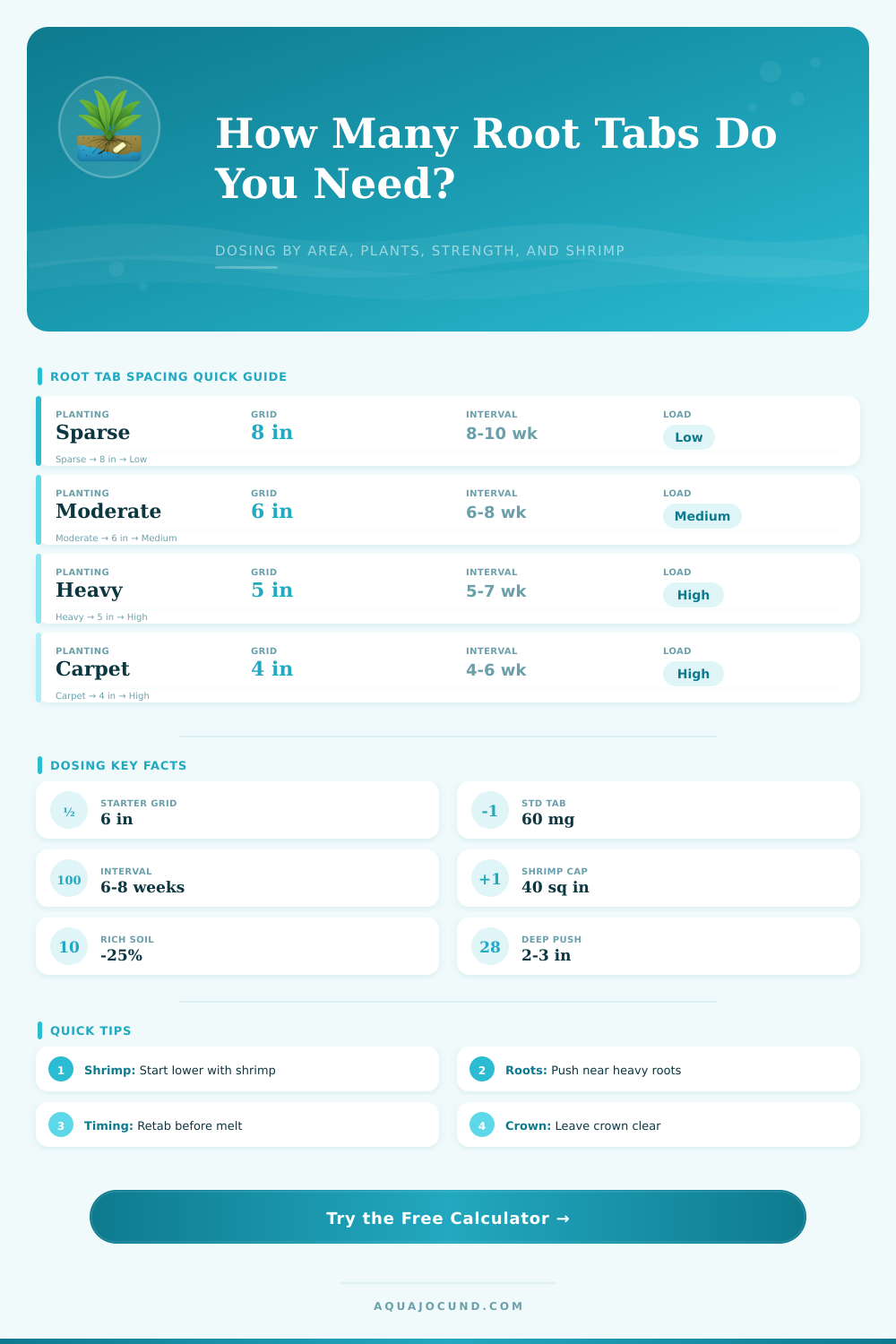
| Plant Density | Sparse: 0.65x | Moderate: 1.00x | Heavy: 1.35x |
| Root Feeders | Stems: 0.75x | Mixed: 1.10x | Lotus: 1.45x |
| Nutrient Load | Lean: 0.85x | Balanced: 1.00x | High growth: 1.20x |
| Shrimp Sensitivity | None: 1.00x | Normal: 0.90x | Very sensitive: 0.60x |
| Tank | Footprint | Area | Typical Tabs |
|---|---|---|---|
| 10 Gallon | 20 x 10 in / 51 x 25 cm | 200 sq in | 3-5 tabs |
| 20 Long | 30 x 12 in / 76 x 30 cm | 360 sq in | 6-10 tabs |
| 29 Gallon | 30 x 12 in / 76 x 30 cm | 360 sq in | 7-11 tabs |
| 40 Breeder | 36 x 18 in / 91 x 46 cm | 648 sq in | 11-18 tabs |
| 55 Gallon | 48 x 13 in / 122 x 33 cm | 624 sq in | 10-17 tabs |
| 75 Gallon | 48 x 18 in / 122 x 46 cm | 864 sq in | 14-24 tabs |
| 125 Gallon | 72 x 18 in / 183 x 46 cm | 1296 sq in | 21-36 tabs |
| Root Feeder | Placement | Usual Grid | Interval |
|---|---|---|---|
| Cryptocoryne | Beside root crown, not under rhizome | 5-6 in | 6-8 weeks |
| Amazon Sword | Ring tabs around outer roots | 4-6 in | 5-7 weeks |
| Lotus or Lily | Near bulb roots, offset from bulb | 4-5 in | 4-6 weeks |
| Vallisneria | Along runner lanes | 6-8 in | 6-9 weeks |
| Carpet Plants | Even grid before trimming | 4 in | 4-6 weeks |
| Sensitivity | Dose Multiplier | Suggested Cap | Use When |
|---|---|---|---|
| No shrimp | 1.00x | Normal dose | Fish-only planted tanks |
| Normal caution | 0.90x | One tab per 40 sq in | Neocaridina communities |
| Sensitive | 0.75x | One tab per 55 sq in | Caridina or young shrimp |
| Very sensitive | 0.60x | One tab per 70 sq in | Breeding colonies or soft water |
Root tabs provide nutrient to the aquatic plants by providing nutrient to the roots of the plants, similar to how land plants absorb nutrient from the soil. Because the aquatic plants live in a water-based environment, the user must place the root tabs into the substrate of the planted tank so that the roots of the plants can reach the root tabs. In order to use root tabs in the planted tank, there are several factor to consider, such as the number of tabs to use, where to place the tabs, and when to replace them.
If the root tabs isnt replaced when they are empty of nutrients, the plants will exhibit sign of nutrient deficiency. Such signs of nutrient deficiency may include yellowing of the leaves of the plants, or the plants may not exhibit any growth at all. The calculator allow for the user to determine how many root tabs is necessary to feed the planted tank by asking question of the user regarding several different factor.
How to Use Root Tabs in a Planted Tank
Each of these factor includes the dimensions of the planted tank, the type of plants to be featured in the planted tank, the type of substrate for the planted tank, and even if there is shrimp in the planted tank. The type of substrate include a question of how many nutrients is already contained within the substrate. For example, if the substrate includes aquasoil or laterite, fewer root tabs will be required than if the substrate include plain sand or gravel.
Different quantity of root tabs will be required for different species and densities of plants to be placed in the planted tank. For example, root tabs will be required in larger quantity if placing plants like lotus or rosette species near their crowns, as opposed to stem species, which require less root tabs due to the lesser nutrient requirement of stem plants. In determining where to place the root tabs in the planted tank, the type of plants that will be grown in the planted tank may influence the answer to that question.
For instance, using a six-inch grid may be appropriate for moderate tanks, but a four-inch or five-inch grid may be better use for planted tanks featuring a carpet of plants or many sword plants. Using a grid that is smaller than six inches will require a higher quantity of root tabs to cover the area of the planted tank. Additionally, the root tabs should be replaced prior to the plants exhibit signs of nutrient deficiency.
Thus, one should not wait until the plants begin to melt. For example, if the plants appear to be growing steady in the tank, there may be an ability to use more than eight weeks to replace the root tabs. However, monitoring of the plants is always require.
A final factor to consider in determining the number of root tabs to use in the planted tank is the possible presence of sensitive shrimp in the tank. Because the excess nutrient content of root tabs may harm sensitive shrimp, the calculator will reduce the number of tabs if the user indicate the presence of sensitive shrimp in the planted tank. For example, nutrient content spike in the water near the root tabs may expose sensitive shrimp to high levels of ammonia or copper, both of which can be harmful to shrimp.
Thus, fewer root tabs are better than too many root tabs; too many root tabs may expose the shrimp to an environment that is dangerous to the shrimp. Placement of the tabs into the substrate is another factor that can impact the health of the planted tank. Each root tab should be pushed at least two to three inches deep into the substrate, but should be placed slightly away from the crown of the plant.
If the root tabs are placed in direct contact with the crown of the plant, the direct contact with the root tab may harm the plant. Additionally, if the root tabs are too shallow within the substrate, the tabs may dissolve into the water of the planted tank rather than feeding the roots of the plants. For planted tanks that is cylindrical or bowfront tanks, the root tabs can be placed into concentric ring within those tanks to ensure each area of the planted tank is supplied with the same amount of nutrients.
There are several mistake that can be made in placing root tabs in the planted tank. For example, it is tempting to use the same formula for each planted tank that one manages, but each planted tank may have different requirement for the root tabs. For instance, a 29 gallon planted tank may contain sword plants, but a 40-breeder planted tank may contain a carpet of plants.
Thus, root tabs should not be replaced with time alone; the growth rate of the plants will dictate the time at which the root tabs should be replaced. For instance, if a planted tank contains CO2 and is exposed to high levels of light, the plants may be strong after eight weeks, indicating that replacing the root tabs at six weeks would be unnecesary. Instead, the plants should be observed to determine whether root tabs should be added.
For example, if the new growth of the plants is pale, the root tabs may be exhausted. Conversely, if there is algae growing on the substrate, there may be too many root tabs; in such a case, the number of root tabs may need to be reduced. Thus, using the plants to determine whether root tabs is needed or exhausted will create a feedback loop for the planted tank, which will ensure the stability of that planted tank.