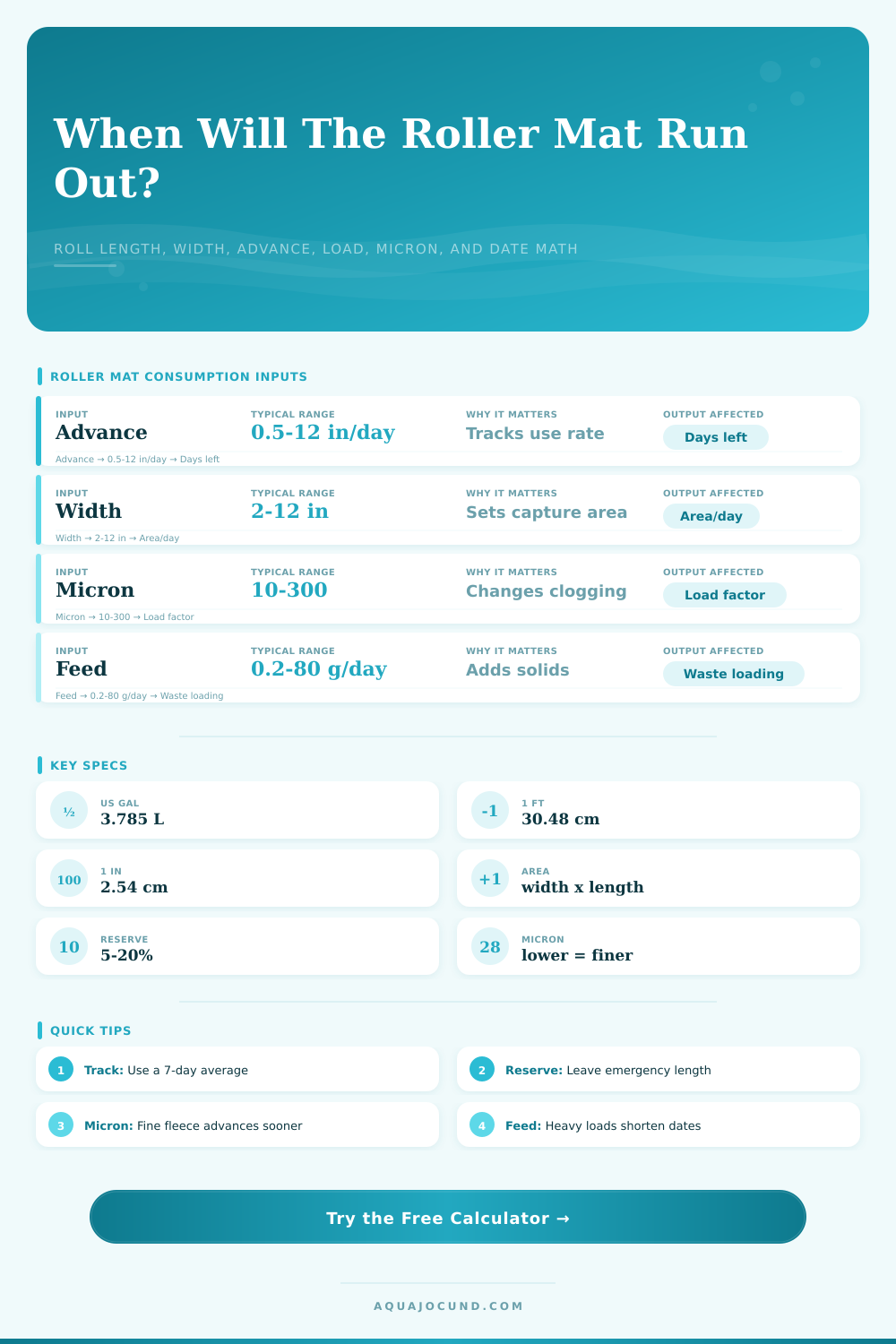
🧻 Roller Mat Consumption Calculator
Estimate fleece roll use, load-adjusted advance, daily waste capture area, solids loading, days remaining, and the next replacement date.
Roller Mat Consumption Results
| Fleece profile | Rating | Relative advance factor | Typical use | Calculation note |
|---|---|---|---|---|
| Polishing fleece | 10 micron | 1.75x | Short-term fine clarity | Clogs fastest under the same load |
| Fine fleece | 25 micron | 1.45x | Fine suspended particles | Higher capture, higher advance |
| Fine-standard fleece | 50 micron | 1.20x | Mixed reef and clear water | Moderate capture pressure |
| Standard fleece | 75 micron | 1.08x | Balanced mechanical filtration | Near baseline consumption |
| General fleece | 100 micron | 1.00x | Common daily operation | Baseline for the calculator |
| High-flow fleece | 150 micron | 0.88x | Higher flow or heavier debris | Less fine capture per pass |
| Coarse fleece | 200 micron | 0.78x | Large particles and prefiltering | Longer use at equal solids load |
| Pond coarse fleece | 300 micron | 0.65x | Outdoor or coarse debris | Lowest fine-particle pressure |
| Roll style | Roll length | Width | Total area | At 4 in/day |
|---|---|---|---|---|
| Narrow compact roll | 50 ft / 15.2 m | 2.4 in / 6.1 cm | 10.0 ft² / 0.93 m² | 150 days before reserve |
| Small sump roll | 82 ft / 25.0 m | 4.0 in / 10.2 cm | 27.3 ft² / 2.54 m² | 246 days before reserve |
| Medium sump roll | 98 ft / 29.9 m | 6.0 in / 15.2 cm | 49.0 ft² / 4.55 m² | 294 days before reserve |
| Wide sump roll | 130 ft / 39.6 m | 8.0 in / 20.3 cm | 86.7 ft² / 8.05 m² | 390 days before reserve |
| Large system roll | 164 ft / 50.0 m | 10.0 in / 25.4 cm | 136.7 ft² / 12.70 m² | 492 days before reserve |
| Pond or vat roll | 197 ft / 60.0 m | 12.0 in / 30.5 cm | 197.0 ft² / 18.30 m² | 591 days before reserve |
| Load entry | Factor | Feed clue | Flow clue | Expected fleece effect |
|---|---|---|---|---|
| Very light | 0.70x | Small daily feed | Clear overflow water | Slower advance than measured baseline |
| Light | 0.85x | Low fish biomass | Little trapped waste | Slightly longer roll duration |
| Moderate | 1.00x | Regular feeding | Stable roller cycling | Baseline calculation |
| Heavy | 1.25x | Several feedings per day | Visible daily mat discoloring | Shorter replacement interval |
| Very heavy | 1.55x | Messy foods or many fish | Frequent motor triggers | Much faster use |
| Koi or grow-out | 1.90x | High feed mass | Large solids and high flow | Fastest expected consumption |
| Measure | Formula | Imperial example | Metric example |
|---|---|---|---|
| Daily capture area | width x daily advance | 4 in x 5 in = 20 in²/day | 10 cm x 12 cm = 120 cm²/day |
| Total roll area | width x full length | 4 in x 984 in = 3,936 in² | 10 cm x 2,500 cm = 25,000 cm² |
| Days before reserve | usable length / adjusted advance | 700 in / 5 in/day = 140 days | 1,780 cm / 12 cm/day = 148 days |
| Solids area load | captured solids / daily area | 990 mg / 20 in² | 990 mg / 129 cm² |
When the water rises in your sump at 2 AM, there’s a certain type of panic that grips reef keeper. You grab the flashlight and rush over to see… the roller mat didn’t work. Your pump is starved, the fleece are all clogged up, and your fish are getting a spa treatment they never asked for. Everyone gets it sooner or later. Understanding what we’re really measuring help prevent this from happening. That’s why measuring what you consume is better than guessing when to run out.
What is the solution? Fleece doesn’t wear out evenly. Depending on what micron rating you selected, how often you feed, and your water chemistry, it will clog unevenly. You can have a nice-looking (and non-functional) pile of perfectly polished fleece in a week or a ratty mess that look like a chew toy for a swamp monster but keeps plugging away for months.
How to Measure Your Fleece Use
The calculator above takes all that math and plugs it in for you with two variables: What did you observe as your rate of advancement, and what was the shape of the roll? No more conversions, no more guessing at coefficients. Simply input your roll geometry and let the calculator do the rest. It bridges the gap between how much feed you throw in and how fast that debris translate into solid waste.
So what do you put in? People usually type in width and length of rolls. But the key is the advance rate. How much fleece does your system move each day (in inches)? You need to know that. It can be calculated easily. Mark the edge of the clean fleece, leave it alone 24 hrs, then measure back how far the dirty portion has moved. Repeat for a week, average, and there you go. Just make sure you don’t let a single “trigger” event skew your results. For example, don’t include a big feed day as part of your average, since it will throw off the numbers. What you’re looking for here is your steady state. The observed advance is the heartbeat; you want the steady state, not the spike. That observed advance becomes the pulse of the equation. All the rest are just noise without it.
So then we have the load factor. This is where it gets fun. Your tank might be tiny, but if it contains a lot of animals that produce a lot of waste, it may clean fleece at a greater rate than a huge system full of plants. Lightly stocked planted tanks emits almost no suspended waste. Chaotic mixed reef systems or heavy feeding koi vats pump out far more solids. By allowing you to set a load multiplier for both debris and feed mass, the tool considers this. So if you’re feeding live meat or frozen shrimp, your load multiplier increases. So the amount you need to advance should increase, or it should feel like you are pushing more onto the material.
Now this also interacts with the micron rating. The finer the fleece, the more stuff it catches… Nice for clarity, but the more it clogs as well. It’s a tradeoff in terms of maintenance versus water quality.
A second thing you never seem to think about is the reserve. Very few people ever get through the whole roll. There is always a tail end that’s either tangled up beyond easy care or too short to really do anything with. A good rule of thumb is to leave yourself 10-20% of the roll for reserve… It will keep the pump from having to suck air once the main body is depleted. This usable length is what the calculator bases its expected replacement date on. Not only does it tell you when the roll will be gone, but when you should order another one, well before you need it. That reserve is your emergency plan for those midnight disasters.
Choosing the right fleece profile involves both art and science. While 10 micron fleece might clean up well from polishing water, it will choke your filter if you don’t have some mechanical filtration upstream. Conversely, 300 micron fleece acts like a prefilter, stopping the big stuff while allowing fines to slip through. This chart on the page explains how the ratings impact consumption. Bottom line: generally, the higher the number, the less frequently you’ll need to change the roll. It sounds counterintuitive, but finer filtration costs more in consumables. That’s the price of clarity.
In the end, it’s all about planning and budgeting. If you know how much you use, you can stock up on supplies when they’re cheap and stop running to the store at the last minute in a panic. You’ll see patterns emerge, spikes in solids during spawning, more algae means more waste, etc. Your tank will have its own pulse and the numbers will show it to you. Then, once you’ve learned its pulse, the roller mat won’t be stressful at all. It’s simply another piece of the puzzle you control. You’ll always know exactly when the next change comes. There will be no more surprises in the middle of the night. Just constant predictable attention to your water.