Rock Displacement Volume Loss Calculator
Estimate how much aquarium water volume is lost to aquascape rock, then use the net volume for dosing, salinity, and water-change math.
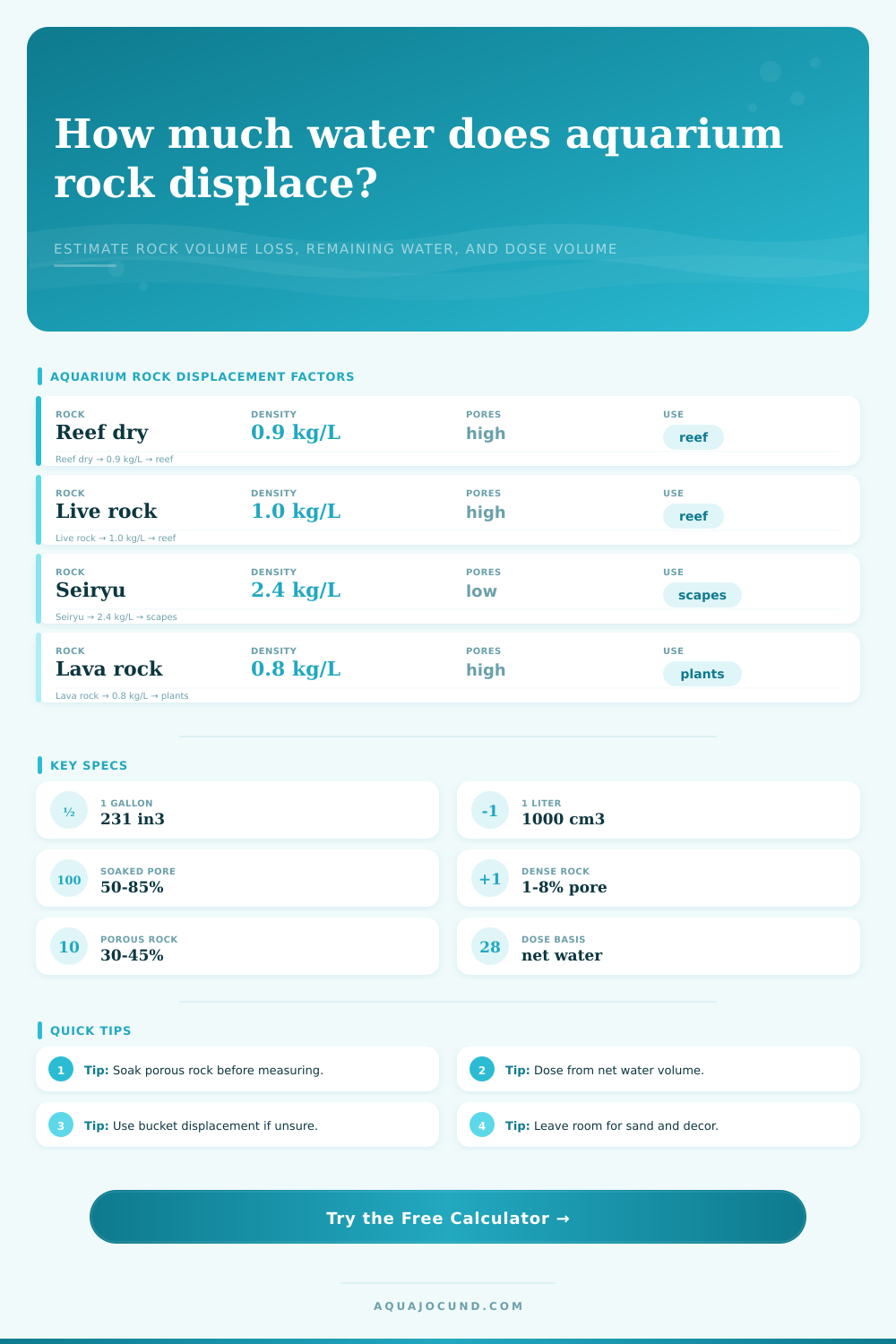
| Rock type | Planning density | Connected pore estimate | Best aquarium use | Volume note |
|---|---|---|---|---|
| Dry reef rock | 0.90 kg/L, 7.5 lb/gal | About 40% | Marine and reef aquascapes | Soaked rock can hold meaningful water inside pores. |
| Cured live rock | 1.00 kg/L, 8.3 lb/gal | About 35% | Mature reef biological structure | Usually already saturated, so net loss is lower than dry volume. |
| Seiryu stone | 2.40 kg/L, 20.0 lb/gal | About 8% | Planted layouts and iwagumi | Dense stone displaces close to its estimated rock volume. |
| Lava rock | 0.80 kg/L, 6.7 lb/gal | About 45% | Shrimp, planted, and filter media scapes | Very porous pieces benefit from a soak before measurement. |
| Dragon stone | 1.35 kg/L, 11.3 lb/gal | About 30% | Nature aquariums and shrimp scapes | Irregular texture makes footprint estimates less precise. |
| Slate shelves | 2.70 kg/L, 22.5 lb/gal | About 3% | Caves, ledges, and cichlid stacks | Flat stacking leaves open water gaps between pieces. |
| Granite river stone | 2.65 kg/L, 22.1 lb/gal | About 1% | Heavy freshwater hardscape | Very dense; weight estimates are usually stable. |
| Tufa or holey rock | 1.20 kg/L, 10.0 lb/gal | About 35% | Hard-water cichlid aquariums | Large holes mean footprint boxes can overstate displacement. |
| Tank | Typical dimensions | Gross volume | Moderate rock load | Likely water loss |
|---|---|---|---|---|
| 5 gallon nano | 16 x 8 x 10 in, 41 x 20 x 25 cm | 5.5 gal, 21 L | 3-5 lb stone | 0.2-0.5 gal, 0.8-1.9 L |
| 10 gallon standard | 20 x 10 x 12 in, 51 x 25 x 30 cm | 10.4 gal, 39 L | 6-10 lb rock | 0.5-1.1 gal, 1.9-4.2 L |
| 20 long | 30 x 12 x 12 in, 76 x 30 x 30 cm | 18.7 gal, 71 L | 12-18 lb rock | 0.9-2.0 gal, 3.4-7.6 L |
| 29 gallon reef | 30 x 12 x 18 in, 76 x 30 x 46 cm | 28.1 gal, 106 L | 18-28 lb reef rock | 1.4-3.0 gal, 5.3-11 L |
| 40 breeder | 36 x 18 x 16 in, 91 x 46 x 41 cm | 44.9 gal, 170 L | 25-40 lb hardscape | 1.8-4.0 gal, 6.8-15 L |
| 55 gallon | 48 x 13 x 21 in, 122 x 33 x 53 cm | 56.8 gal, 215 L | 35-55 lb rock | 2.5-6.0 gal, 9.5-23 L |
| 75 gallon | 48 x 18 x 21 in, 122 x 46 x 53 cm | 78.5 gal, 297 L | 50-80 lb rock | 3.5-8.5 gal, 13-32 L |
| 125 gallon | 72 x 18 x 21 in, 183 x 46 x 53 cm | 117.8 gal, 446 L | 80-130 lb rock | 5.5-14 gal, 21-53 L |
| Method | What to measure | Strength | Watch point |
|---|---|---|---|
| Bucket displacement | Water rise after soaking and submerging rock | Best direct field measurement | Rock must be fully underwater without splashing out water. |
| Weight estimate | Total dry or drained weight and rock type | Fast planning before the tank is filled | Mixed rock lots may need an average density selection. |
| Footprint box | Length, width, height, and solid packing percent | Useful for planned piles, arches, and caves | Open voids, caves, and ledges can change packing a lot. |
| Dose back-check | Additive amount expected for known tank response | Helps refine net water volume over time | Use only after livestock, sand, and equipment are stable. |
Most aquarists buy a tank based off its labeled volume without accounting for space taken up by bottom materials. Then, they complain about incorrect water chemistry they experience later on.
What happened to all that volume? Where did it go? It’s not some mysterious volume. It’s the rock. It’s the stone. It’s the hardscape, aka the stuff you stacked up to form your landscape.
Why Rocks Change the Water Amount in Your Tank
Adding large amounts of rock to an aquarium mean removing water from the picture, whether for filtration, dosing, or maintaining salinity. Once you plug in size and material of your rocks, the calculator above does the math for you. You’ll save yourself the guesswork about conversions and coefficients. But knowing how those numbers shift is equally valuable then arriving at correct results.
Density matter. All rocks are not the same. Granite and seiryu stone is solid and dense. Dry reef rock is full of holes and light. Sure, it seems like a bunch of stuff but when you add water it fills up with water and becomes lighter. If you put a big pile of dense stone in there then the solid portion will take up space the water would. Water doesn’t occupy as much space as solid objects do. The solid pieces takes up the space where water would. That’s what most people don’t get. They think that they see something that takes up lots of space, therefore it’s empty space. It isn’t. There is still mass and volume from stone itself.
The time is the kicker here and porosity is a big part of the equation. Rock with new, dry pores will trap air inside the rock. Initially, when you fill the tank, the rock won’t allow water into those pores right away because there’s air there. As weeks to months go by, the rock will become saturated. Those tiny hole will be filled with water. It will absorbs some water. This decreases amount of water available to fish and increases the effective volume of the rock.
You’ll be under-dosing if you dose based on the tank’s gross volume. To account for this, the calculator allows you to choose soak condition, which is important for careful keepers who must have exact pH buffers or salinity.
You can estimate this displacement in one of three ways. You can use weight, which is fast but assumes you know density of your particular stone. You can use footprint, where you estimate the layout ahead of time when purchasing the rock. Or, you can measure length, width, and height of the pile you want to create and multiply that figure by a packing percentage (how solid is that pile?).
You’ll need to use some intuition mixed with some math. Simple displacement is best way. Place your rock into a bucket of water after soaking. How high does it displace? That’s your real displacement. Every nook and cranny, every odd-shaped corner gets accounted for. Tedious, yes. But undeniable. It is absolutely worth doing if you’re maintaining a sensitive reef set up or keeping shrimp which are very particular about parameters.
The chart on the page provide a table of density estimates for common rocks as a starting point (assuming you can’t do a bucket test).
The biggest mistake people make is with dosing. Most manufacturers suggests a dose of x amount per ten gallons. Say your tank says it is twenty gallons. But once you factor out all the sand and rock, the usable water are reduced to sixteen gallons. Now you’re underdosing by twenty percent. Over time that adds up. This cause a lot of salinity spikes and crashes on marine tanks. You think you’re adding enough salt for twenty gallons, but there is less water than that, so the concentration is higher.
When you’re making plans for an aquascape, keep this in mind. Plan for the invisible volume loss. Add hardscape then check your specific gravity before any livestock. Dose according to net volume rather than the tank’s label. This will allow for adjustments to your dosing schedule accordingly.
Remember that the rock is more than decoration; it’s also part of ecosystem. Respect its volume. Accounting for its volume is a small correction, but it could of make all the difference between a system that constantly fights chemical imbalances and a stable system.