Refugium Size Calculator
Estimate refugium volume, chamber footprint, operating depth, flow rate, and lighting targets from your display tank and nutrient-export goal.
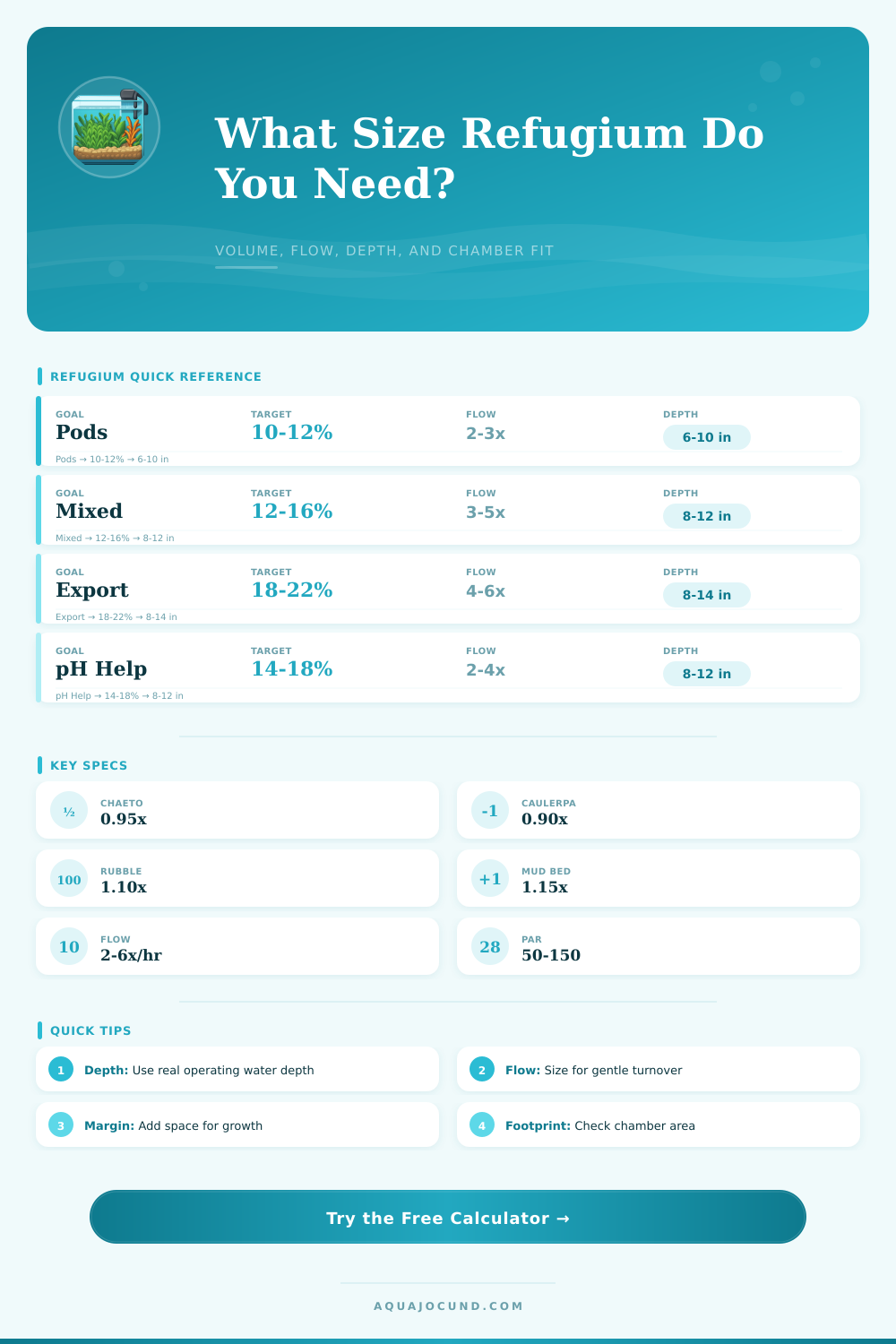
| Media type | Volume factor | Best water depth | Light target | Flow style |
|---|---|---|---|---|
| Chaetomorpha ball | 0.95x | 8-12 in / 20-30 cm | 80-150 PAR | Moderate tumble |
| Caulerpa bed | 0.90x | 6-10 in / 15-25 cm | 60-120 PAR | Gentle sheet flow |
| Gracilaria tumble | 1.00x | 8-14 in / 20-36 cm | 90-160 PAR | Moderate tumble |
| Ulva sheet macroalgae | 0.95x | 6-10 in / 15-25 cm | 70-140 PAR | Broad gentle flow |
| Live rock rubble zone | 1.10x | 6-12 in / 15-30 cm | 30-80 PAR | Slow habitat flow |
| Mineral mud with macroalgae | 1.15x | 8-12 in / 20-30 cm | 60-120 PAR | Slow to standard |
| Deep sand bed refugium | 1.25x | 10-16 in / 25-41 cm | 40-100 PAR | Slow laminar |
| Mixed macroalgae garden | 1.05x | 8-14 in / 20-36 cm | 80-150 PAR | Standard mixed flow |
| Goal | Base refugium target | Turnover target | Use case |
|---|---|---|---|
| Low-nutrient polishing | 8% of net display volume | 2.5x refugium volume/hr | Established low-feeding tanks |
| Pod nursery | 10% of net display volume | 2.2x refugium volume/hr | Wrasses, mandarins, and habitat focus |
| Balanced reef support | 14% of net display volume | 3.5x refugium volume/hr | General mixed reef sump design |
| Reverse-cycle pH support | 16% of net display volume | 3.0x refugium volume/hr | Macroalgae lit opposite the display |
| Nutrient export | 20% of net display volume | 4.5x refugium volume/hr | Regular nitrate and phosphate drawdown |
| Heavy bioload control | 24% of net display volume | 5.0x refugium volume/hr | Large fish or heavy feeding systems |
| Display size | Dimensions | Metric dimensions | Balanced refugium | Export refugium |
|---|---|---|---|---|
| 10 gal | 20 x 10 x 12 in | 51 x 25 x 30 cm | 1.2-1.6 gal | 1.8-2.4 gal |
| 20 long | 30 x 12 x 12 in | 76 x 30 x 30 cm | 2.4-3.2 gal | 3.6-4.8 gal |
| 40 breeder | 36 x 18 x 16 in | 91 x 46 x 41 cm | 4.8-6.4 gal | 7.2-9.6 gal |
| 55 gal | 48 x 13 x 21 in | 122 x 33 x 53 cm | 6.6-8.8 gal | 9.9-13.2 gal |
| 75 gal | 48 x 18 x 21 in | 122 x 46 x 53 cm | 9.0-12.0 gal | 13.5-18.0 gal |
| 125 gal | 72 x 18 x 22 in | 183 x 46 x 56 cm | 15.0-20.0 gal | 22.5-30.0 gal |
| 180 gal | 72 x 24 x 24 in | 183 x 61 x 61 cm | 21.6-28.8 gal | 32.4-43.2 gal |
| Refugium style | Flow target | Light target | Operating note |
|---|---|---|---|
| Pod nursery | 2-3x refugium volume/hr | 30-80 PAR | Slow zones protect small organisms |
| Chaeto export | 3-6x refugium volume/hr | 80-150 PAR | Enough movement prevents dead spots |
| Mixed macroalgae | 3-5x refugium volume/hr | 70-140 PAR | Use broad flow across the full bed |
| Mud or deep sand | 2-4x refugium volume/hr | 40-120 PAR | Keep surface moving without scouring media |
A refugium are a component that can be added to a reef tank system. A person may add a refugium to their reef tank system either after they notice that the nutrient in the tank are increasing, or if their sump has additional spaces for that refugium. The size of the refugium can be challenging to determine.
For instance, variables like the volume of the refugium, the depth of the water in the refugium, the type of media that the user will use within the refugium, and the flow rate of the refugium may all interact with each other to create difficulty in determining the correct size for a refugium; if any of those factors are incorrectly set, the refugium may underperform or not fit into the available space in the reef tank system. The calculator will provide a mathematical result that take into account the dimensions of the display tank, the amount of rock that is within that display tank, the bioload of the reef tank system, and the goal for that refugium. Each of those variable will impact the result of the calculation; for instance, the amount of space that the rocks within the display tank take up will impact the volume of water within the display tank.
How to Size a Refugium for Your Reef Tank
Consequently, the goal for the refugium is calculated based off the volume of water within the display tank, not the gross volume of the display tank. For instance, if the rocks within the display tank take up 18% of the total volume of the display tank, then the water volume within the display tank is 18% less than the gross volume of the display tank; therefore, there will be less than 100% of the gross volume of the display tank that can be considered as having a potential goal for the refugium to be established within it. Additionally, if the bioload within the system is light with a bare bottom to the display tank, then the volume of water within the display tank will be closer to 100% of the gross volume of that display tank.
Therefore, the goal for the refugium will be higher for that variable if the bioload within the reef tank system are light. Depending upon the goal for the refugium, different size of the refugium will be created. For instance, if the goal for the refugium is to act as a pod nursery for the reef tank system, then the flow rate will need to be slow such that the reef fish can move through the refugium.
However, if the goal for the refugium is to perform nutrient export, then the user will need to provide more extensive media to the refugium to aid in the removal of the nutrients from the reef tank system; consequently, the nutrient export goal will require more volume to the refugium as well as a stronger flow rate. Finally, if the goal for the refugium is to provide pH buffering for the reef tank system through reverse-cycle lighting, then the user will need to provide enough macroalgae for the volume of the refugium to cover the area of the refugium, but without the same flow rate that is required in order to remove nutrients from the system. The type of media that will be established within the refugium will also play a role in the size of that refugium.
For instance, if chaetomorpha is to be used as the media within the refugium, then the volume of that refugium can be lower than if other media is used; chaetomorpha is an efficient media for sequestering the nutrients from the reef tank system. Additionally, Caulerpa is another media that are dense enough that it can be used in a smaller volume of the refugium. Rubble and mud beds, on the other hand, are typically used within the refugium as a form of habitat for the reef fish, and thus requires more space than other types of media.
The depth of the refugium will also play a role within the calculation; shallow depth allow for the same amount of volume within the refugium to be distributed over a larger footprint than those with deeper depths of refugia. Consequently, the user must enter the depth of the refugium into the calculator, but not the total height of the refugium (as that depth is the measurement that will determine the volume of water that will be contain within the refugium). Another factor in determining the size of the refugium is flow and footprint.
For instance, the calculator will calculate the turnover rate of the refugium based upon the goal of the refugium and the type of media that is to be established in that refugium; that turnover rate can then be multiplied by the flow that is to be used within the refugium (which will have a preference and footprint for the system in which that refugium is to be established). For instance, if the goal for the refugium is to provide a habitat for the reef fish pods, then gentle flow will be required. However, if the goal for the refugium is to help to control the level of nutrients within the reef tank system, then more intense flow will be required such that no areas of media within the refugium become stagnant.
Consequently, the system designer will enter the length and width of the refugium into the calculator; if the calculated flow rate and footprint are not met by the available footprint of the refugium, the calculator will provide suggestion as to how the parameters of the refugium may be adjusted to meet those flow rates. The parameters of reef tanks may not always match those that is provided in the presets provided in the calculator. For instance, bow-front reef tanks have different gross volumes than rectangular reef tanks.
Additionally, a 40 breeder reef tank that is to be used as a system for frag systems will have a different bioload than a 40 breeder reef tank that is to be used for mixed reef tank system. Consequently, a percentage margin may be provided to provide extra volume to those reef tanks. For instance, a 10% margin will account for extra room for the growth of the reef fish within the reef tank; however, a 20% or 30% margin will account for extra room for harvesting macroalgae or controlling nutrient level within the reef tank system.
This percentage margin will be applied to the calculated volume after the type of media and bioload are accounted for in the calculation of the required volume of the refugium. Lighting targets will impact the amount of macroalgae that is established within the refugium to provide those benefits to the reef tank system. If the light levels are too low for the amount of macroalgae that is established within the refugium, there will be insufficient nutrient export from the tank.
Too much light may result in nuisance algae grow within the refugium. Additionally, while the calculator will provide estimations as to the amount of light that should be provided to the reef tank system, the exact wattage of the reef lights cannot be provided; the efficiency of each reef light fixture may not be the same, but the reference material for the calculator will include information regarding the lighting target that are provided by the reef tank system. The most common error in establishing a refugium for a reef tank system is to size the refugium instead of using the calculations that are provided by the refugium calculator.
For instance, while the refugium may appear large in size when it is empty of media, it may become cramped if the media is added. Additionally, another of the most common error is to use the total height of the refugium as the depth of the refugium; instead, the depth of the water within the refugium should be entered into the calculator. The calculator is structured in a way that prevent these common error.
The number that is provided as the result of using the refugium calculator is the specific requirement for the refugium for the reef tank system. The goal for those who establish the refugium is not to add the amount of volume to the reef tank system indicated in the calculation. Instead, the goal is to begin with that calculation to determine the requirement of the reef tank system, and then to make adjustment to that calculation to account for additional factor (such as flow rate) to those reefs with the same goal.