Refugium Light Wattage Calculator
Estimate LED fixture watts from refugium footprint, macroalgae PAR needs, water depth, photoperiod, spread, and fixture efficiency.
Real Refugium Presets
📏Refugium Dimensions
🌿Algae and Lighting Goals
Refugium Lighting Result
🧪Macroalgae and Refugium Light Grid
📊Macroalgae PAR Reference
| Growth Type | Working PAR | Typical Photoperiod | Lighting Note |
|---|---|---|---|
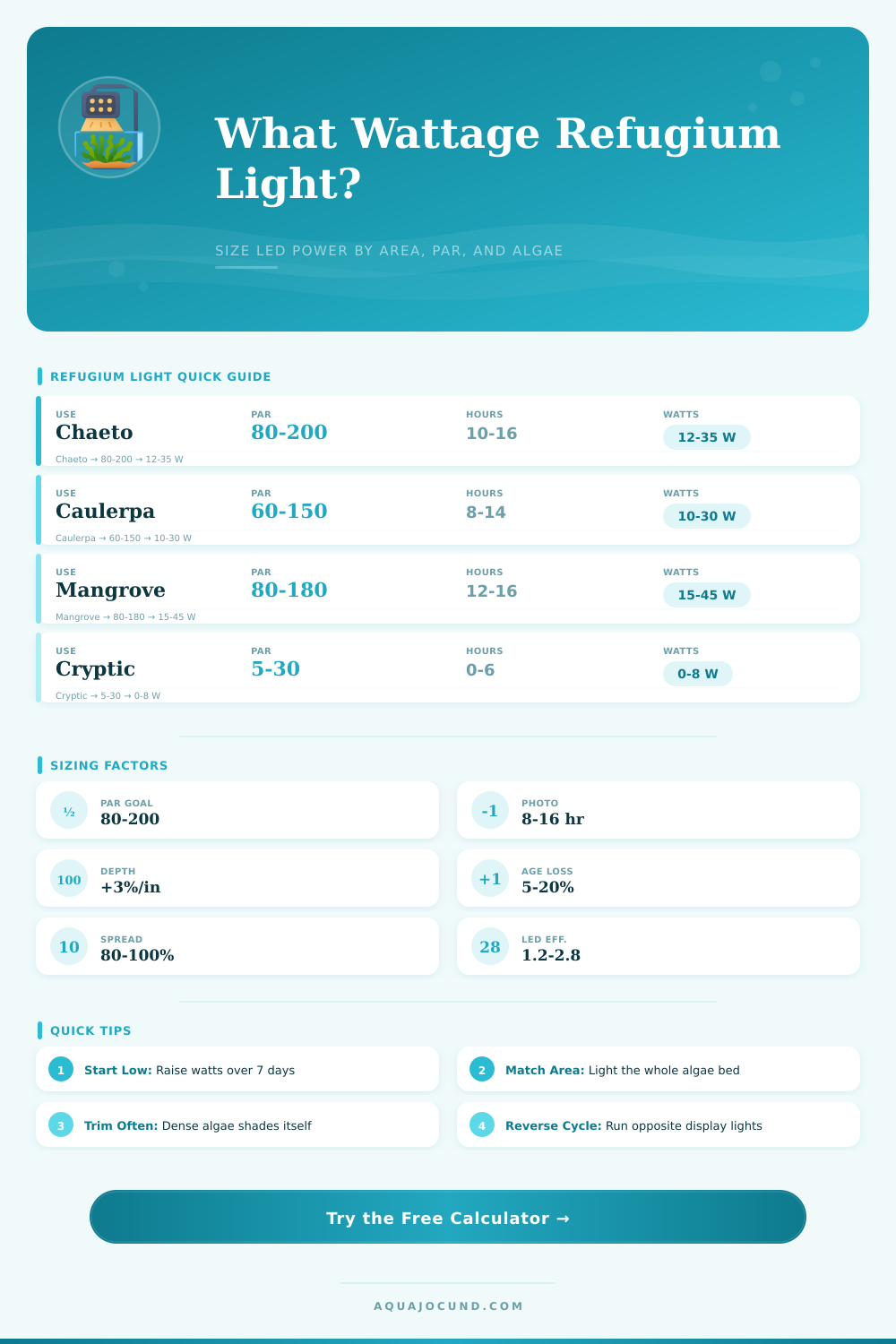
| Chaetomorpha | 80-200 umol/m2/s | 10-16 hours | Strong export growth with full coverage and trimming. |
| Caulerpa | 60-150 umol/m2/s | 8-14 hours | Moderate-high light; avoid extreme swings after pruning. |
| Gracilaria and red macro | 40-100 umol/m2/s | 8-12 hours | Often prefers gentler light than dense chaeto. |
| Ulva or sea lettuce | 50-120 umol/m2/s | 8-14 hours | Does well with broad even spread and tumbling flow. |
| Mangrove shoots | 80-180 umol/m2/s | 12-16 hours | Leaves need air-side light; roots do not need high PAR. |
| Cryptic pod zone | 5-30 umol/m2/s | 0-6 hours | Use very low light or shade for sponge-heavy sections. |
💡Fixture Efficiency Comparison
| Fixture Type | Efficiency Used | Best Refugium Use | Calculator Adjustment |
|---|---|---|---|
| Economy clip-on LED | 1.2 umol/J | Nano chambers and shallow baskets | Higher watts required for the same PAR. |
| Mid-grade refugium LED | 1.7 umol/J | Most sump compartments | Balanced default for common reef setups. |
| High-output bar or puck | 2.3 umol/J | Deep chaeto beds and larger chambers | Lower wattage for the same useful photon output. |
| Horticulture-style panel | 2.8 umol/J | Large trays or remote refugiums | Efficient but may need dimming and splash protection. |
| Unknown old fixture | 1.4 umol/J | Existing lights without PAR data | Conservative estimate with age loss applied. |
📐Common Refugium Size Guide
| Setup | Typical Lit Footprint | Chaeto Watts | Notes |
|---|---|---|---|
| Nano rear chamber | 4 x 8 in / 10 x 20 cm | 5-12 W | Keep the beam tight and avoid heating the chamber. |
| 10 gal sump section | 8 x 10 in / 20 x 25 cm | 10-20 W | Usually enough for small chaeto balls. |
| 20 long chamber | 10 x 12 in / 25 x 30 cm | 15-30 W | Broad spread matters more than peak wattage. |
| 40 breeder sump bay | 12 x 16 in / 30 x 41 cm | 25-50 W | Use dimming or raise the fixture during acclimation. |
| Large remote refugium | 18 x 24 in / 46 x 61 cm | 60-120 W | Panel fixtures can cover the footprint evenly. |
⏱Photoperiod and DLI Reference
| Schedule | Best Use | PAR Pairing | Watch For |
|---|---|---|---|
| 6-8 hours | New macroalgae acclimation | Low to medium PAR | Slow export and pale growth if nutrients are high. |
| 8-12 hours | Routine mixed refugium | Medium PAR | Good balance for most sump chambers. |
| 12-16 hours | Chaeto export and reverse cycle | Medium-high PAR | Trim dense mats so lower layers get light. |
| 16-18 hours | Heavy nutrient export push | Moderate PAR | Can stress some macros if nutrients bottom out. |
| 24 hours | Special short-term use only | Low PAR | Not a default; observe macro response closely. |
To select the best light for an refugium, you must match the light to the needs of algae, and ensuring that the light matches the algae’s needs will prevent the waste of energy for the refugium system. A refugium is a side chamber to the main display tank that help to even out the nutrient levels in the tank by removing excess nutrients from the water. The light above the refugium provide the energy for the algae to carry out the process of removing nutrients from the tank.
If the algae do not receive enough light to encourage growth, the nutrient levels in the tank will even out. If the light levels are too high for the algae in the refugium, the algae may grow more quickly, or the top layer of algae may shade the lower layers of algae, making it hard to manage the growth of the algae in the system. The amount of light power that you need for your refugium to effectively grow the algae will depend on the size of the area that the light must cover.
How to Choose a Light for a Refugium
For instance, a narrow sump chamber will require a different type of light than that of a wide mud box, even if the same type of algae is growing within each of these compartments. The depth of the water in which the algae is to grow will also play a role in how much light power is required to reach the bottom of the water in deep refugium chambers. The height of the light fixture above the water in the refugium is another factor in how much light reaches the algae; the higher the light fixture is above the algae, the less light that the algae will receive.
Each of these factors will play a role in the decision of the type of light that is to be use in the refugium. Not all types of macroalgae require the same levels of light intensity. For instance, Chaetomorpha can handle high levels of light intensity.
Chaetomorpha will remove nutrients