Refugium Flow Rate Calculator
Calculate target refugium turnover, dwell time, pump delivery after head loss, bypass split, and drain safety.
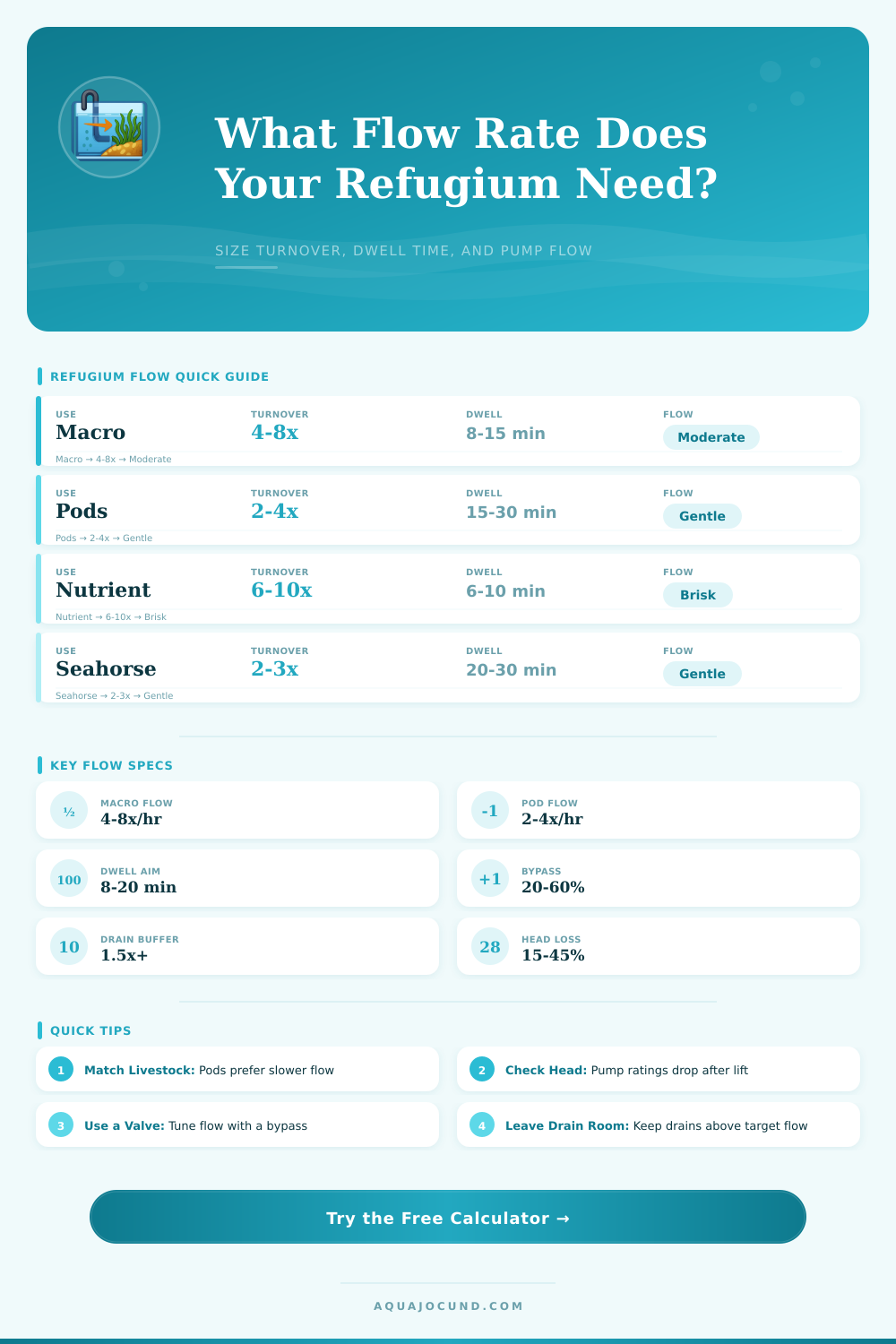
| Refugium Purpose | Typical Turnover | Dwell Time Range | Best Flow Character |
|---|---|---|---|
| Balanced macroalgae export | 4-8x refugium volume per hour | 8-15 minutes | Moderate sheet flow or gentle tumble |
| Copepod nursery | 2-4x refugium volume per hour | 15-30 minutes | Slow pass-through with calm rubble zones |
| High nutrient export | 6-10x refugium volume per hour | 6-10 minutes | Brisk exchange without blasting macroalgae |
| Cryptic sponge zone | 1-2x refugium volume per hour | 30-60 minutes | Low light, low turbulence, steady oxygen |
| Mangrove or mud lagoon | 1-3x refugium volume per hour | 20-60 minutes | Gentle laminar movement over sediment |
| Macro or Habitat | Recommended Turnover | Flow Risk if Too Low | Flow Risk if Too High |
|---|---|---|---|
| Chaetomorpha ball | 4-8x | Detritus mats inside dense clumps | Ball pins against wall or overflow teeth |
| Caulerpa bed | 3-6x | Film algae and trapped mulm around runners | Uprooted fronds and loose fragments |
| Gracilaria tumble | 5-10x | Branches settle and shade each other | Broken tips and noisy spillover |
| Pod rubble pile | 2-4x | Oxygen-poor pockets in deep rubble | Pods swept out before reproducing |
| Cryptic live rock zone | 1-2x | Low oxygen and excess sediment | Sponge surfaces exposed to turbulence |
| Display Size | Refugium Volume | Moderate Flow Target | Use Case |
|---|---|---|---|
| 10 gal nano | 1-2 gal usable | 6-12 gph | Small chaeto basket or rear chamber |
| 20-30 gal reef | 3-6 gal usable | 18-36 gph | Pod nursery and light nutrient export |
| 40 breeder | 6-10 gal usable | 36-60 gph | Macro bed with rubble pocket |
| 75 gal reef | 10-18 gal usable | 60-108 gph | Chaeto export and pod production |
| 125 gal reef | 18-30 gal usable | 108-180 gph | High export refugium or lagoon sump |
| Plumbing Setup | Estimated Loss | Refugium Control | Drain Capacity Check |
|---|---|---|---|
| Short line, few elbows | About 8% plus 4% per ft head | Small ball valve or compact DC pump | Drain at least 1.25x actual refugium flow |
| Normal sump return | About 15% plus 5% per ft head | Tee and gate valve for fine bypass control | Drain at least 1.5x actual refugium flow |
| Long pipe or many elbows | About 25% plus 6% per ft head | Oversize pump and throttle with valve | Drain at least 2x actual refugium flow |
| Return manifold | About 35% plus 7% per ft head | Separate valves for refugium and reactors | Drain at least 2x actual refugium flow |
A refugium are a specific part of the aquarium system and is a place where biological processes occurs within the aquarium. A refugium provide space for macroalgae to grow within the system, and it also provides space for small organisms like pods to live within the refugium. The water that pass through the refugium removes nutrient from the display tank, and the water within the refugium provides the medium for the macroalgae to grow.
The amount of water that moves through the refugium must be determined, but the correct amount of water flow for the refugium depend upon the type of macroalgae that is to be grow within the system. The amount of water flow that move through the refugium is not solely determined by the rating of the pump that is used to move the water through the system. Water flow within the system can be affected by two factor that reduce the total amount of water that the pump can move: head loss and plumbing friction.
Choosing the right water flow for a refugium
Head loss is the amount of water that a pump must lift to a certain height; the higher that the water is lift, the less water that the pump can move through the system. Plumbing friction is the reduction in the flow of water that occurs as the water passes through elbow and pipes within the system; the more elbows through which the water pass, or the wider the pipe of the plumbing, the less water that the pump will move. The amount of water that is moved can be calculate by taking into account the pump rating, head height, and plumbing friction.
For instance, a pump that is rated at 450 gallons per hour will move less than 450 gallon per hour if the pump is required to lift the water four feet; it will move even more less water if the water is also required to pass through many elbows within the plumbing system. Not all types of macroalgae requires the same amount of water flow. For instance, chaetomorpha requires moderate water flow so that the chaetomorpha will tumble; if the flow of water is too fast, the chaetomorpha will mat together and block the available light to the algae.
Copepod nurseries require slower water flow so that the copepod larvae does not get swept away from the nurseries. Mangrove or mud zone require very gentle water flow so as not to disturb the sediment and the roots of the mangroves. A calculator can be used to choose the type of macroalgae for a refugium; the calculator will indicate whether the flow of water that is establish in the system is within the range of the flow that the algae prefers.
If the flow rate is too high or too low, the screen will provide a warning message to indicate that the system will not function correct. Another factor to consider in the establishment of a refugium is the dwell time. Dwell time is the length of time that the water spend within the refugium.
If the flow through the refugium is too fast, the water may pass through the system without allow the macroalgae to remove nutrients from the water. If the flow is too slow, the water may not contain enough dissolved oxygen for the nitrifying bacteria that live in the lower portion of the refugium. A calculator allows the person to enter the desired dwell time and turnover rate for the system; the calculator will automatically select more conservative of the two values.
The reason for this selection is to ensure that one of the two factors is not being ignore in the effort to optimize for only one of the two factors. Another consideration when establishing a refugium is the size of the bypass valve and the drainage system. Most aquarists will use a pump to provide water to the display tank, and the water that exit that display tank will pass through a bypass valve that allows for a percentage of that water to be sent to the refugium.
A calculator allows the aquarist to enter the desired flow rate for the refugium, and the calculator will indicate the percentage of the flow that pass through the bypass valve. Additionally, the calculator will indicate whether the drain can handle that percentage of the total water flow out of the tank. It is important to ensure that the drain has some margin for error; if the drain is sized to receive the same amount of water as exit the tank, then snails, algae, or salt creep may block the drain.
Should the drain become blocked, the water will back up through the system. The factors of head loss and plumbing friction may be forget when initially establishing the refugium. However, these two factor will significantly change the flow of water through the system.
For instance, if an aquarist decide to add elbows to the system or a manifold that distributes the water to the reactors within the tank, the plumbing friction will increase. Increased plumbing friction will lead to a decreased flow of water through the system. Thus, if the flow that is calculated for the system with the current plumbing is too low, the aquarist can shorten the length of the plumbing run, remove a restriction in the system, or accept a lower percentage of the water that is sent through the bypass valve to the refugium.
Should the percentage of the water that goes to the refugium be lowered, the water exchange through the refugium will occur at a slow rate. The calculations made for the establishment of the refugium may change during the systems operation. For instance, if the water temperature within the system change, the performance of the pump may change.
Salt creep will gradually narrow the pipes within the system, and detritus will change the effective volume of the refugium. Additionally, the presence of the macroalgae within the system can be used to determine if the flow through the system is correct; if the chaetomorpha has a gentle rolling motion, if the rubble zone has calm pockets within the water, and if the water exchange does not uproot the runner of the Caulerpa, then the flow through the system is correct. Establishing a balance within the refugium ensures that the refugium will perform its task without causing problem for the remainder of the system.