Refugium Chaeto Volume Calculator
Estimate chaeto volume, wet mass, chamber fit, tumble clearance, harvest rhythm, and nutrient export capacity.
Use measured daily rise or food-derived estimate.
Calculation Breakdown
| Macroalgae | Relative Export | Light Response | Best Use |
|---|---|---|---|
| Chaetomorpha | 1.00x baseline | Strong at 10-18 hr | Tumbling refugiums |
| High-light chaeto | 1.25x baseline | Best with strong spread | Export-focused reef sumps |
| Caulerpa | 1.15x baseline | Fast under long light | Rooted beds and trays |
| Gracilaria | 0.70x baseline | Moderate response | Gentle tumble displays |
| Ulva | 1.10x baseline | Fast with high flow | Shallow raceway style chambers |
| Ogo | 0.80x baseline | Moderate response | Open baskets |
| Halimeda | 0.35x baseline | Slow nutrient export | Decorative macro displays |
| Refugium Chamber | Inside Dimensions | Raw Volume | Typical Chaeto Fill |
|---|---|---|---|
| Nano rear chamber | 4 x 3 x 10 in / 10 x 8 x 25 cm | 0.5 gal / 1.9 L | 0.2-0.3 gal |
| AIO basket bay | 5 x 4 x 12 in / 13 x 10 x 30 cm | 1.0 gal / 3.8 L | 0.4-0.7 gal |
| Small sump section | 10 x 8 x 9 in / 25 x 20 x 23 cm | 3.1 gal / 11.8 L | 1.5-2.2 gal |
| Medium sump section | 14 x 10 x 10 in / 36 x 25 x 25 cm | 6.1 gal / 23.0 L | 3.0-4.3 gal |
| Large refugium bay | 18 x 14 x 12 in / 46 x 36 x 30 cm | 13.1 gal / 49.6 L | 6.5-9.0 gal |
| Operating Goal | Light Hours | Clearance | Harvest Interval |
|---|---|---|---|
| Stability-first nutrient trim | 8-10 hr/day | 25-35% | 14-21 days |
| Normal mixed reef export | 12-14 hr/day | 25-35% | 10-18 days |
| High input export push | 16-18 hr/day | 30-40% | 7-14 days |
| Reactor or tight chamber | 12-16 hr/day | 35-50% | 7-14 days |
| Assumption | Working Value | Calculator Use | Adjustment |
|---|---|---|---|
| Baseline chaeto nitrate uptake | 0.55 mg NO3 per g wet per day | Primary volume sizing | Scaled by light and macro profile |
| Baseline phosphate uptake | 0.035 mg PO4 per g wet per day | Checks phosphate-side demand | Reports limiting requirement |
| Light response | 12 hr = 1.00x | 10-18 hr practical band | Capped to avoid extreme output |
| Harvest growth fraction | 4% per day at 12 hr | Projected removable mass | Scaled by light and interval |
You purchased some Chaetomorpha for your refugium and waited patiently for it to grow out. Three weeks later, however, all you have is a slimy brown sludge of algae. Why did that happen? It starved itself due to its own mass or it was packed in so tightly that it died.
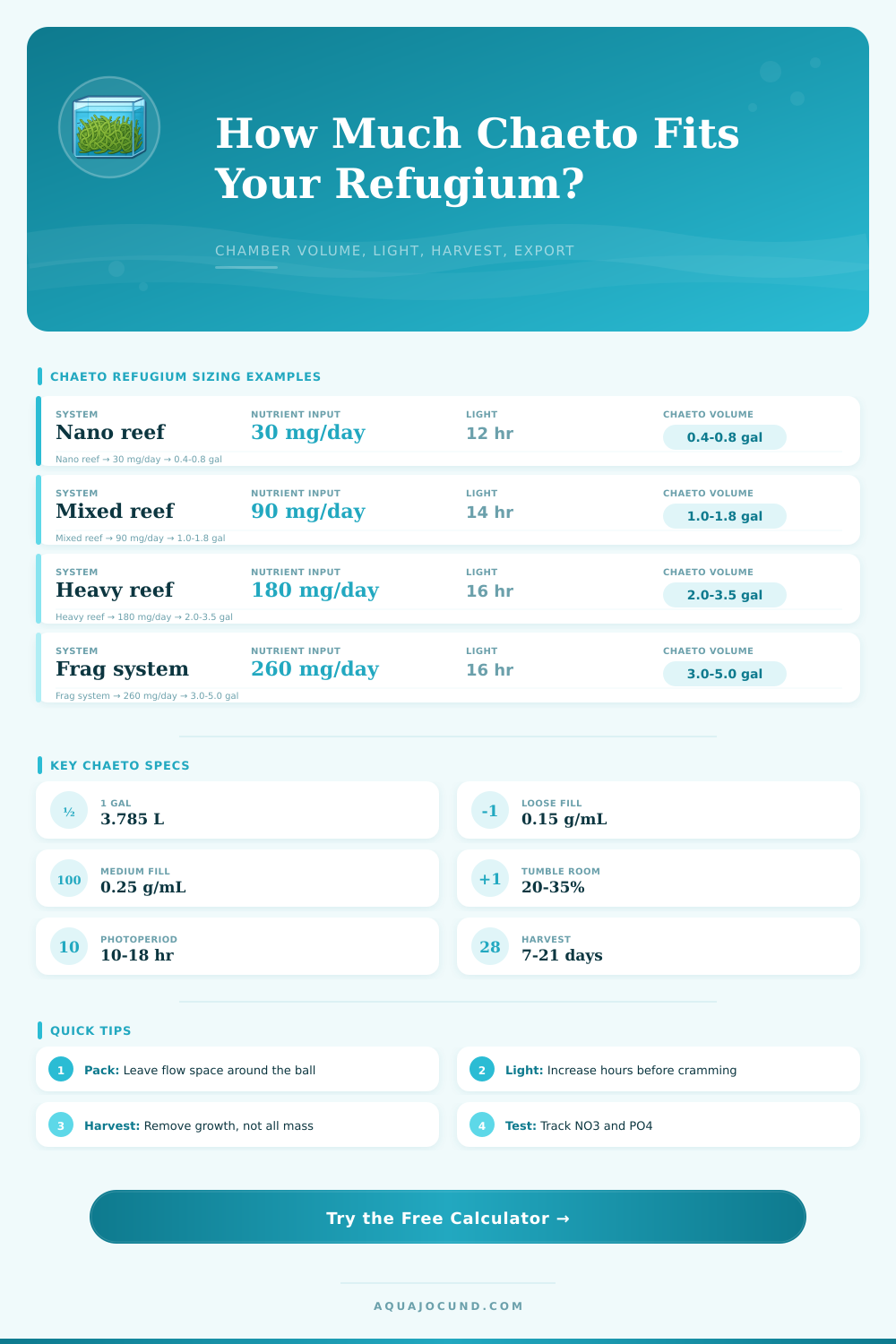
Getting the right size of Chaetomorpha is more important then buying the cheapest bag at LFS, and it depends on both biology and physics. With those two inputs, the calculator do the rest. (See the calculator above) No need to guess if a three gallon chamber fits a two gallon ball. Most reefers only think about volume. However, Chaetomorpha require not just volume but also breathing and rolling space. If you fill a chamber to capacity with no room to tumble around, you’ve created a dead zone where rot take hold before the algae has time to grow.
How to Grow Healthy Algae
The tool recognizes this and calculates the usable volume minus the tumble clearance you specify. In other words, it makes you think about how much empty space you really need to ensure the algae remain healthy. That’s the difference between raw capacity and functional capacity, where most setups goes wrong.
The lighting portion of this equation is equally difficult. While it might seem that more light = bigger, that’s not necessarily true for Chaetomorpha as opposed to SPS coral. The chart in the bottom section of the page details how various macro species does under different light cycles. For example, it shows that Chaetomorpha does best with anywhere from ten hours per day up to eighteen hours per day. Anything beyond that is less effective (and costs you more in electricity).
The chart also shows that your harvesting schedule should match how many hours a day you’re running light. The more you grow the more frequently you’ll have to harvest. Otherwise, the algae will quickly overtake the chamber and strangle your tank. Remember… We’re looking at nutrient export. It’s not about creating something that looks nice (although it does look good).
To do this, the calculator factors in amount of wet mass needed each day to remove the nitrates and phosphates you add. This matches how much feed goes into your livestock. A system that removes eighty milligrams of nitrate per day requires much more biomass than a small nano tank containing a single clownfish. Depending on the export percentage desired, the tool will recommend either scaling up or down accordingly. If you’re after crystal clear water, you may want to go for fifty percent removal. Those who like a more stable, less aggressive approach to filtration can get away with lower percentages. Knowing the relationship between algae demand and food input allows you to prevent overstocking your refugium.
The difference between a macroalgae bed that works and one that’s an experiment is in this step: harvesting. Unless it is physically removed from the water, the growth does nothing but help your system. Letting the old growth rot will release those same nutrients right back into the tank, defeating the purpose of getting the chamber size just right. If you’ve entered in your desired packing density and interval, the calculator estimates the harvest quantity for you. That’s how much wet mass (roughly) you’d pull every week.
That makes harvesting less of a vague chore and more of a measurable part of the maintenance routine. Weighing out your clumps before tossing them gives you real world feedback to tweak the next round of calculations.
Another variable is packing density: A dense mat packs more nutrients per milliliter but risks creating anaerobic pockets if water flow is insufficient. Looser-packed tumbling allows better penetration by water flow but results in lower concentrations of biomatter within the same physical space. You can toggle back and forth between these two types with the calculator, which also will adjust its recommendation based on those packing styles. It will remind you that a free floating ball behaves differently than a basket held set-up. This gives you some ability to tweak the math based off your own sump shape and flow characteristics.
There aren’t really any hard and fast rules when it comes to running a refugium. Trends matter most. While the calculator is based off physical limitations and known uptake rates, which make it an excellent launching pad; nothing beats your eyes as a sensor. Look for color changes, track your nitrates and let your experience dictate how often you should of be harvesting (let the plants grow until they tell you to stop).
If you’re doing it correctly, your algae will remain a vibrant green swaying softly under current flow. It’ll become a silent helper in the backdrop of your reef, maintaining stable water parameters and removing nutrients. If it moves healthily, you know you have the right size.