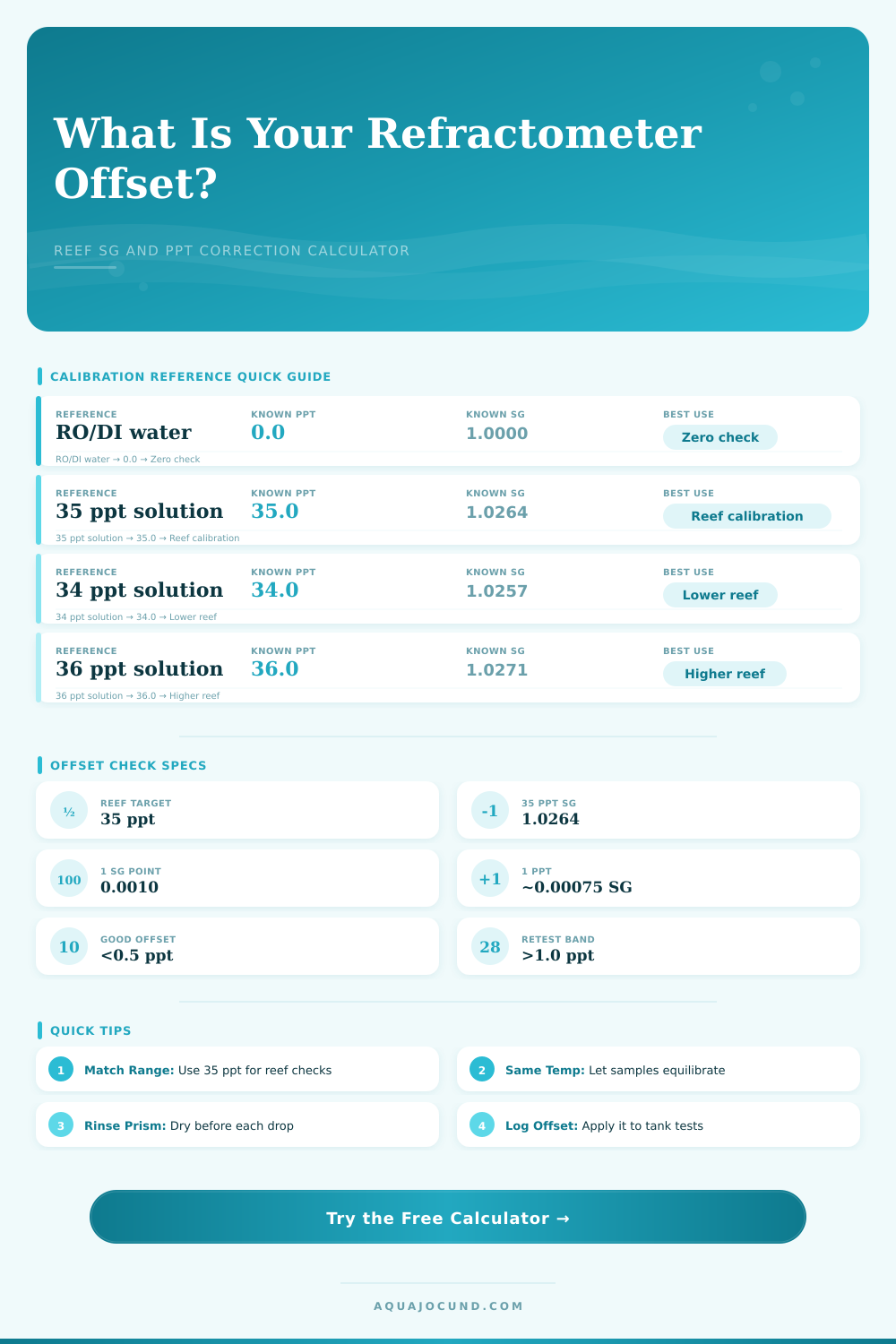
🧪 Refractometer Calibration Offset Calculator
Find the measurement offset from a known reference solution, then correct reef salinity readings in SG and ppt.
✅ Calibration Offset Result
| Reference Type | Known ppt | Approx SG | Best Role | Offset Note |
|---|---|---|---|---|
| RO/DI or distilled water | 0.0 | 1.0000 | Zero check | Useful, but less accurate at reef range. |
| 10 ppt low-range reference | 10.0 | 1.0075 | Low salinity check | Good for checking scale behavior. |
| 30 ppt lab reference | 30.0 | 1.0226 | Near low reef | Closer to reef water than zero. |
| 34 ppt reef reference | 34.0 | 1.0257 | Lower reef target | Good for systems kept slightly low. |
| 35 ppt reef reference | 35.0 | 1.0264 | Standard reef target | Best single-point reference for reef tanks. |
| 36 ppt reef reference | 36.0 | 1.0271 | Upper reef target | Useful if the tank is normally high. |
| Custom reference | User value | Calculated | Certificate or lab mix | Enter the known value on the same scale. |
| Observed on 35 ppt Ref | Offset | Correction to Sample | Example Sample | Corrected Result |
|---|---|---|---|---|
| 35.0 ppt / SG 1.0264 | 0.0 ppt | No correction | 35.0 ppt | 35.0 ppt / SG 1.0264 |
| 34.5 ppt / SG 1.0260 | -0.5 ppt | Add 0.5 ppt | 34.5 ppt | 35.0 ppt / SG 1.0264 |
| 34.0 ppt / SG 1.0256 | -1.0 ppt | Add 1.0 ppt | 34.2 ppt | 35.2 ppt / SG 1.0265 |
| 35.5 ppt / SG 1.0268 | +0.5 ppt | Subtract 0.5 ppt | 35.5 ppt | 35.0 ppt / SG 1.0264 |
| 36.2 ppt / SG 1.0273 | +1.2 ppt | Subtract 1.2 ppt | 35.8 ppt | 34.6 ppt / SG 1.0261 |
| Condition | Calculator Setting | Estimated Residual Drift | Practical Measurement Note |
|---|---|---|---|
| Reference and sample rested together | Fully equilibrated readings | 0.00 ppt per °C | Best repeatability for logging offsets. |
| ATC refractometer in same room | ATC refractometer, same room | 0.02 ppt per °C | Still allow the prism and drop to settle. |
| Unknown compensation behavior | Unknown compensation | 0.05 ppt per °C | Use the result as a wider confidence band. |
| No ATC or fast cold/warm sample | No ATC or manual compensation | 0.08 ppt per °C | Retest after temperatures match better. |
| Salinity ppt | Approx SG | Reef Context | 1 ppt Shift Looks Like |
|---|---|---|---|
| 32 ppt | 1.0241 | Low reef range | About 0.00075 SG |
| 33 ppt | 1.0249 | Slightly low | About 0.00075 SG |
| 34 ppt | 1.0257 | Lower natural range | About 0.00075 SG |
| 35 ppt | 1.0264 | Common reef target | About 0.00075 SG |
| 36 ppt | 1.0271 | Upper natural range | About 0.00075 SG |
| 37 ppt | 1.0279 | High reef reading | About 0.00075 SG |
It happens to everyone. You’re staring down at your refractometer, reading off the numbers only to find out they is all wrong. After several months of carefully dialing in the water chemistry on your reef tank, you diligently dose your Alkalinity and Calcium. Then, suddenlly you notice salinity has drifted an entire part per thousand. Don’t panic. Your refractometer isn’t broken. It’s not cracked. It’s not dry. It’s just biased. And this bias, this offset, is what makes the difference between knowing and guessing.
For most hobbyists it’s a light switch: Calibrate with some distilled water, adjust until lines match, done. It’s calibrated. Refractometers are optical devices. How much water you bend light through depend on how dense the liquid is. Your refractometer may calibrate to 0 with pure water but still be out-of-whack by a half a point at 35ppt. That’s where this tool helps. It is a known reference solution based off what your actual tank’s salinity is. You know exactly what it is at that level. You enter your sample and reference readings into the calculator, which do all the math for you. You no longer have to subtract the bias yourself. You do not need conversion units.
How to Fix Your Refractometer Errors
First, calibrate with a bottle of reference solution. When the bottle indicates a value of thirty-five and your meter read thirty-four point five, then your offset is -0.5. That’s the difference the calculator use on your tank sample reading. Also, it allows you to switch between specific gravity and parts per thousand easy. Some online communities and products uses one or the other scale as their preferred format. So if you know that 1 part per thousand is approximately equivalent to one point zero two six four SG, then you can read one scale and convert to another without issue. No second device required.
There’s another silent but significant factor here: temperature. Even when it has automatic temperature compensation, there is still some time require for the sensor to reach the same temperature as liquid inside the prism. Your measurement will then begin to drift if your room is warm while you use a cold reference solution. The tool can accounts for this by entering temperatures into its input fields, which help it to guess at any residual error that may exist. Allowing your test tube to rest on the bench for several minutes does matter. And it’s not just because you’re being patient. It’s because it’s about physics. Heat will cause the sample density to change. Without both the sample and instrument on the same thermal baseline, the offset calculation become noisy.
The other aspect of the routine that gets the least attention is rinsing the prism. Salt left over from your last test may leave a residue on the prism which will throw off your current test. Surprised? Wipe down the prism and make sure it’s completely dry before adding new drop. Use a soft cloth or lens tissue. Wait for it to settle. Anything you do here will add more variability then any calibration issue you’re attempting to resolve. You want consistency. Not speed.
Once you have the corrected salinity, you can make informed decisions about water changes or top-off water. So long as your offset isn’t above a full point, you’re golden. If you are over a point, then you weren’t getting accurate results before and the difference was enough to impact your livestocks health. The included reference tables provides a quick sanity check versus normal values, they let you see what the number should of been given ideal conditions.
And calibration isn’t a once-and-done deal, either. It’s a habit. Calibrate once a month. Calibrate anytime you think something may be wrong. Make note of what adjustments you make and do so over time. Maybe you’ll learn that your meter has drifted a little bit since the last drop. Or maybe keeping it in a cooler room makes it more accurate. That kind of insight won’t come from a calculator. But it helps you trust your observations because the tool provides a starting point for accuracy.
A refractometer is only as good as your willingness to verify it. Unless you prove the numbers you see on that glass against something you know, then they’re just suggestions. Prove it and adjust for the offset. Now you don’t guess anymore; you manage. It is worth a few extra minutes to be clear on what it is. Testing the reference solution takes like five minutes. If you get the number right, the fish won’t know how you did it, but they will certainly feel the benefit of stable water.