Reef Trace Element Schedule Calculator
Plan a trace element dosing schedule from water volume, coral demand, water-change replacement, ICP review timing, depletion risk, and dose frequency.
🪸Trace Schedule Presets
⚙System Volume and Trace Profile
💧Water Changes, ICP, and Dose Timing
Trace Element Schedule Estimate
🔬Trace Group Comparison Grid
📋Trace Group Schedule Factors
| Trace group | Baseline | Typical risk | Scheduling note |
|---|---|---|---|
| Broad trace blend | 5 mL / 100 L / week | Medium | Best as a steady maintenance schedule |
| Iodine and halogens | 2 mL / 100 L / week | High | Use smaller doses and close ICP follow-up |
| Iron and manganese | 1.5 mL / 100 L / week | High | Often depleted quickly in refugium systems |
| Potassium support | 4 mL / 100 L / week | Medium | Do not chase large moves without testing |
| Strontium support | 3 mL / 100 L / week | Medium | Pair with calcium and alkalinity stability |
| Boron and buffer traces | 2.5 mL / 100 L / week | Low | Move slowly when alkalinity is changing |
| Ultra trace metals | 1 mL / 100 L / week | High | Use only with lab guidance and low margins |
🪷Coral Demand Multipliers
| Reef style | Demand factor | Common schedule | ICP cue |
|---|---|---|---|
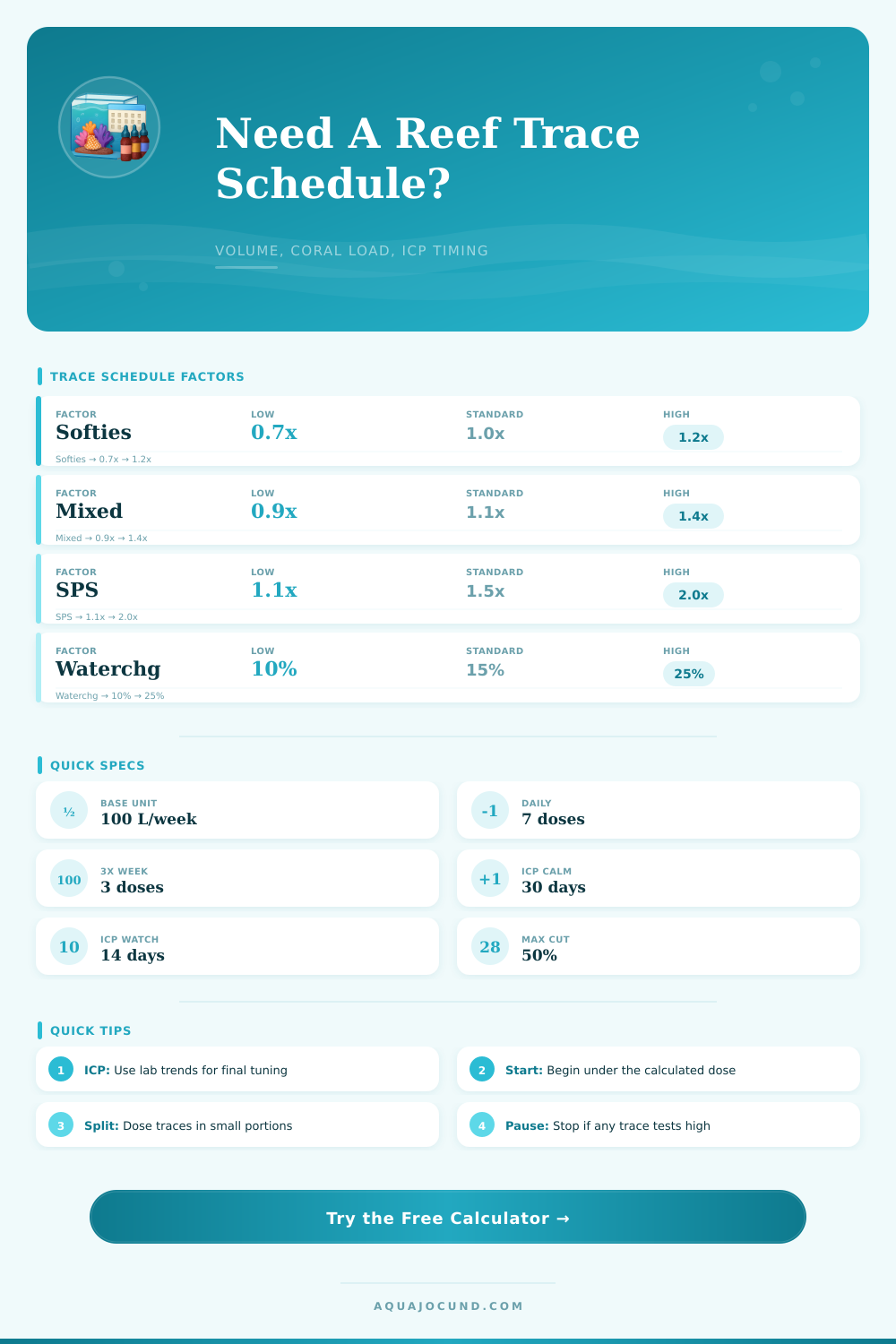
| Soft coral dominant | 0.70x | 2-3 doses weekly | Hold dose if traces trend high |
| LPS dominant | 0.90x | 3 doses weekly | Watch iodine and potassium trends |
| Mixed reef | 1.10x | Daily or 3x weekly | Adjust from two ICP points |
| SPS dominant | 1.45x | Daily micro-dosing | Falling traces need split doses |
| Acropora heavy | 1.80x | Daily micro-dosing | Use tighter ICP intervals |
| Heavy feeding NPS | 1.35x | Daily or 6x weekly | Check metals and iodine separately |
🌊Water Change Replacement Credit
| Water change pattern | Weekly exchange | Trace credit | Schedule effect |
|---|---|---|---|
| 5% weekly | 5% | Low | Most trace demand remains in dosing plan |
| 10% weekly | 10% | Moderate | Good baseline for mixed reefs |
| 15% weekly | 15% | Strong | Often lowers broad trace dosing |
| 25% every 14 days | 12.5% | Moderate | Use smaller doses between changes |
| No routine change | 0% | None | ICP trend becomes more important |
⏱Common Reef Volume Examples
| System | Planning volume | Broad blend base | Daily split |
|---|---|---|---|
| 13 gal nano reef | 49 L | 2.5 mL/week | 0.36 mL/day |
| 25 gal lagoon | 95 L | 4.7 mL/week | 0.68 mL/day |
| 40 breeder reef | 151 L | 7.6 mL/week | 1.08 mL/day |
| 75 gal display | 284 L | 14.2 mL/week | 2.03 mL/day |
| 120 gal with sump | 454 L | 22.7 mL/week | 3.24 mL/day |
When it comes to reef keeping, everything seems to be a balancing act. Calcium and alkalinity is the big items that get most of the attention. If you don’t pay attention to those things they can crash in short order. Trace elements exist under the radar. They play an important role in coral health but only gets attention when they’re no longer there at all.
The trick is paying attention to how your particular tank uses up these elements over time. That’s what determines the right schedule. It’s a personalized process based off observation, not a strict recipe that works for everybody.
How to Make a Trace Element Dosing Plan
To do the arithmetic behind that dosing regimen, use the calculator at the top of the page. First enter your specific water volume (don’t rely on the tank’s external gallons since it doesn’t account for the sump equipment, sand, and live rock). If you miscalculate water volume, you will either underdose your corals or overdose (which could be toxic to your livestock due to small margin of safety in trace element concentrations).
Next, enter your coral makeup. A frag wall full of Acropora or other SPS requires much higher levels of halogens and metals different than easygoing soft corals. Based on this biological demand, the system multiplies its dosage recommendations accordingly such that the routine reflect biology not just water volume.
Trace element management depend heavily on water changes. While many hobbyists consider water changes to be nothing more than removing phosphate and nitrate from the tank, they are also naturaly replacing trace and minor elements. Tanks with weekly ten percent water changes requires less supplemental dosing than tanks with little to no water change. This water change replacement credit will appear in the final recommendation, you don’t have to worry about overdosing unnecessaraly. Before it adds more product to the equation, it measures what nature is already providing. It prevents the common mistake of overdosing by adding more product when you are already trying to replace what was lost.
The amount matters, too. You don’t want to overdo microdosing by adding a week’s worth of trace elements all at once. This results in spikes. These spikes can cause other issues, such as stressing livestock or starting undesirable algae blooms. By spreading out very small doses every day or multiple times a week, microdosing keep levels constant. This smooths out the peaks and valleys, which depends on how often you set it up to run. For example, the amount dispensed each time will be different depending on whether you have it configured to deliver every day or every three days.
It also factors in when to do an ICP review. An inductively coupled plasma (ICP) test is a gold standard way to check what your trace element levels look like over time, but those tests take time and money to get back. Linking the dosing schedule with a reasonable interval to do an ICP means you’ll know if things need adjusting before they shows up in the tank.
When using a doser, begin conservatively. There’s a “safety reduction” option in the calculator that will deliberatey undose (for example) by 20%. It provides a margin of error for tweaking until you see how first doses affect things in the real world. Keep in mind that trace elements are powerful even at very low levels, so be patient. Observe the coral growth tips or color shifts, but only use actual numbers from the lab to adjust. Use table of common baselines on the page as a guide, but in the end, your system’s specific biology provide the answer.
So what does a proper trace schedule look like? In short: nothing at all. Nothing that jumps out at you during your day. Nothing is visible in the water column. Nothing is apparent unless you’re paying attention to metabolic function. This trace schedule enables that function in the background while everything else hums along. Get it right and the corals just take care of themselves, growing steadily without needing any attention from you. That’s efficient. That’s how a complex chemical equation transforms into a functioning ecosystem.